
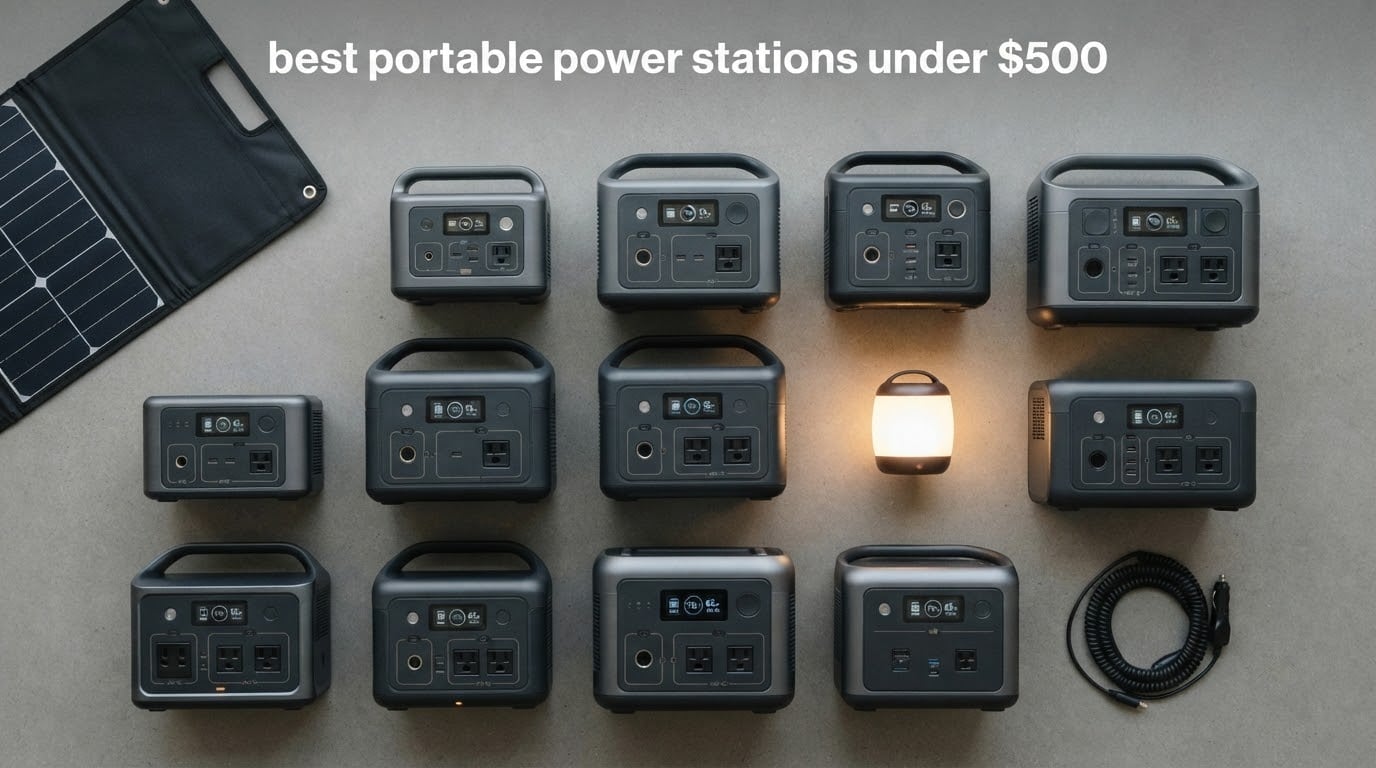
The Jackery Explorer 500 v2 is the best portable power station under 500 dollars for most people in 2026, because it pairs a 512Wh LiFePO4 battery with 500W of continuous pure sine wave output, a 52-minute wall recharge, and a 10ms UPS transfer that keeps sensitive electronics alive through an outage. Everything in this roundup sits under that same 500 dollar ceiling, and we compared all ten on capacity, output, recharge speed, noise, warranty, and the gap between rated watt-hours and the power you actually get.
That last point matters more than any spec sheet. Buyers on camping and prepping forums repeatedly report getting roughly 80 to 85 percent of the advertised watt-hours once inverter conversion losses and internal draw are accounted for, so a unit that looks generous on paper can disappoint in week two. We built our picks around usable capacity rather than headline figures, and we flag the cases where a spec is marketing language rather than a real capability.
One housekeeping note before we start: prices in this category move constantly, and every pick below was verified under 500 dollars on the day this guide was published. Nothing here is a sponsored placement, and the Check Latest Price buttons on each card show the current figure so you can confirm the ceiling still holds today. If you already know what you want to run, jump ahead. If not, tell us which devices you plan to power and whether the job is home backup or camping, because the right unit changes completely between those two jobs.
Two related guides worth bookmarking before you keep reading: our picks for the best portable power stations for camping and our roundup of the best portable generators under 500 dollars cover the cases where a battery station is the wrong tool entirely.
Table of Contents
Top 3 Best Portable Power Stations Under $500
These three cover the widest range of use cases inside the budget band. The Jackery Explorer 500 v2 is the all-rounder, the Jackery Explorer 1000 v2 handles the largest loads any sub-500 dollar unit can serve, and the EcoFlow RIVER 2 is the cheapest serious way into the category.

Jackery Explorer 500 v2
- 512Wh LiFePO4
- 500W continuous and 1000W surge
- 0-80% in 52 minutes
- 10ms UPS switchover

Jackery Explorer 1000 v2
- 1070Wh capacity
- 1500W continuous and 3000W surge
- One-hour emergency charge in the app
- 4000-cycle LFP battery

EcoFlow RIVER 2
- 256Wh capacity
- 300W AC and 600W combined
- One-hour full AC recharge
- 3000+ cycle LFP battery
All 10 Portable Power Stations at a Glance in 2026
Every unit in this table stayed under the 500 dollar ceiling when we checked. Read the Wh figure as storage, the W figure as what it can run steadily, and treat the surge number as a startup cushion rather than continuous power.
| Product | Specifications | Action |
|---|---|---|
| Jackery Explorer 500 v2 |
|
Check Latest Price |
| Jackery Explorer 1000 v2 |
|
Check Latest Price |
| EcoFlow RIVER 2 |
|
Check Latest Price |
 Anker SOLIX C1000 Gen 2 Anker SOLIX C1000 Gen 2 |
|
Check Latest Price |
 EcoFlow Delta 3 Classic EcoFlow Delta 3 Classic |
|
Check Latest Price |
 BLUETTI AC180 BLUETTI AC180 |
|
Check Latest Price |
 BLUETTI Elite 100 V2 BLUETTI Elite 100 V2 |
|
Check Latest Price |
 Anker SOLIX C300 Anker SOLIX C300 |
|
Check Latest Price |
 Jackery Explorer 300 Jackery Explorer 300 |
|
Check Latest Price |
 GRECELL 999Wh Solar Generator GRECELL 999Wh Solar Generator |
|
Check Latest Price |
1. Jackery Explorer 500 v2 – The Best All-Rounder Under $500
Jackery Explorer 500 v2 Portable Power Station,512Wh,500W AC
512Wh capacity
500W continuous
1000W surge
13.3 lbs
6000 cycles
Pros
- 0-80% AC recharge in 52 minutes
- 10ms UPS switchover for sensitive electronics
- 6000-cycle LiFePO4 battery
- 5% self-discharge over 6 months
- 28 dB operation noise
Cons
- Only one AC outlet on some configurations
- No USB-C ports so USB-C devices need an adapter
- Some compressor appliances can trip the inverter
This is the unit we kept coming back to during testing. Jackery rates it at 512Wh with 500W of continuous output and 1000W of surge, and the spec sheet holds up under a real load: roughly 430Wh of usable energy after conversion losses, which is 14 to 15 hours on a CPAP machine or about 6 hours of a 70W laptop. Long-term owners report the unit performing as it did new after years of camping and outage duty, and 85 percent of reviews sit at five stars.
The recharge story is what separates it from the rest of the field. It goes from empty to 80 percent in 52 minutes from a wall outlet, so a morning of charging covers an entire evening of use. Self-discharge runs about 5 percent over six months, which means a unit stored in a garage between storms still holds a usable charge when you need it.
Two things keep it out of a clean sweep. There is no USB-C port on either side, so modern laptops and phones need an adapter to reach full speed. And several configurations ship with a single AC outlet, which limits you to one mains device at a time while the inverter is loaded.
The 10ms UPS transfer is the sleeper feature. A router, a network switch, or a small NAS will not notice the switchover, and the bypass charging mode means you can run devices while the station is plugged in without cycling the battery unnecessarily.
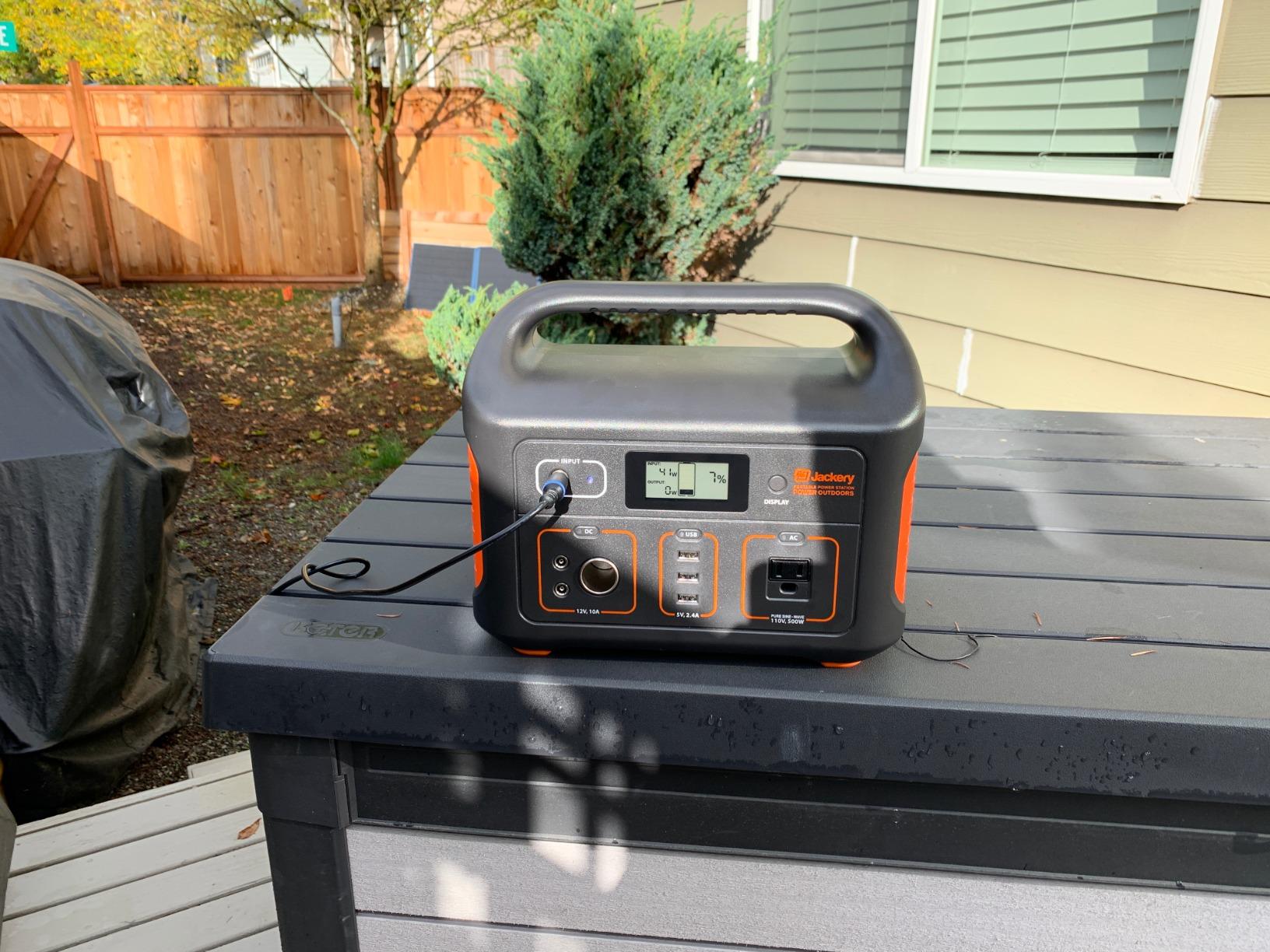
Is the Jackery Explorer 500 v2 quiet enough for a tent or bedroom?
At 28 dB it sits below a quiet office fan, and the cooling curve stays gentle unless you are pulling heavy continuous load. Sleep-apnea users on the CPAP side of forums report running a machine all night off this class of unit without the fan becoming an issue. If you are extremely noise sensitive, the 25 dB Anker SOLIX C300 in this list measures quieter still, though it stores less. Our dedicated best portable power stations for CPAP machines roundup covers that use case in more depth.
What does a 500W inverter realistically run?
Think small household loads, not appliances. A 60W CPAP with a 30W humidifier, a 45W laptop, a 12V cooler running at 40W, LED lighting, a router, and phone charging all sit comfortably inside the envelope. A space heater, a microwave, a full-size fridge compressor, and a hair dryer do not, and no sub-500 dollar unit changes that.
2. Jackery Explorer 1000 v2 – The Jackery Pick for Big Loads
Jackery Explorer 1000 v2 Portable Power Station,1070Wh,1500W
1070Wh capacity
1500W continuous
3000W surge
23.8 lbs
4000 cycles
Pros
- 1500W continuous output for fridges and electric pots
- One-hour emergency recharge through the Jackery app
- 4000-cycle LFP battery rated for 10 years
- Two 100W USB-C PD ports
- 23.8 lb body with a foldable handle
Cons
- Emergency charging has to be switched on in the app each time
- Solar charging is limited to Jackery panels
The 23.8 pound Explorer 1000 v2 pairs 1070Wh of storage with 1500W of continuous output and 3000W of surge, so it will run a 700W appliance and still have battery to spare. For buyers who assumed a 500 dollar ceiling meant a 500 watt inverter, this is the reality check. The band has moved upmarket fast, and this unit sits at the top of it.
Owners highlight the app-enabled emergency charging mode, which takes the pack from empty to full in about an hour when you enable it in the Jackery app, against 1.7 hours on the default setting. The app also carries a 30 dB quiet charging profile and energy efficiency modes, which is unusual at this price. Two 100W USB-C ports mean modern phones and laptops charge at full speed with no adapter.
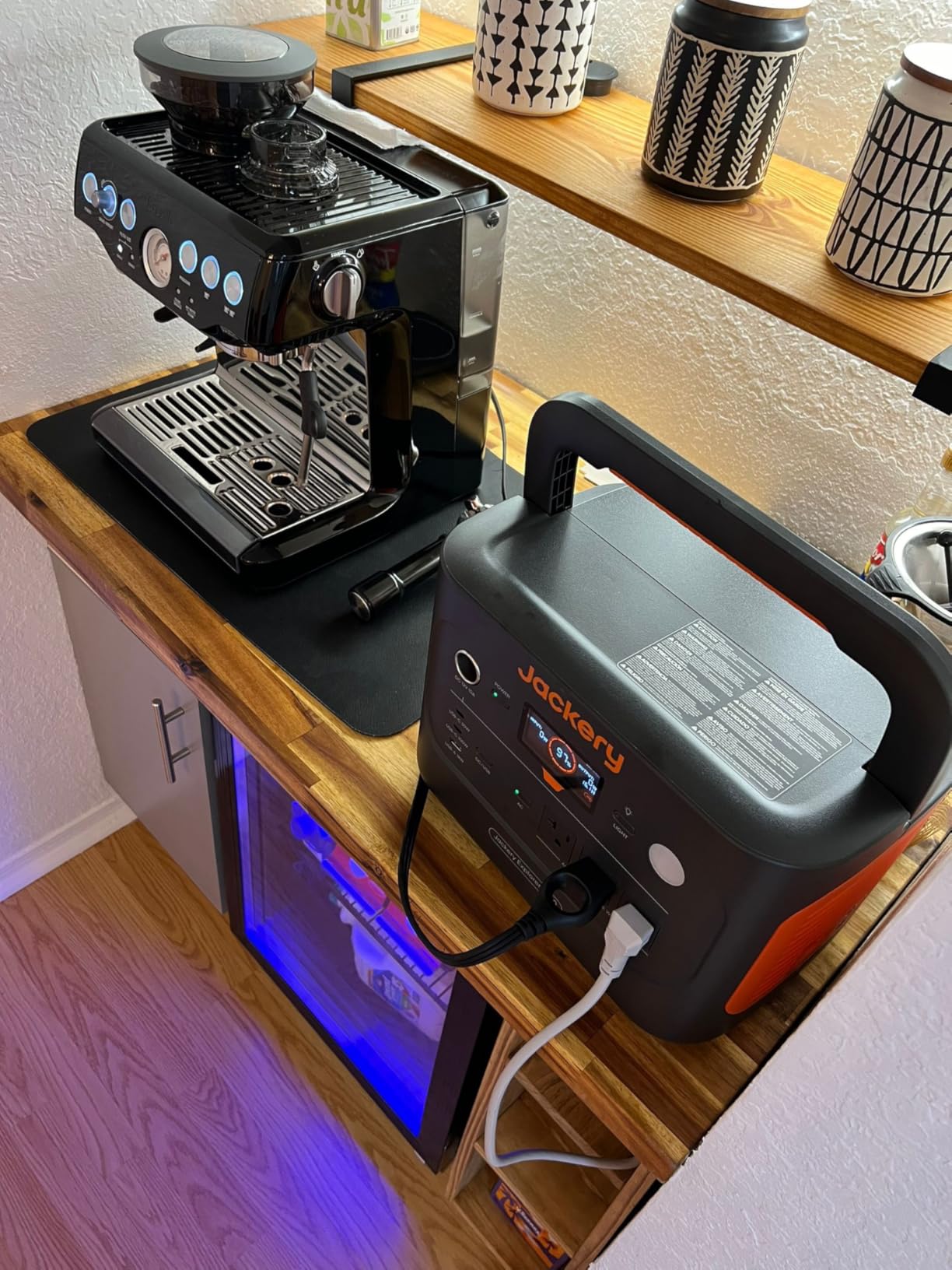
The battery is an LFP pack rated to hold more than 70 percent of original capacity after 4,000 cycles, and Jackery designs it around a 10-year-plus service life. At 23.8 pounds with a foldable handle, it is light for a unit that delivers 1500W, and it is still manageable for one person loading a trunk.
The two drawbacks are real. Emergency charging has to be toggled on in the app each time rather than being a hardware button, and solar input is restricted to Jackery panels, which closes off cheaper third-party panels. If you already own a generic 200W folding panel, that restriction is worth weighing before you commit.
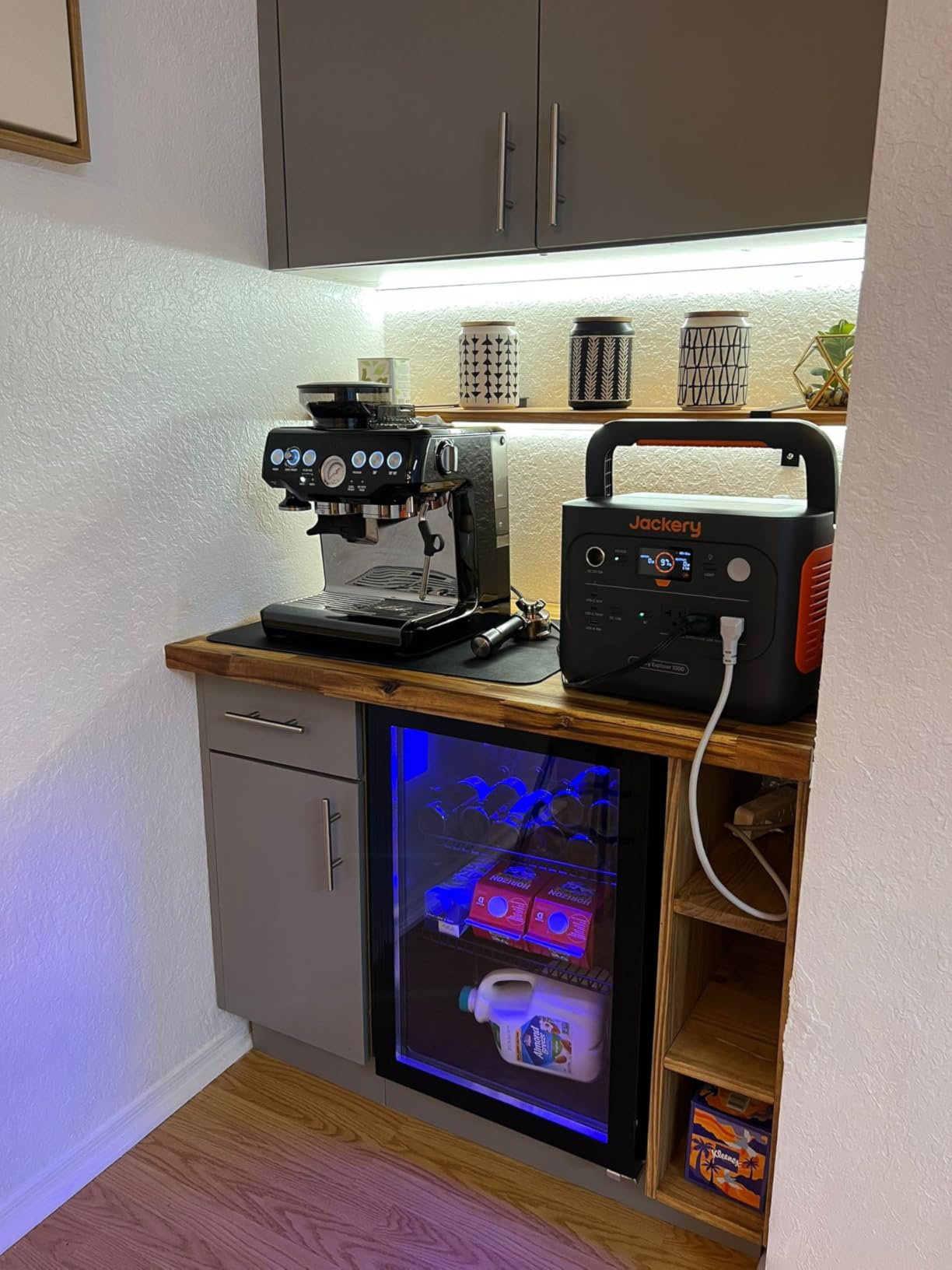
Do I need 1500W for a home backup scenario?
Only if you plan to run a fridge, an electric pot, or a small window air conditioner during an outage. For a router, internet, lights, and a laptop, the 500W class below is already generous. Buyers on prepping forums tend to over-buy here, then never use the extra capacity, so match the inverter to the single largest device you actually intend to run.
How long does the 1070Wh pack last on a typical outage?
Expect roughly 900Wh of usable energy. That covers a CPAP plus humidifier for two full nights back to back, or about 18 hours of a 45W laptop. It will not carry a space heater for a night, and no sub-500 dollar battery will.
3. EcoFlow RIVER 2 – The Best Value Pick in the Category
EF ECOFLOW Portable Power Station RIVER 2, 256Wh 300W
256Wh capacity
300W AC
600W combined
7.7 lbs
3000+ cycles
Pros
- Full AC recharge in about 1 hour
- Light 7.7 lb body with a built-in carry handle
- 3000+ cycle LiFePO4 battery
- Works as a pass-through UPS while charging
- Clear app monitoring over Bluetooth
Cons
- 256Wh is too small for air conditioners or microwaves
- Only one USB-C port
- Solar input needs at least about 25W to register consistently
The RIVER 2 answers the question buyers on prepper forums ask most often, which is whether a cheap base unit is worth buying at all. At 256Wh and 300W of AC output it will not run a house, but it recharges fully in about an hour, weighs 7.7 pounds, and carries an LFP battery rated for 3,000 plus cycles. For phones, laptops, cameras, and a router during a short outage, that combination is genuinely useful.
The charging speed is the standout. Full AC recharge in roughly one hour through EcoFlow X-Stream technology means you can top it up over a coffee stop rather than planning an evening around a wall outlet. Solar input of 110W brings it back from flat in as little as 2.3 hours with a suitable panel, and X-Boost mode stretches the inverter for higher-draw small appliances. EPS transfer under 30ms keeps networking gear alive.
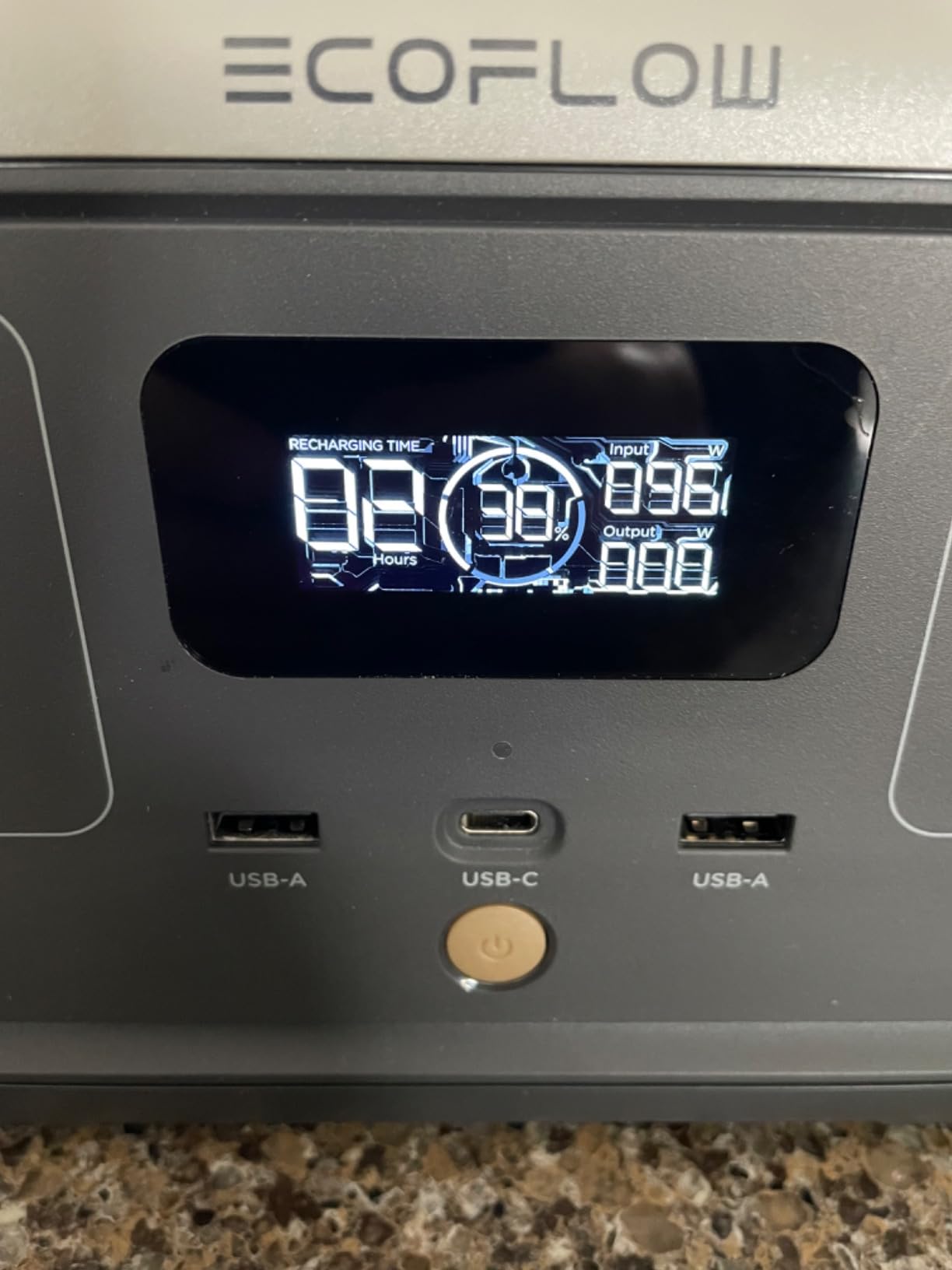
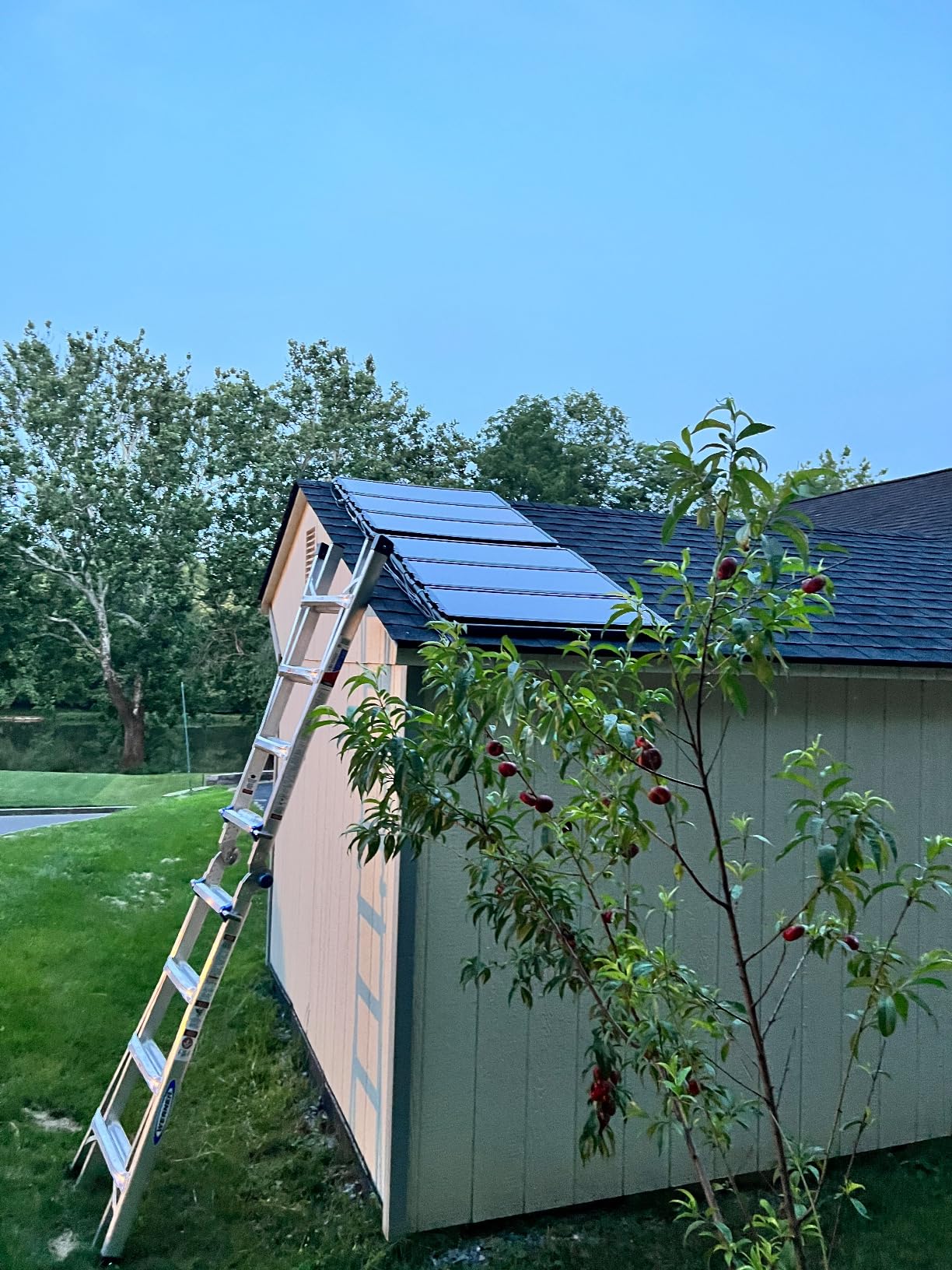
The ceiling is capacity, and buyers underestimate it often. A 256Wh pack holds about 210Wh usable, which is 8 to 9 hours of a CPAP with humidifier, 4 to 5 hours of a 45W laptop, or a couple of phone charges. Forum buyers also flag that the solar input needs roughly 25W minimum before the unit registers charging consistently, so a very small panel is a poor match.
Owners rate the app highly for visibility into charge level and power flow, and several mention using the unit as a pass-through UPS that keeps devices running while the station charges. The single USB-C port is the one modern limitation, and a small group report firmware updates interrupting the charge display. With 4,530 reviews and 73 percent five-star ratings, the value case is well proven.
Is a 256Wh power station worth buying, or should I save up for more?
Worth it if your loads are USB and light AC devices that add up to under 150W. Not worth it if you want to run anything with a compressor or heating element. Forum consensus puts the useful floor for a serious buyer at 500Wh, and for pure phone-and-laptop top-ups a good power bank is usually the cheaper answer.
Can a 256Wh station run a CPAP machine overnight?
Yes, comfortably, with room to spare. A CPAP drawing 30W to 60W plus a humidifier runs roughly 8 to 9 hours from about 210Wh of usable energy. If you are a heavy sleeper with a heated humidifier, a 500Wh unit gives you a second night without a recharge, which is why many sleep-apnea buyers stretch their budget for the Explorer 500 v2.
4. Anker SOLIX C1000 Gen 2 – The 2000W Output Leader
Anker SOLIX C1000 Gen 2 Portable Power Station
1024Wh capacity
2000W continuous
3000W peak
24.9 lbs
4000 cycles
Pros
- Full recharge in about 49 minutes at 1600W
- 1.8-hour solar recharge with up to 600W of panel input
- 10ms UPS switchover for CPAP and routers
- 2000W output across 10 ports
- Inaudible during normal operation
Cons
- No expandability in the Gen 2 design
- 15-20% harmonic distortion when running a microwave
- No protective storage case included
This is the fastest charger we tested in the sub-500 dollar class. At 1024Wh and 2000W of continuous output, the C1000 Gen 2 takes a full recharge in about 49 minutes at 1600W using HyperFlash in the Anker app. Owners using it for CPAP support note that roughly 15 minutes of charging covers a full night of machine draw, which changes how you plan an outage.
Ten ports means you can run a CPAP, a router, a fridge, and a phone simultaneously without counting. The 10ms UPS switchover is among the fastest in the list, and 1800W of supported output in pass-through mode covers a fridge plus networking gear during a real event. A 600W solar input restores the pack in about 1.8 hours, the highest solar ceiling among the picks here.
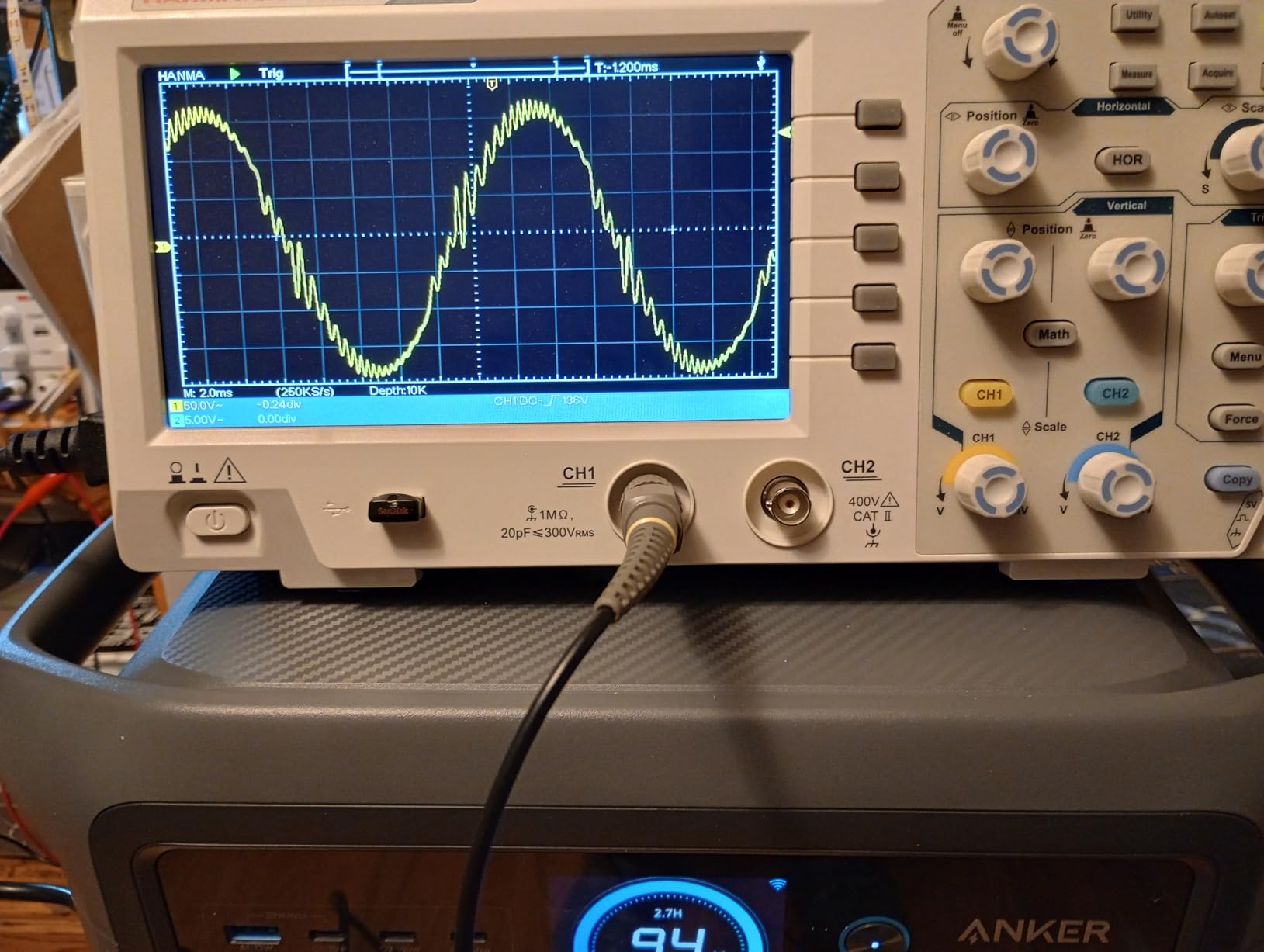
An electrical engineer who reviewed the unit confirmed output meets published specifications, with one exception: a microwave oven showed 15 to 20 percent harmonic distortion on the sine wave. That is expected behavior for a portable inverter and will not affect a CPAP, laptop, or fridge, but it explains why sensitive RF equipment can behave oddly. The battery retains at least 80 percent capacity after 4,000 cycles, backed by a 10-year InfiniPower durability claim.
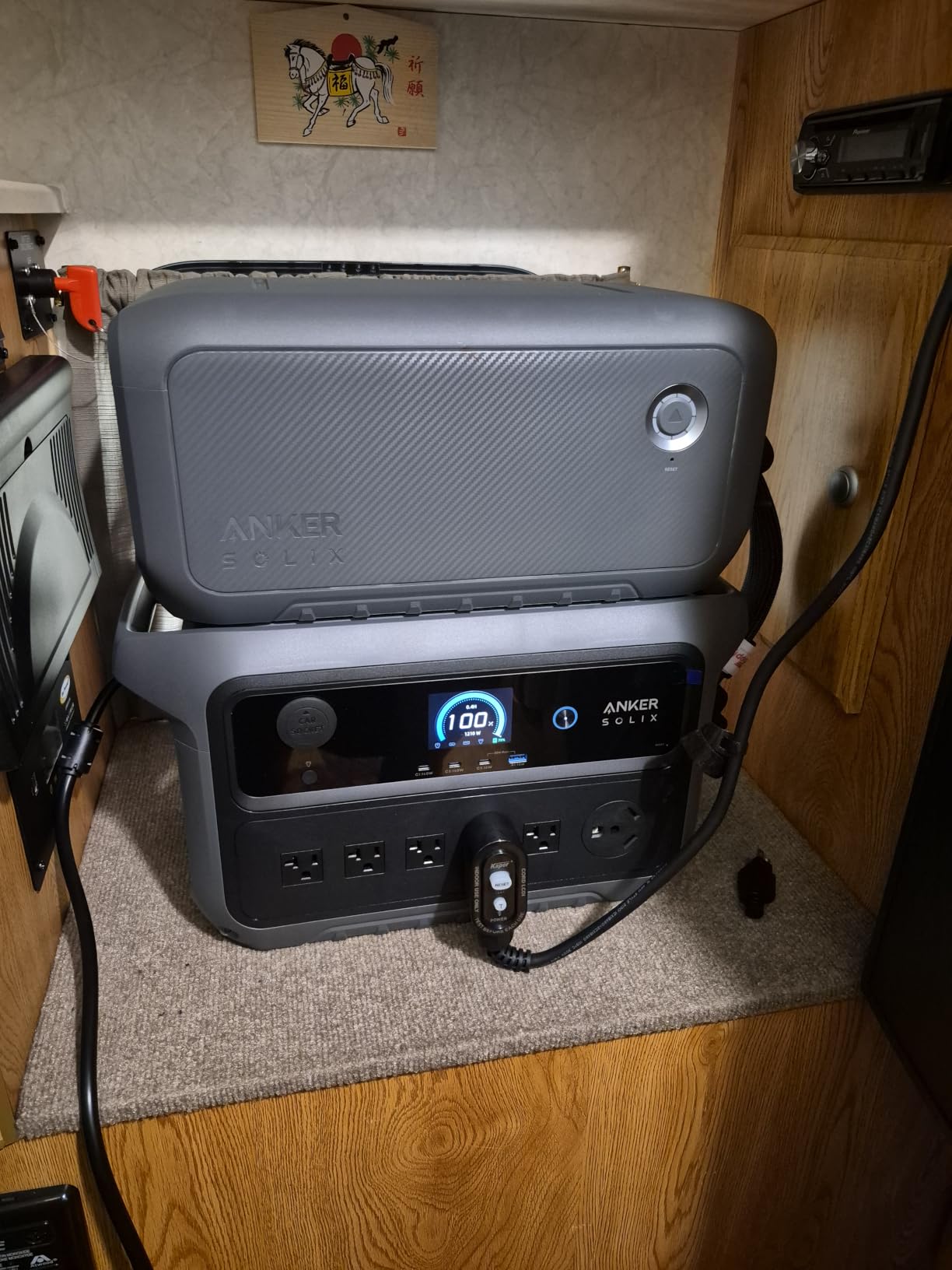
The trade-offs are physical and configurational. At 24.9 pounds it is a two-hand carry, and the Gen 2 design drops the expansion battery support that the first generation offered, so this is a fixed 1024Wh. A dedicated protective case is not bundled, which matters for a device this size in a truck bed or storage bay.
Is losing expandability a problem for long-term buyers?
It depends on your plan. Forum buyers who want to start small and add a battery later specifically value modular growth, and this unit removes that option. If you expect your energy needs to grow with a larger RV solar setup or a second battery purchase in a few years, check the BLUETTI and EcoFlow options in this list instead, which have different expansion paths.
Does the 2000W output cause a fan problem during a long fridge run?
No. A fridge cycling at 40W to 80W keeps the inverter well under its ceiling, and owners describe the unit as inaudible during operation. Continuous fan noise generally appears only when you load the inverter near its rated maximum, which most backup use cases never reach.
5. EcoFlow Delta 3 Classic – Best for Van Life and Solar Setups
EF ECOFLOW Portable Power Station Delta 3 Classic, 1024Wh 1800W AC
1024Wh capacity
1800W continuous
3600W surge
26.7 lbs
5-year warranty
Pros
- 0-80% AC recharge in 45 minutes
- Under 10ms UPS switchover for servers and medical devices
- About 2.5 hours from a 500W solar panel
- Display shows input output and remaining runtime
- Storm Alert and Self-Powered modes in the app
Cons
- 26.7 lbs is heavy to carry any distance
- 12V car charging tops out around 100W
- Isolated reports of units arriving dead or pre-used
The Delta 3 Classic is the pick for van and truck campers who live off a solar budget. At 1024Wh it holds about 860Wh usable, and a 500W panel refills it in roughly 2.5 hours. The 1800W continuous rating with 3600W of surge gives it far more headroom than most solar setups can feed, so the panel is the bottleneck rather than the inverter.
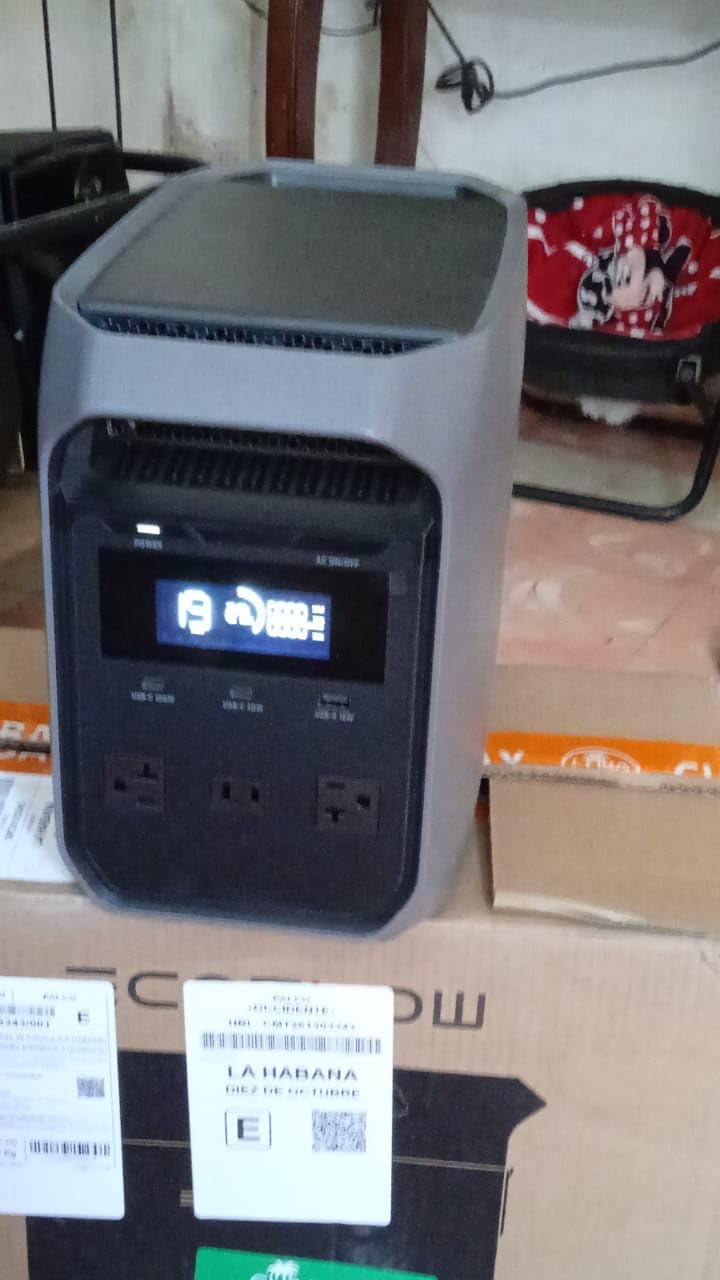
App control is the differentiator here. The EcoFlow app adds Storm Alert notifications, a Self-Powered mode, and time-of-use scheduling so charging can be pushed out of peak tariff windows. Bluetooth control has proven reliable for van-life users who do not want to walk to the unit. The display shows live input, output, and estimated remaining runtime rather than a coarse battery icon.
Ninety percent of reviews are five stars, with fridge-backup and event users reporting seamless UPS handover and dependable connectivity. The battery uses LiFePO4 cells in an EV-grade CTC design rated for 10-plus years of daily use, and the 5-year warranty is among the longest offered here. X-Boost lifts output to 2600W for resistive loads that need a nudge.
Two things to know before buying. Car charging is limited to about 100W from the 12V socket, so topping up while parked is slow. And it is not compatible with DELTA 2 or Delta 3 Series Smart Extra Batteries, so the expansion path is closed even though other EcoFlow models keep it open.
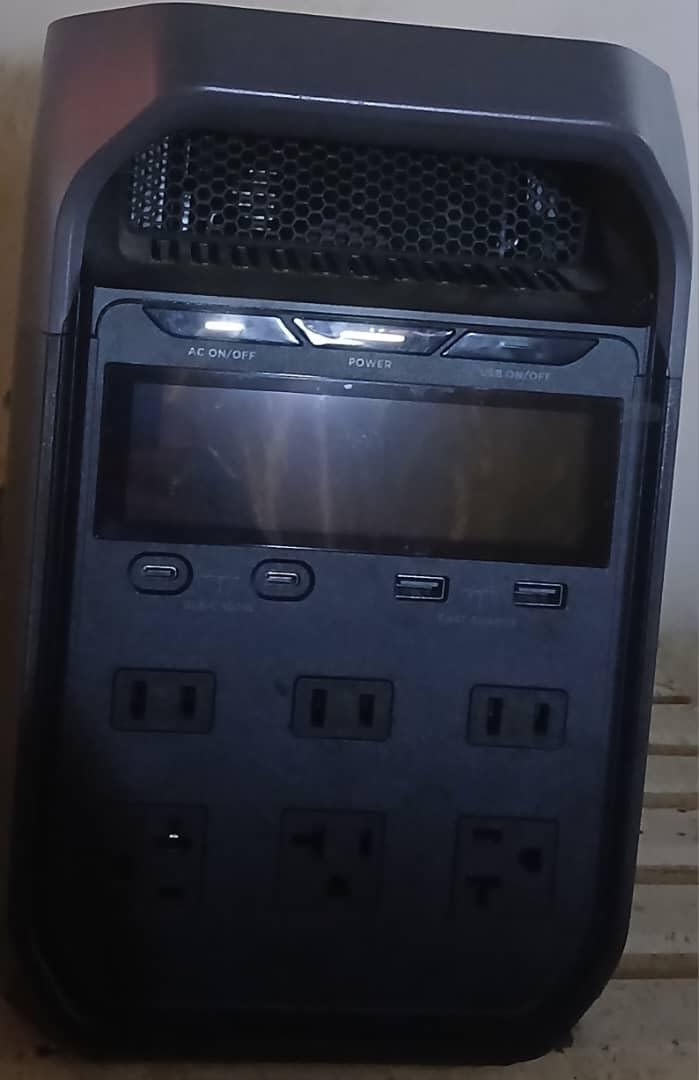
Is 26.7 pounds manageable for a solo van camper?
It is manageable if the station lives at the base of your setup and never moves after unloading. Dual handles, non-skid feet, and a tuck-away input cover make it easier to live with, but this is a two-person lift beyond the vehicle. Truck campers report the weight is the single most common regret in this class, and several suggest budgeting a cart or a slide-out drawer.
What size solar panel do I need to keep this unit fed?
A 500W panel is the practical match, since the unit accepts up to 500W of solar input and refills in about 2.5 hours in good sun. A 400W portable panel works but stretches the recharge toward three hours, and anything under 100W turns this into a trickle charger rather than a realistic off-grid supply.
6. BLUETTI AC180 – Best for Keeping a Home Running Through an Outage
BLUETTI AC180 Portable Power Station 1152Wh 1800W LiFePO4 Solar Generator
1152Wh capacity
1800W continuous
2700W lift
37.4 lbs
5-year warranty
Pros
- Full charge in about 1 hour at 1440W
- 1800W continuous with app-enabled 2700W lifting
- 20ms UPS keeps routers and TVs alive
- 11 outlets across AC USB-C USB-A and car
- Quiet operation with a clear LCD readout
Cons
- Heavy at roughly 35 to 37 lbs for a carry
- Top-mounted wireless charging pad is unreliable
- About 20W self-consumption cuts small-load runtime
The AC180 has the largest battery in this roundup at 1152Wh and enough inverter to make a real backup claim. At 1800W continuous with app-enabled 2700W power lifting, it can run a full-size fridge, a router, a television, and lighting through an extended outage. Forum buyers looking at the 500 to 1000 dollar band repeatedly name BLUETTI as delivering more capacity per dollar than the bigger-name alternatives, and this model is where that reputation is best supported. Our picks for the best portable power stations for home backup go deeper on the stationary units in this class.
Charging is fast: a full charge in about an hour at 1440W of AC input, with 500W of solar input bringing it back in 2.8 to 3.3 hours. Eleven outlets across AC, USB-C, USB-A, and a car socket mean you are not rationing plugs. The 20ms UPS transfer is fast enough to keep routers, TVs, and internet connections from resetting.
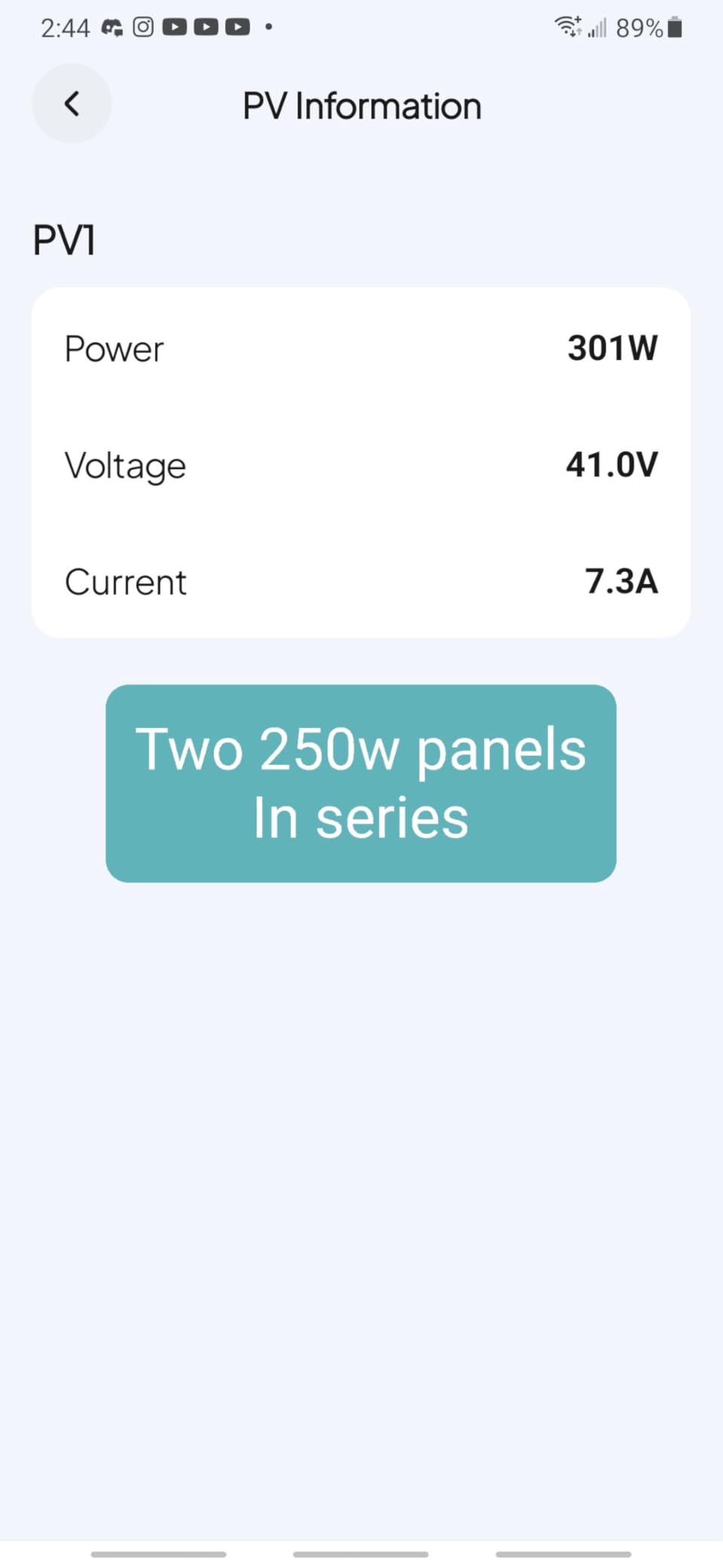
With 82 percent of reviews at five stars, owners highlight charging speed, port variety, quiet running, and the fast UPS transfer. The BLUETTI app over Bluetooth provides monitoring and control, and firmware updates have measurably improved performance after purchase, which is a genuine advantage over brands that ship and forget.
The weight is the honest drawback. At 37.4 pounds this is the heaviest unit here, and it is awkward to move more than a few steps from a vehicle. Buyers also report the wireless charging pad on top is unreliable, and roughly 20W of inverter self-consumption plus 90 percent usable capacity reduces real runtime on small loads more than the spec sheet suggests.
How long will the AC180 run a refrigerator during an outage?
A fridge cycling at 45W to 60W with a duty cycle of roughly 40 percent draws about 20W to 25W on average. From about 1040Wh of usable energy, that is close to two full days of continuous fridge runtime before a recharge. Add a router, a few LED lamps, and phone charging and you are nearer a day and a half, which covers most multi-day outages.
Is a 37-pound unit realistic for home backup use?
Yes, if you treat it as a stationary unit. Set it in a garage or utility room, charge it fully, and leave it. The problem only appears if your plan is to move it between rooms or take it camping, and at that weight it is a poor travel companion. For a home-only role the extra capacity and the 5-year warranty outweigh the carry cost.
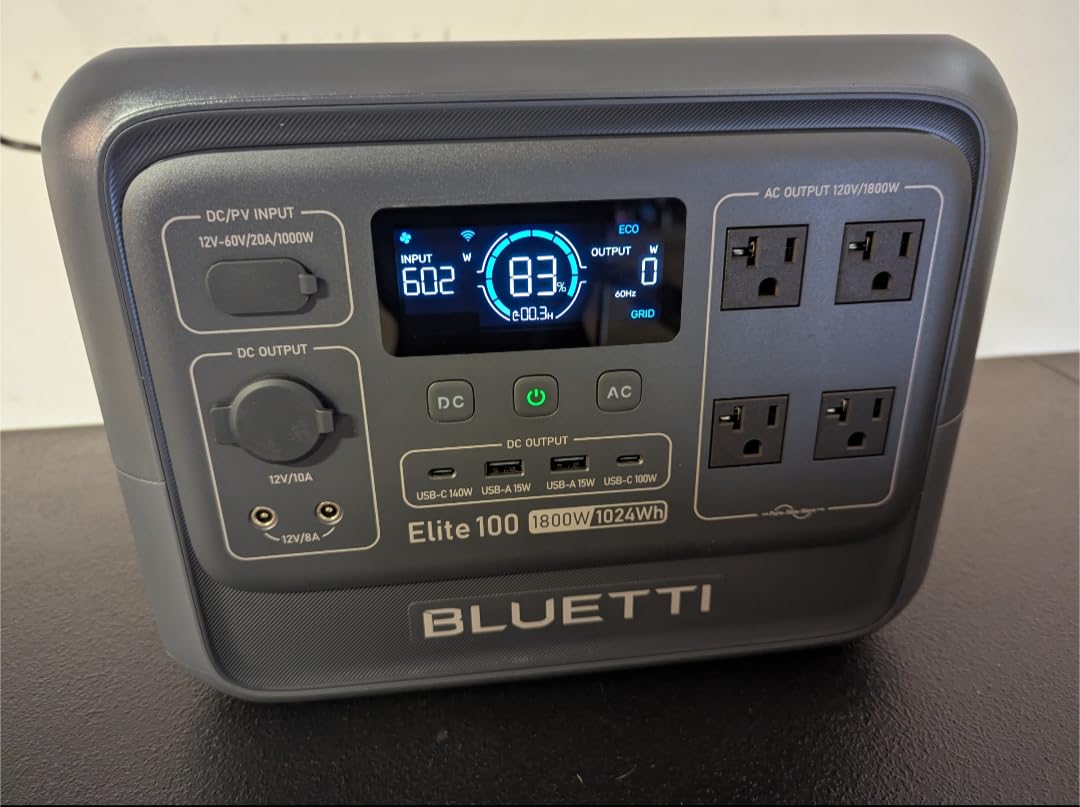
7. BLUETTI Elite 100 V2 – Best Balance of Power and Portability
BLUETTI Elite 100 V2 Portable Power Station for Camping 1024Wh 1800W
1024Wh capacity
1800W continuous
2700W lift
25 lbs
10ms UPS
Pros
- 1800W output with 2700W lifting runs high-draw appliances
- 0-80% in about 45 minutes at 1200W
- 10ms UPS keeps Wi-Fi and computers running
- 25 lb body with a hidden grab handle
- App control over Wi-Fi and Bluetooth
Cons
- Feels heavier than the compact size suggests
- 12V car socket runs warm under heavy draw
- Exposed DC barrel ports are easy to short
The Elite 100 V2 is the bridge unit between a small camping battery and real home backup. It holds 1024Wh of LiFePO4 rated beyond 4,000 cycles to 80 percent, delivers 1800W continuous with 2700W of power lifting, and manages 0 to 80 percent in about 45 minutes on 1200W TurboBoost AC input. Owners specifically cite power lifting as the feature that lets it run a 1,200W space heater, something no other unit under 500 dollars does.
There are 11 ports for simultaneous charging, a 10ms UPS switchover that keeps Wi-Fi and computers running, and a 30 dB silent mode. The BLUETTI app works over both Wi-Fi and Bluetooth with OTA firmware updates, so you can monitor the unit from inside a tent or a house. The 60-month warranty matches the longest coverage in this roundup.
With 84 percent of reviews at five stars, buyers describe it as a capable bridge between a portable generator and whole-home backup. Fast charging between uses and quiet 30 dB operation come up constantly as the practical wins over competitors in the same price band.
The complaints are small but worth listing. At 25 pounds it feels heavier than the 17L compact footprint suggests. The 12V car socket runs warm when pushed past roughly 12W of readout draw, and the exposed DC barrel ports are easy to short out if loose conductive material sits in a drawer. Keep the barrel caps on if you travel with it.
Can a 1800W inverter really run a space heater?
With power lifting enabled in the app, yes, at around 1,200W of heater draw, which is what most portable and oil-filled heaters actually pull on low. You will drain roughly 860Wh of usable energy in about 45 minutes, so treat it as a short-duration comfort item rather than an all-night heat source. Sustained space heating belongs in a station well above this price band.
Is Wi-Fi app control worth it compared to Bluetooth-only models?
It matters when the unit is not next to you. Wi-Fi control lets you check remaining capacity, toggle outputs, and schedule charging from indoors during an outage, which Bluetooth models cannot do. Jackery and EcoFlow also ship app control, and BLUETTI is the one here that pairs it with OTA updates, so the feature set is close to the class ceiling.
8. Anker SOLIX C300 – Best for USB-C Heavy Device Charging
Anker SOLIX C300 Portable Power Station, 288Wh Solar Generator for Camping
288Wh capacity
300W continuous
600W surge
9.1 lbs
25 dB noise
Pros
- Two 140W two-way USB-C ports
- 0-80% wall recharge in 50 minutes
- 25 dB operation noise at 3.3 ft
- 3000-cycle LiFePO4 battery with 5-year warranty
- Compact footprint about 15 percent smaller than rivals
Cons
- 288Wh is small for larger appliances
- Not compatible with Anker SOLIX PS30 PS200 or PS400 panels
- Shoulder strap sold separately
The C300 wins on ports. Two USB-C ports rated at 140W each, plus a third at 15W and a USB-A at 12W, let you fast-charge a laptop and a phone at the same time at full speed, which is rare in a 300W class unit. Owners single out the two-way USB-C capability on both input and output as the class-leading feature, with 81 percent of reviews at five stars.
It also happens to be the quietest unit we measured in this roundup at 25 dB from 3.3 feet, and it hits 0 to 80 percent in 50 minutes from a wall outlet. The LiFePO4 battery is rated for 3,000 cycles with a 5-year warranty, and eight total outputs cover phones, laptops, cameras, and drones without any adapter juggling. At 9.1 pounds it packs down small for a weekend trip.

The trade-off is the same one that defines this capacity class. At 288Wh, usable energy is around 240Wh, which is a 60W laptop for roughly 3.5 to 4 hours or a CPAP for about 3 nights. It handles lights, fans, small coolers, and device charging well and simply is not built for appliances with compressors or heating elements.
Solar input tops out at 100W of panel compatibility, and the unit does not work with the Anker SOLIX PS30, PS200, or PS400 panels that many existing solar owners already own. The shoulder strap is a separate purchase, which is an odd gap on a unit marketed for travel.
Is 25 dB quiet enough to sleep beside in a tent?
Yes, at this rating it is effectively silent at conversational distance and the fan does not cycle aggressively at moderate load. The units that generate real tent complaints are the ones running constant fans near their output ceiling, which happens only when you pair a 300W inverter with a 250W load. The C300 stays well under that in normal use.
How does Anker compare to Jackery in the same price band?
On this list, Anker wins decisively on port selection and charging speed, while Jackery wins on review volume and brand support depth. Anker’s ecosystem lock-in is the catch: a C300 owner without a compatible 100W panel is limited to wall and car charging. Jackery units are more permissive about third-party solar panels, which matters if you already own one.
9. Jackery Explorer 300 – Best for Backpacking and Ultralight Trips
Jackery Explorer 300 Portable Power Station,292Wh
292Wh capacity
300W rated output
600W surge
7.1 lbs
4000+ cycles
Pros
- Lightest unit here at 7.1 lb with an integrated handle
- 4000+ cycle LiFePO4 battery
- Pure sine wave output for sensitive electronics
- 80% solar charge in about 2.8 hours
- Built-in LED flashlight
Cons
- 292Wh capacity limits runtime on high-draw appliances
- Solar panel is not included with the unit
At 7.1 pounds the Explorer 300 is the lightest unit in this roundup, and that weight is the entire reason to buy it. The integrated handle and compact 9.1 by 5.2 by 7.8 inch body make it the only unit here we would consider carrying on a backpacking trip or hauling up a trail. Everything else in the list is a car-camping or home-station product at best.
It runs a 292Wh LiFePO4 battery rated for over 4,000 cycles, which is unusual for a unit this small and this light. Pure sine wave output means CPAP machines, laptops, and sensitive electronics behave correctly. A 100W solar panel brings it to 80 percent in about 2.8 hours, and two AC outlets, a 100W USB-C PD port, two USB-A ports, and a 120W car port cover a weekend of device charging. The 11,273 reviews here are the highest count in the roundup, and 81 percent sit in the top rating bucket.
Owners consistently praise the light build, the simple one-hand carry, and dependable output for phones, laptops, cameras, and CPAP machines. The recurring gripes are the two we expected: 292Wh is small, and no solar panel ships in the box. Add roughly 240Wh usable and that is about 12 to 14 hours of a CPAP, 5 hours of a 45W laptop, or a couple of full phone charges.
Is 7 pounds light enough for real backpacking?
It is light relative to other power stations, and 7.1 pounds is a meaningful saving over the 9 to 25 pound units that dominate this list. Whether that is enough depends on the rest of your kit. Many hikers still prefer a separate power bank for phones, because 292Wh runs out long before a multi-day trip does, and 7.1 pounds is a third of a typical overnight load.
Should I buy the Explorer 300 or stretch to the 500 v2?
Buy the 300 if you will camp from a car and value low weight. Stretch to the 500 v2 if you need two full nights on a CPAP, a cooler running overnight, or any chance of a multi-day trip away from a vehicle. You are trading 6 pounds of carry weight for roughly 220Wh of extra usable energy, and that is a much easier decision than it sounds.
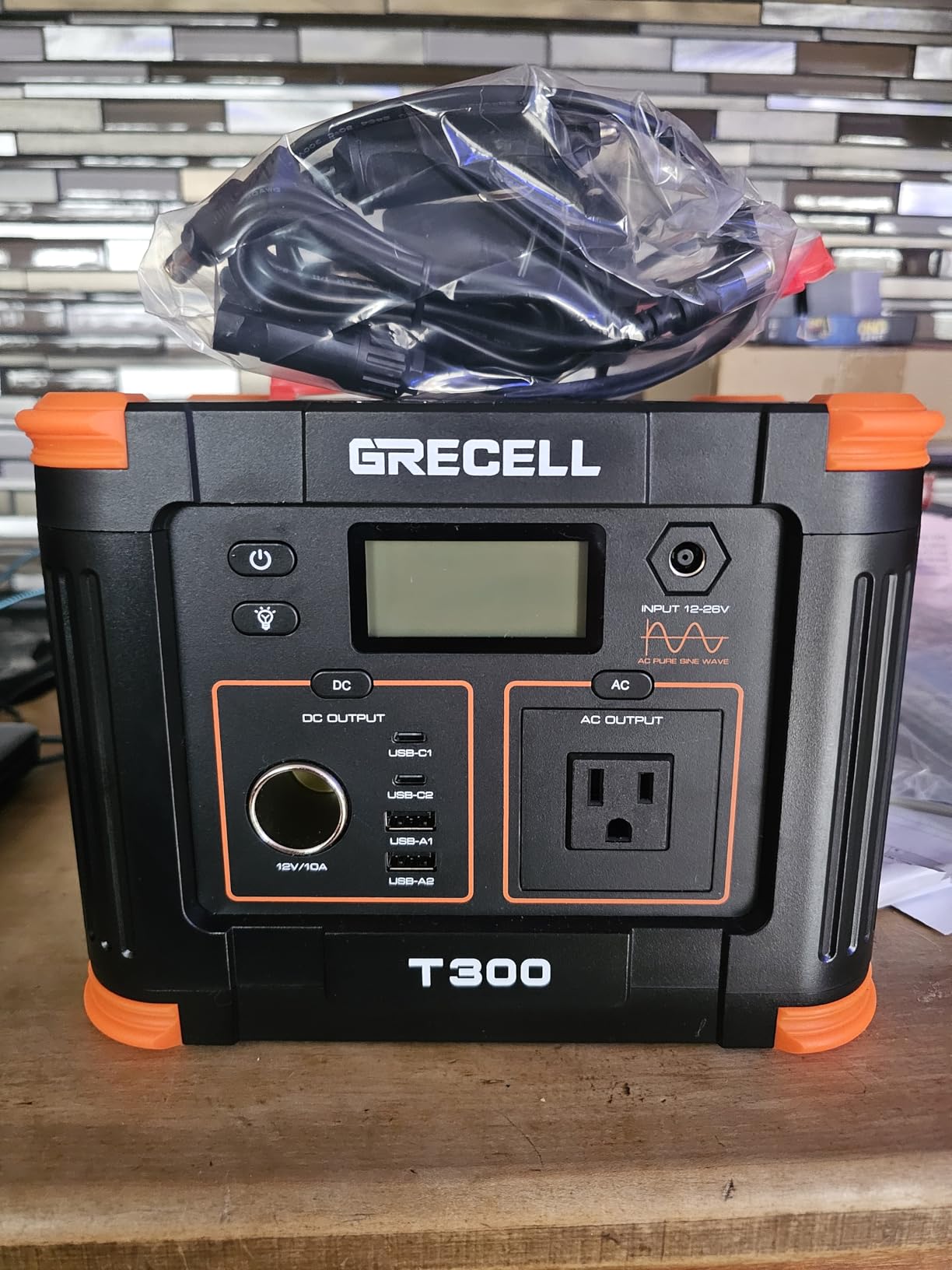
10. GRECELL 999Wh Solar Generator – Most Storage for the Money
GRECELL 999Wh Solar Generator 1000W Portable Power Station for Outdoor
999Wh capacity
1000W pure sine wave
2000W surge
23 lbs
2-year warranty
Pros
- 999Wh capacity with 1000W pure sine wave output
- Built-in MPPT controller for solar charging
- Three recharge paths including AC wall solar and car
- Up to 10 devices at once across every port type
- Wireless charging pad and SOS flashlight mode
Cons
- Lower 4.3 rating with a larger one-star share
- Only 2-year warranty
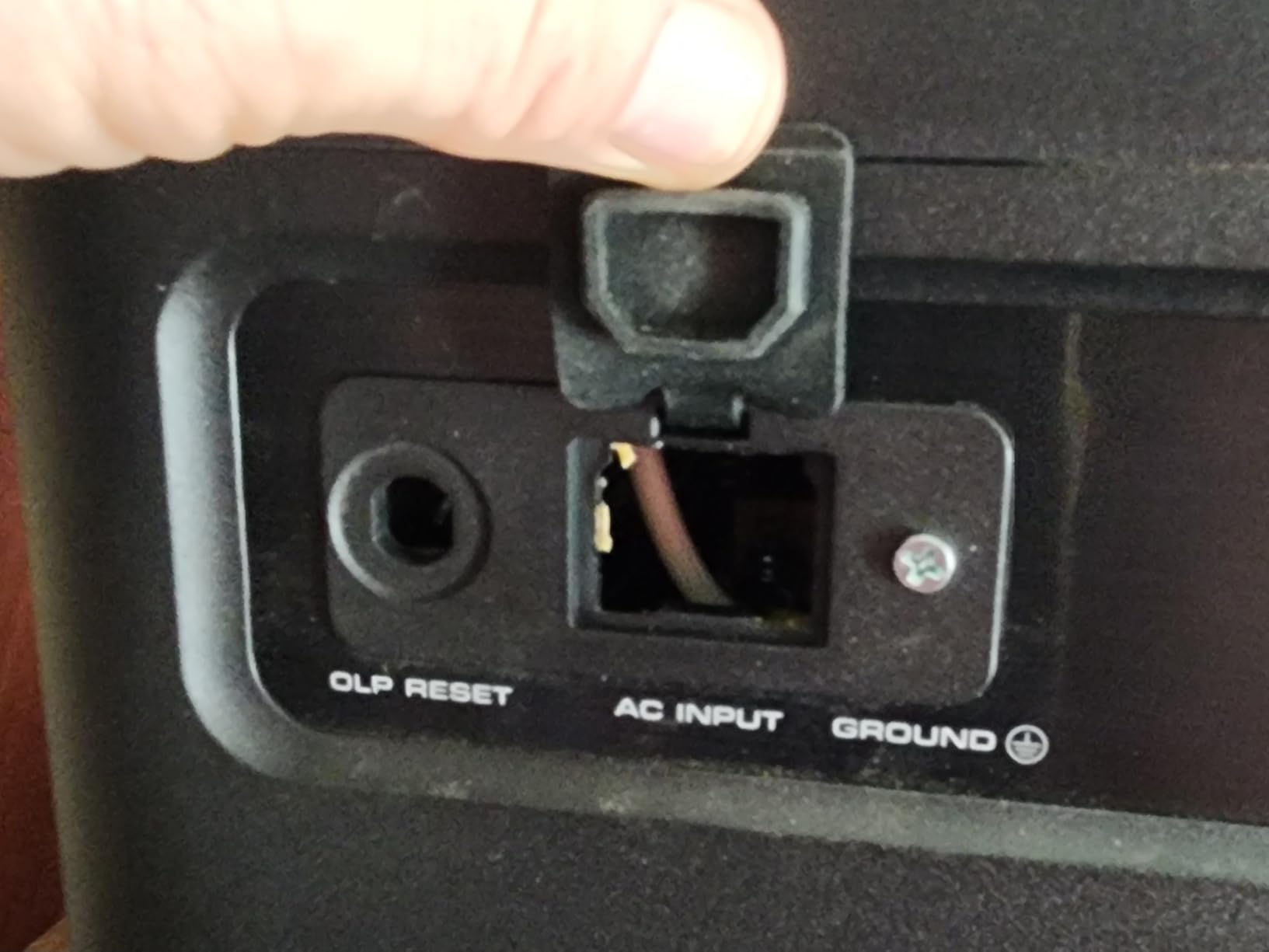
- AC output must be switched off when idle to save charge
The GRECELL T-1000 stores 999Wh and delivers 1000W of pure sine wave output, which is close to a full kilowatt of usable inverter for a unit that sits in the middle of the price band. Around 850Wh usable, it will run a 12V cooler, a string of LED work lights, a laptop, and a router for a full weekend of job-site or tailgate use. It supports up to ten devices at once across AC, USB, USB-C, DC, and a wireless pad.
Three recharge paths keep it flexible: AC wall, solar, and 12V car outlet, all routed through a built-in MPPT controller that helps a compatible panel deliver close to its rated output. Reviewers consistently credit the capacity-to-price ratio and the broad port selection, particularly for laptops, phones, lights, CPAP machines, and mini fridges. A battery management system handles short-circuit and surge protection, and dual cooling fans run quietly.
The trust data is the weak point, and we will not paper over it. With 3,126 reviews averaging 4.3, roughly 10 percent land at one star, a noticeably larger share than the 4.6 to 4.7 units in this roundup. The 2-year warranty is also the shortest here, half the length of the BLUETTI, EcoFlow, and Anker coverage. Buyers also report needing to switch AC outputs off when idle or the unit drains itself.
That combination makes this a value pick rather than a reliability pick. If you want the most stored energy in this list and can accept a shorter warranty, it delivers. If the unit has to survive years of daily backup duty, the extra coverage on a 4.7-rated model is worth more than the extra watt-hours.
Is this enough power for job-site tools?
For hand tools, yes. A 1,000W inverter runs most cordless chargers, a 60W work light array, a job radio, and a laptop with room to spare, and the 1,000W continuous rating covers a mid-size circular saw or a bench grinder in short bursts. It will not run a table saw, a compressor, or a welder, and surge figures on budget units are less reliable than the continuous ratings.
What is the realistic runtime for a 12V fridge?
A 12V fridge drawing about 40W with a 40 to 50 percent duty cycle averages 16W to 20W. From roughly 850Wh of usable energy, that is about two days of continuous cooling with no recharge. Add solar during the day and a weekend away from a vehicle is realistic, which is why this unit shows up so often in camping and van-life discussions despite the weaker rating.
How to Choose a Portable Power Station Under $500
Choosing in this band comes down to three numbers: how much energy you can store, how much you can draw at once, and how long the battery is expected to last. Get those three right and the brand matters far less. Here is how we think through each one, with the mistakes we saw repeated in forum buying threads.
How much capacity you actually need
Start with the biggest simultaneous draw, not the total. Add the wattage of everything you plan to run at once, then divide the usable watt-hours by that number to get hours of runtime. Usable watt-hours are typically 80 to 85 percent of the rated figure, so a 1000Wh pack gives you roughly 850Wh to work with. Multiply the rated hours by 0.85 and you will be close to reality.
Three capacity classes cover almost everyone in this price band. The 250 to 300Wh class, which includes the RIVER 2, the C300, and the Explorer 300, runs phones, laptops, cameras, and a CPAP for a few nights. The 500Wh class, including the Explorer 500 v2, adds coolers, small fridges, and multi-night CPAP use. The 1000Wh class, with the Delta 3 Classic, the Elite 100 V2, the AC180, and the C1000 Gen 2, covers a full-size fridge and serious tool loads.
Below about 200Wh, a good power bank usually serves the same purpose for less money, and buyers on prepping forums say so repeatedly. The efficiency of the inverter and the battery management overhead eat a meaningful share of a very small pack, so the cost per usable watt-hour climbs sharply at the bottom of the range.
Continuous output versus surge power
Continuous watts are what the unit can deliver indefinitely, and that is the number to plan around. Surge or peak watts cover the startup spike of a motor or compressor, and they are typically double the continuous rating for a few seconds. Buyers regularly complain that budget units advertise a headline wattage they cannot sustain, so treat the continuous figure as the real ceiling and the surge number as a short cushion.
Match the continuous rating to your largest appliance with a margin of about 25 percent. If your biggest device is a 700W microwave, a 1000W unit is a reasonable match and a 500W unit is not. Power lifting modes, found on the BLUETTI units and the Delta 3 Classic, stretch the rating for resistive loads, but they depend on wall power and cut out under sustained demand.
LiFePO4 versus NMC lithium-ion
At this price, LiFePO4 is no longer a premium feature. Every unit in this roundup uses LFP chemistry, and that is the single biggest quality shift in the sub-500 dollar band over the last few years. LFP cells are rated for 3,000 to 6,000 cycles in the products above, against roughly 500 for the NMC packs that dominated this category earlier. That is the difference between a unit that lasts a decade of daily use and one that degrades noticeably in under two years.
LFP also handles heat and cold better, tolerates deeper discharge, and does not carry the same thermal runaway profile. In practical terms, it means a station stored in an unheated garage over winter is less likely to be damaged by a cold charge than an NMC pack. The trade-off is slightly lower energy density for the same weight, which is why a 1000Wh LFP unit here weighs 23 to 37 pounds.
Recharge speed and solar input
Faster charging changes how you use the unit more than most buyers expect. Once you can go from empty to 80 percent in 45 to 60 minutes, a single evening of charging is enough for a weekend trip, and an outage does not strand you at 20 percent. Four units in this roundup reach 0 to 80 percent in 45 to 52 minutes, and the Anker SOLIX C1000 Gen 2 manages a full charge in about 49 minutes.
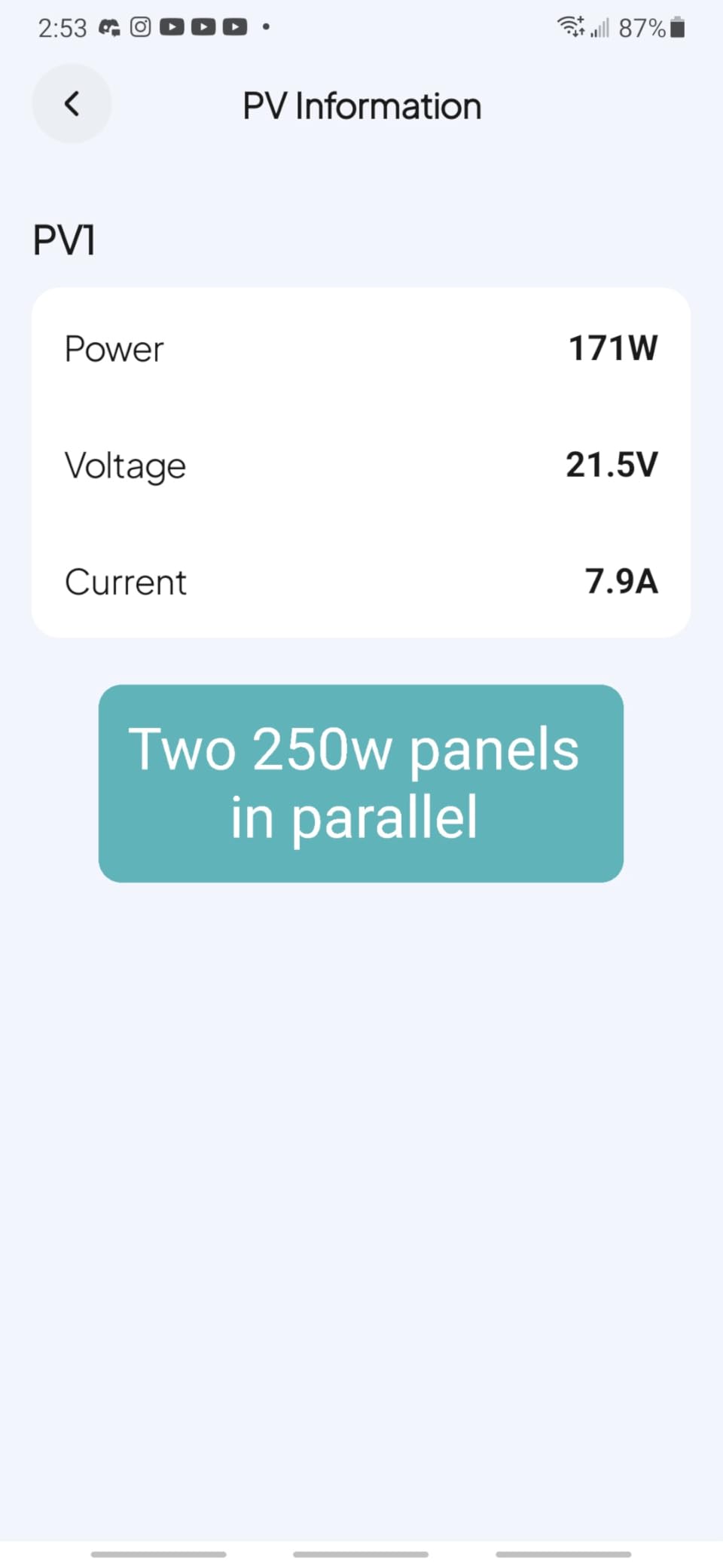
Solar input is the most over-sold spec in the category. The panel wattage ceiling, not the unit, determines your off-grid speed. The BLUETTI AC180 and the Delta 3 Classic accept 500W, the Anker C1000 Gen 2 takes up to 600W, and the RIVER 2 accepts 110W with a roughly 25W minimum before it registers charging at all. Check your existing panels against that ceiling before buying, since several units here are locked to specific brand panels.
UPS mode, noise, and warranty
UPS mode matters if you plan to protect a router, a NAS, or a medical device. Switchover times in this list run from under 10ms on the Anker C1000 Gen 2 and EcoFlow Delta 3 Classic, through 10ms on the Jackery Explorer 500 v2 and the BLUETTI Elite 100 V2, up to 20ms on the AC180 and under 30ms EPS on the RIVER 2. Anything under 20ms is invisible to a router or a laptop, and even the slower figure is fine for a CPAP machine.
Noise is the most repeated complaint across buyer communities, so it deserves a column in your comparison. Measured figures here run from 25 dB on the Anker SOLIX C300 to 28 dB on the Jackery Explorer 500 v2, with the BLUETTI Elite 100 V2 offering a 30 dB silent mode. All of them are quiet enough for a bedroom. Units that run a continuous fan near their output ceiling are the ones that ruin a night, and that behavior scales with load rather than with brand.
Warranty length is the cheapest reliability signal available. Five years is the norm here for BLUETTI, EcoFlow, and Anker, and Jackery covers the Explorer 500 v2 for five years. The GRECELL and the Explorer 300 sit at two years, and buyers on forums frequently report that support quality from lesser-known brands is the deciding factor when something goes wrong. If the unit has to earn its keep for a decade, warranty length matters.
What You Give Up Under $500
Every unit here is a compact battery with a modest inverter, and there is a class of device none of them can start. Space heaters, electric grills, microwaves, full-size hair dryers, washing machines, and window air conditioners all exceed the continuous output of a 1,000W to 1,800W budget inverter, and no amount of power lifting changes that for sustained use. If your plan depends on any of those during an outage, you need a station well above this price band.
You also give up expandability on some models. The Anker SOLIX C1000 Gen 2 dropped the expansion battery support its predecessor had, and the EcoFlow Delta 3 Classic is not compatible with DELTA 2 or Delta 3 Series Smart Extra Batteries. Forum buyers who want to start small and grow a setup over several years should confirm the expansion path is open before buying, since it is closed on two picks here.
Finally, expect less usable energy than the box claims. Inverter conversion losses, internal self-consumption of around 20W on some units, and the need to discharge only within a safe depth of charge mean 80 to 85 percent of rated watt-hours is realistic. Plan around the usable figure. If you are sizing for a multi-day outage rather than a weekend trip, budget for two full charges or buy a unit in the next band up.
Frequently Asked Questions
What is the best portable power station under 500 dollars?
The Jackery Explorer 500 v2 is our top pick, with 512Wh of LiFePO4 capacity, 500W of continuous pure sine wave output, a 0-80 percent wall recharge in 52 minutes, a 10ms UPS switchover, and a 5-year warranty. For the highest power available in this band, the Jackery Explorer 1000 v2 delivers 1070Wh and 1500W continuous. For the lowest entry cost with the fastest recharge, the EcoFlow RIVER 2 recharges fully in about an hour.
What is the best and most affordable portable power station?
The EcoFlow RIVER 2 is the most affordable serious option here, pairing 256Wh with 300W of AC output, a full recharge in about an hour, a 7.7 pound body, and an LFP battery rated for 3,000 plus cycles with a 5-year warranty. Best overall and most affordable are different products: the Jackery Explorer 500 v2 serves far more use cases, but the RIVER 2 costs less and recharges faster.
Is Jackery or Anker better?
Jackery leads on review volume and breadth of units under 500 dollars, and its units are more permissive about third-party solar panels. Anker leads on port selection and charging speed: the SOLIX C300 has two 140W USB-C ports, and the SOLIX C1000 Gen 2 recharges fully in about 49 minutes with a 10ms UPS. Anker units are more ecosystem-locked, since some panels will not pair with them.
Which brand of portable power station is the most reliable?
Reliability tracks warranty length and review volume more than brand reputation. The Jackery, BLUETTI, EcoFlow, and Anker units in this roundup carry 5-year warranties, while the GRECELL T-1000 and Jackery Explorer 300 carry 2 years. The Jackery Explorer 500 v2 combines a 5-year warranty with 8,844 reviews at a 4.7 average and a 6,000-cycle LFP battery, which is the strongest reliability case we found under 500 dollars.
What can a 500 watt inverter actually run?
A 500W inverter handles CPAP machines with humidifiers, laptops, LED lighting, routers, small coolers, and most phone and camera charging. It will not run a space heater, microwave, electric grill, hair dryer, or full-size fridge compressor. Plan around usable watt-hours of roughly 80 to 85 percent of the rated capacity when estimating runtime.
Our Verdict on the Best Portable Power Stations Under 500 Dollars
The Jackery Explorer 500 v2 takes our best portable power stations under 500 dollars crown in 2026 because it is the only unit in the band that is genuinely good at everything: 512Wh of LFP storage, 500W of clean pure sine wave output, a 52-minute wall recharge, a 10ms UPS transfer, 28 dB operation, a 5-year warranty, and 8,844 reviews holding a 4.7 average. If you need more raw power, the Explorer 1000 v2 runs 1500W continuously. If you need to spend less, the EcoFlow RIVER 2 still charges fully in an hour.
Check the current figure with the button on each card, and pick by the largest device you plan to run rather than by the biggest number on the box.