
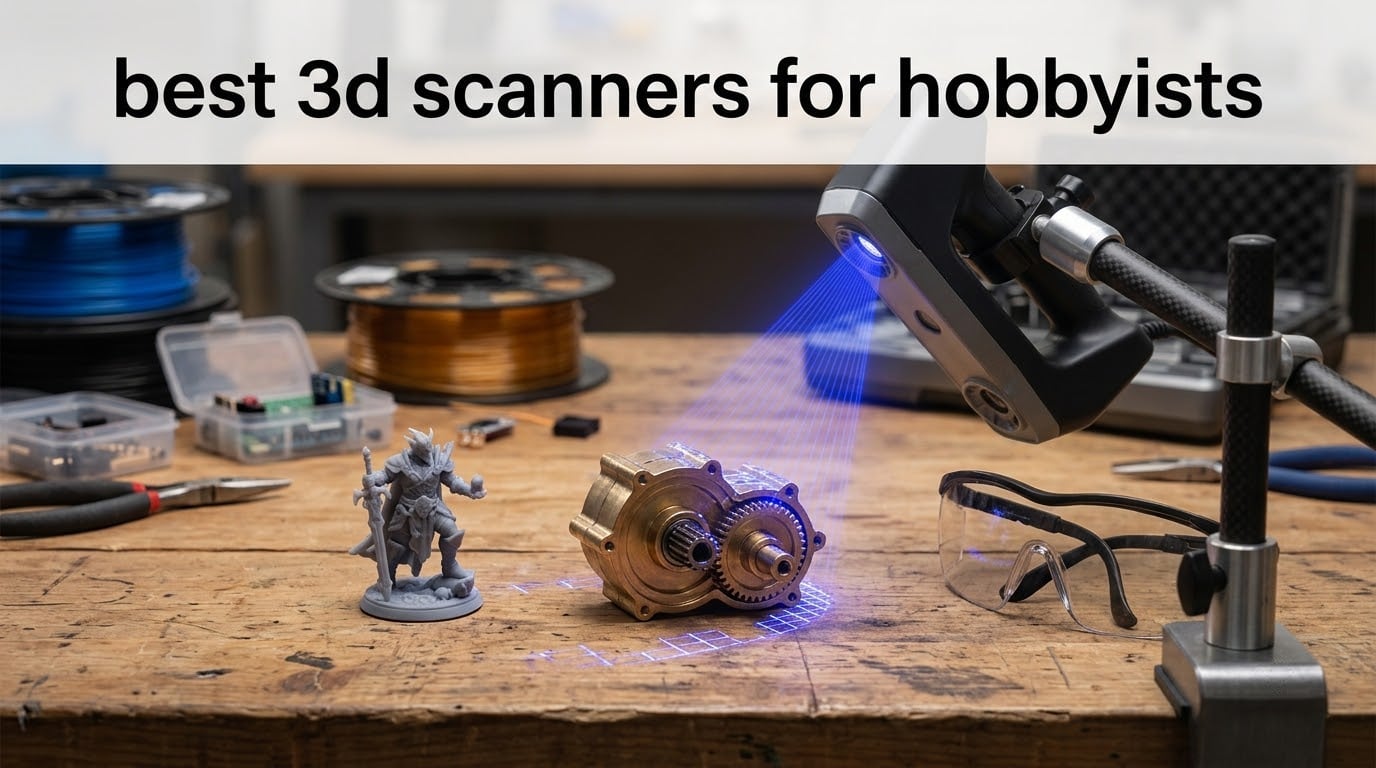
Hobby 3D scanning has quietly become one of the highest-leverage skills a maker can pick up. Point a scanner at a damaged miniature, a broken appliance hinge, a car body panel or a cosplay prop, and a few minutes later you have a mesh file heading straight for your slicer. The problem is that the market is now crowded, and the spec sheets read like alphabet soup.
That is why our guide to the best 3D scanners for hobbyists in 2026 splits the field into three tiers: entry-level scanners that cover most weekend projects, mid-range handhelds that handle reverse engineering, and premium hybrid units built for large objects, color capture and repeatable professional-style results. All ten picks here are current consumer and prosumer hardware you can actually buy, and every accuracy figure quoted comes from the manufacturer’s own published specification for that unit.
One honest caveat before we start, because it comes up constantly in scanning forums: stated accuracy is not comparable across brands. A 0.02 mm figure from one manufacturer may be measured single-frame on a calibration artifact, while another’s 0.03 mm is a volumetric figure taken across a working volume. Treat these numbers as tiers, not head-to-head scores. If you want the full breakdown of what each term means, skip to the accuracy section below before you pick a number.
If you are still building your bench, our guides to the best 3D printers and the best 3D pens cover the print side of the workflow. A scanner is only half the loop, and the printer you hand the mesh to shapes your file format choices as much as the scanner does.
Table of Contents
Top 3 Best 3D Scanners for Hobbyists (October 2026)
These three cover the widest range of hobby jobs in the guide. The Revopoint POP 4 is the one most people should buy, the MetroX Pro is the strongest raw hardware in a kit, and the MIRACO Plus is the only truly self-contained option here.
Revopoint POP 4
- 0.03mm single-frame accuracy
- 105 fps multi-line laser
- Wi-Fi 6 with battery grip
- 10mm to 2m scan volume

Revopoint MetroX Pro
- 0.02mm accuracy
- 62-line blue structured light
- dual-axis auto turntable
- full RGB color capture

Revopoint MIRACO Plus
- Photogrammetric metrology
- 48MP RGB camera with flash
- on-device processing
- 750g body
The Best 3D Scanners for Hobbyists at a Glance
Here is every scanner in the guide, sorted roughly from most versatile downward. Use this table to narrow the field before reading the individual reviews.
| Product | Specifications | Action |
|---|---|---|
| Revopoint POP 4 |
|
Check Latest Price |
| Revopoint MetroX Pro |
|
Check Latest Price |
| Revopoint MIRACO Plus |
|
Check Latest Price |
 Creality CR-Scan Otter Creality CR-Scan Otter |
|
Check Latest Price |
 3DMakerpro Mole 3DMakerpro Mole |
|
Check Latest Price |
 Creality Pika Creality Pika |
|
Check Latest Price |
 3DMakerpro Moose Lite Premium 3DMakerpro Moose Lite Premium |
|
Check Latest Price |
 Creality Otter Lite Creality Otter Lite |
|
Check Latest Price |
 3DMakerpro Seal Lite 3DMakerpro Seal Lite |
|
Check Latest Price |
 Creality CR-Scan Raptor Creality CR-Scan Raptor |
|
Check Latest Price |
Three quick reads on that table. Six of these ten reach 2000 mm of object coverage, so the “big object” problem is largely solved at this price tier. Nine of ten handle dark or shiny surfaces in at least one lighting mode without spray. And only one, the MIRACO Plus, renders the scan without a tethered PC in the loop.
1. Revopoint POP 4 – Best Overall for Hobbyists
Revopoint POP 4 3D Scanner, AI Segmentation, for 3D Printing, Premium
0.03mm accuracy
10mm to 2x2x2 m volume
Wi-Fi 6 plus 5500mAh grip
286 g
Pros
- 0.03mm single-frame accuracy with published volumetric formula
- Five lighting modes from full-field structured light to 30-cross blue laser lines
- Scans dark and shiny surfaces without spray
- Battery grip gives about 4 hours of cordless work
- Scan volume from 10mm cube to 2 meter cube
Cons
- AI segmentation is Windows-only
- Revo Design and Revo Measure are paid add-ons
- Demanding PC specification including an RTX 3060 class GPU
This is the scanner I keep reaching for, and the one I hand to friends who ask what to buy first. Five scanning modes sit behind one button: full-field structured light, hybrid HD, VCSEL rapid capture, 30 cross blue laser lines, and a single-line deep-hole mode. That range means you are not changing hardware when you move from a 30 mm figurine to a car bumper.
The stated performance is 0.03 mm single-frame accuracy, with a published volumetric formula of 0.03 mm plus 0.05 mm times distance in metres. That transparency is unusual at this tier and it tells me the manufacturer is confident in the measurement chain rather than quoting a marketing peak.
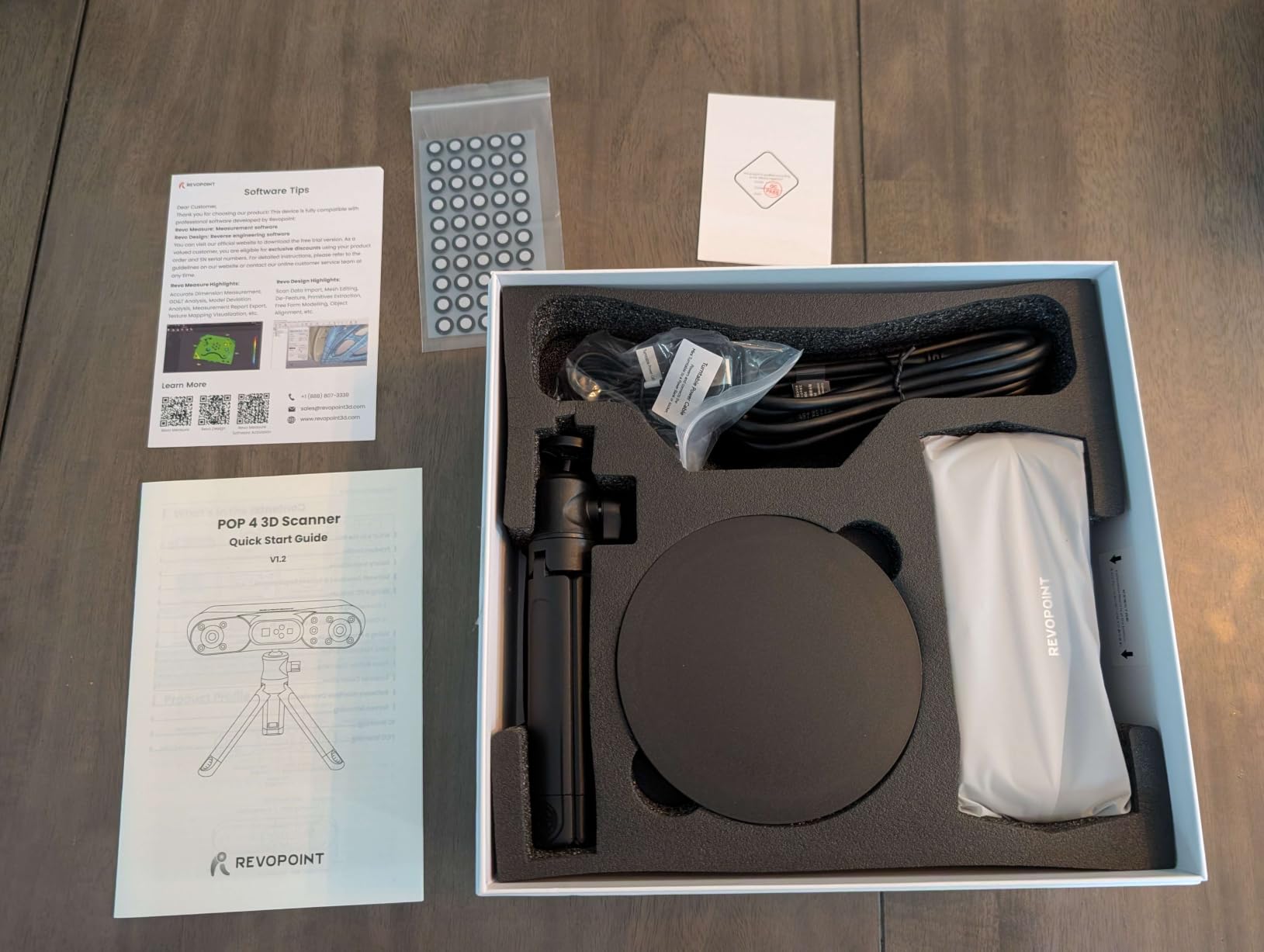
What impressed me most in real use is the lighting flexibility. Full-field structured light handles fast rough passes, VCSEL covers the 300 to 800 mm working band where handheld scanning lives, and the cross laser lines rescue the flat and reflective surfaces that defeat cheaper units. In practice I scanned a glossy black phone case with no spray and no markers.
Battery life is the sleeper feature. The 5500 mAh grip gives roughly four hours of cordless scanning over Wi-Fi 6.0, with phone or tablet acting as a cross-screen. For a hobbyist who scans on the kitchen table, a car in the driveway, or terrain on the floor of a workshop, being tied to a laptop by USB is the thing you notice most.
What the POP 4 gets right that cheaper scanners do not
Dark and reflective surfaces are handled in multiple modes, not just one. Owner reviews repeatedly single out the ability to scan shiny and black parts without texture spray, which removes the single most common step that ruins a hobbyist’s first scan.
The scan volume range is genuinely enormous, from a 10 mm cube up to a 2 meter cube, and the deep-hole mode is a quiet bonus for capturing the inside of sockets, tubes and castings.
Where the POP 4 will frustrate you
It wants a genuinely capable computer. Revopoint lists a minimum of an Intel i7 13th Gen or Ryzen 7 5800 class processor with 16 GB of RAM and an NVIDIA RTX 3060 with 8 GB, or a Mac with M1 Pro or better and 16 GB. Many scanning forum posts about failed captures trace back to an underpowered laptop rather than the scanner.
AI object segmentation is Windows-only, and both Revo Design and Revo Measure are paid add-ons to the bundled Revo Scan 6. Budget for that if your workflow runs through CAD rather than straight to a slicer.
2. Revopoint MetroX Pro – Best Premium Kit
Revopoint MetroX Pro 3D Scanner, Blue Laser Scan, for 3D Printing, Advanced
0.02mm accuracy
62-line blue structured light
Dual-axis auto turntable
14.82 lbs
Pros
- 0.02mm accuracy with 0.01mm single-frame precision
- 62-line full-field blue structured light at up to 7 million points per second
- Dual-axis auto turntable automates full-object capture in one click
- HD RGB camera for full color scans
- Kit includes markers and scanning aids
Cons
- Corded only with no battery option
- Tracking occasionally resumes in the wrong orientation
- Color scanning needs experimentation to dial in
This is the most complete package in the guide. You get 30 cross-line lasers, 15 parallel lines, a 62-line full-field blue structured light mode running at up to 7 million points per second, and a dual-axis automatic turntable that captures a full object in one click. Owners scanning office-chair-scale objects describe the detail as professional-grade, and the kit includes markers, scanning aids and a protective latching tote.
The numbers back that up. Single-frame accuracy reaches 0.02 mm with 0.01 mm single-frame precision, and the volumetric formula is 0.02 mm plus 0.04 mm times distance in metres. Three tracking modes, feature, marker and global marker, let you trade convenience against repeatability depending on how hard the geometry is.
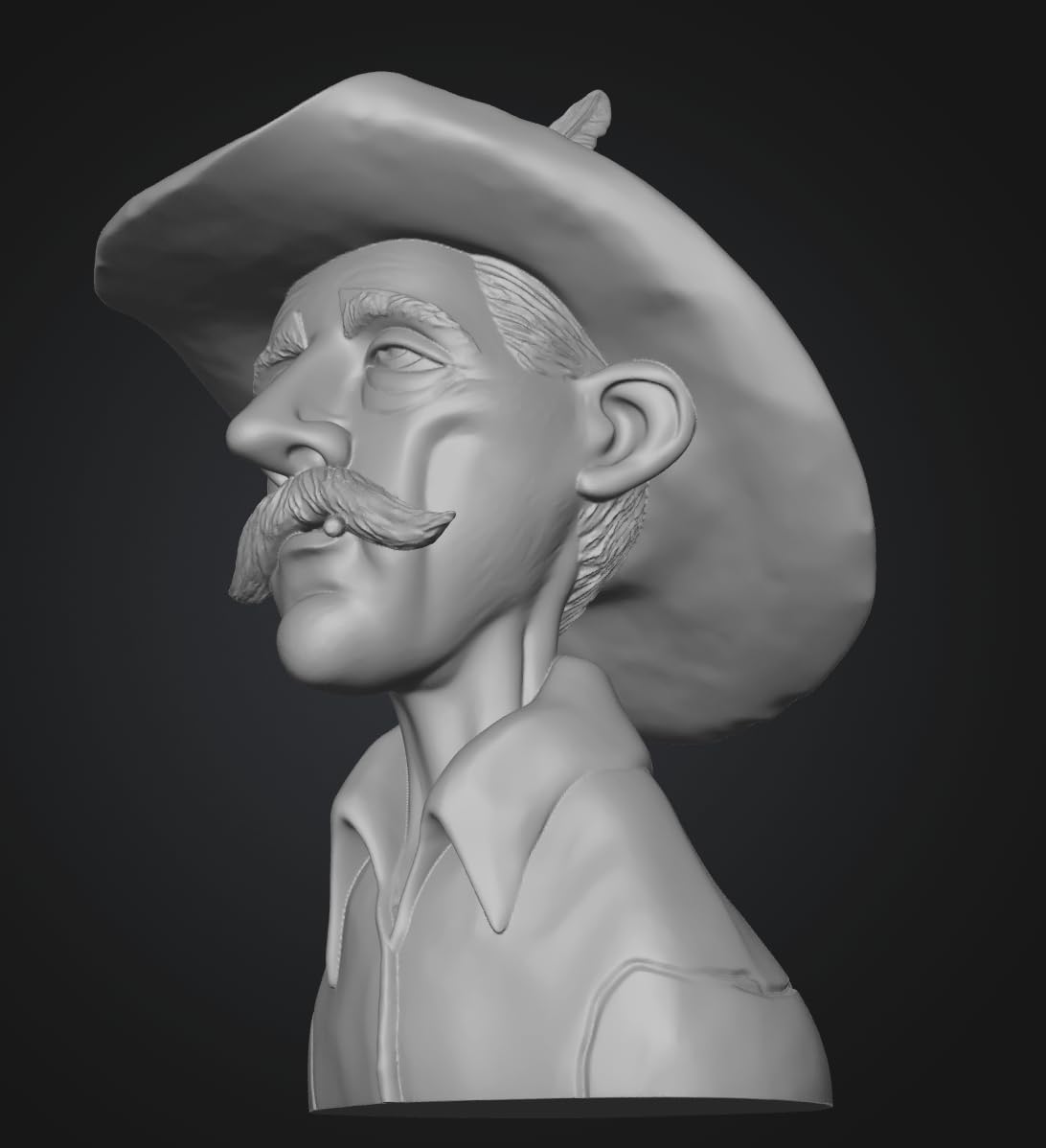
One of the more interesting engineering choices is that cross-line and parallel modes handle shiny or dark surfaces without spray at up to 2 million points per second. That means the mode you use for a matte model and the mode you use for a chrome-looking trim piece can both be fast. The Revo Mirror app streams the scan live from your PC to a phone or tablet, which is genuinely useful when the object is bigger than your desk.
It also exports cleanly to CAD packages, with the alignment tooling needed to get from overlapping scans into a usable solid model. If reverse engineering is a regular part of your hobby, that export path matters more than raw point rate.
Reasons to spend up here
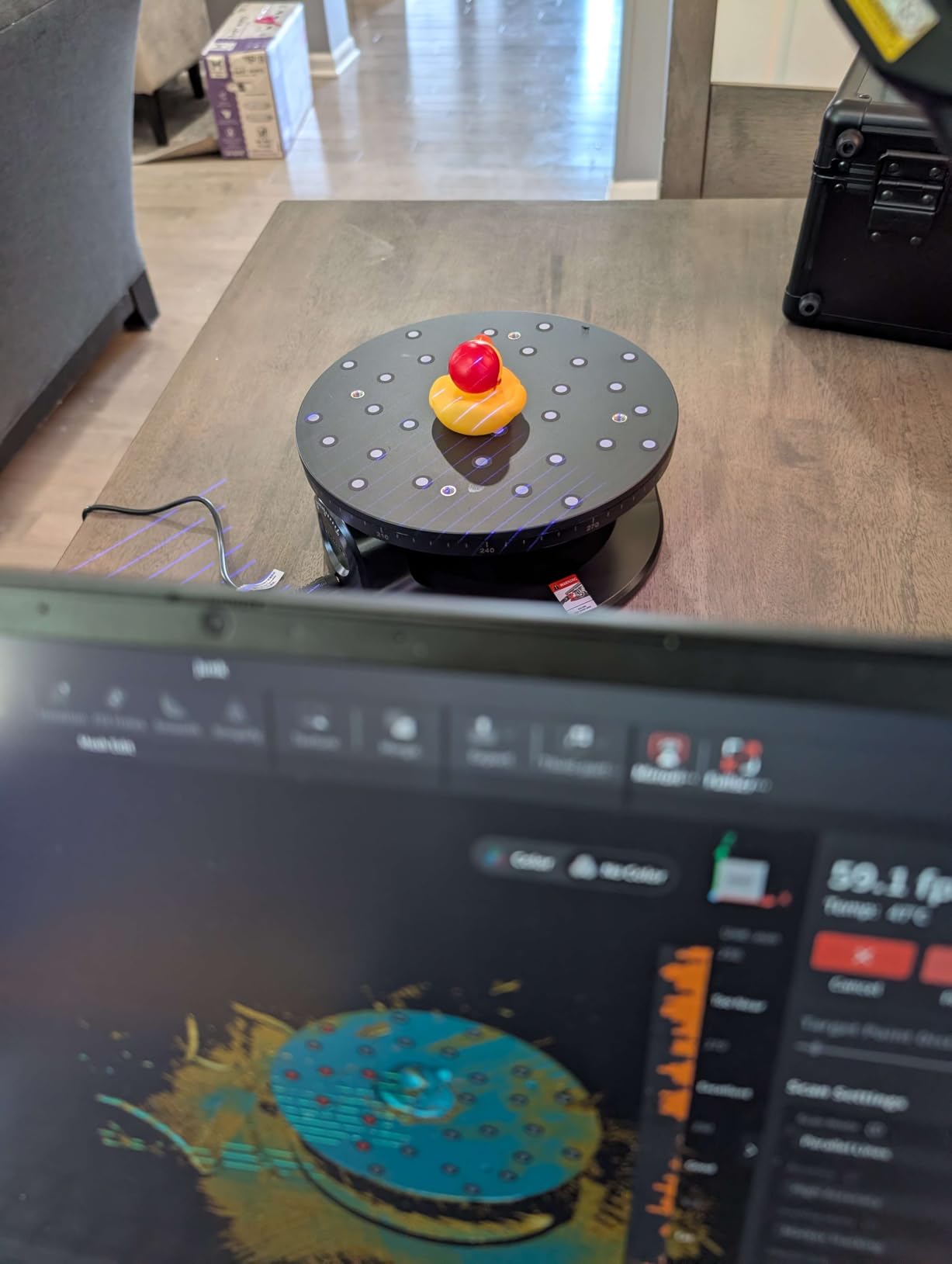
The auto turntable is the feature that changes the workflow. Rolling an object through three or four awkward angles by hand and hoping the software stitches them is the tedious part of scanning, and this removes it with one click.
Color capture is a real output here rather than a checkbox. If you are archiving an object in color for a game, a diorama or an AR project, the HD RGB camera combined with full-field structured light gives you texture and geometry in one pass.
The catch with the MetroX Pro
It is corded only, with no battery handle option, so this is a desk scanner despite the handheld form. Owners also report that tracking can drop and occasionally resume in the wrong orientation, which forces a restart of that pass.
Full-color scanning takes experimentation to dial in, and glossy or black surfaces still scan best when you approach nearly perpendicular. A few buyers also found the included USB-C cable needed an adapter their machine lacked, so check your ports.
3. Revopoint MIRACO Plus – Best Self-Contained Scanner
Revopoint MIRACO Plus 3D Scanner, All-in-One Scan, for 3D Printing
Photogrammetric metrology
750 g all-in-one
48MP RGB camera
2 hour battery
Pros
- Renders on-device so no tethered PC is required
- Quad infrared depth cameras with Near and Far modes
- 48MP RGB camera with flash LEDs for color capture
- Infrared laser allows direct face and body scans
- Exports PLY OBJ STL ASC 3MF GLTF and FBX
Cons
- Software requires x86_64 architecture
- Tracking struggles on very small objects
- Floppy flip screen hinge out of the box
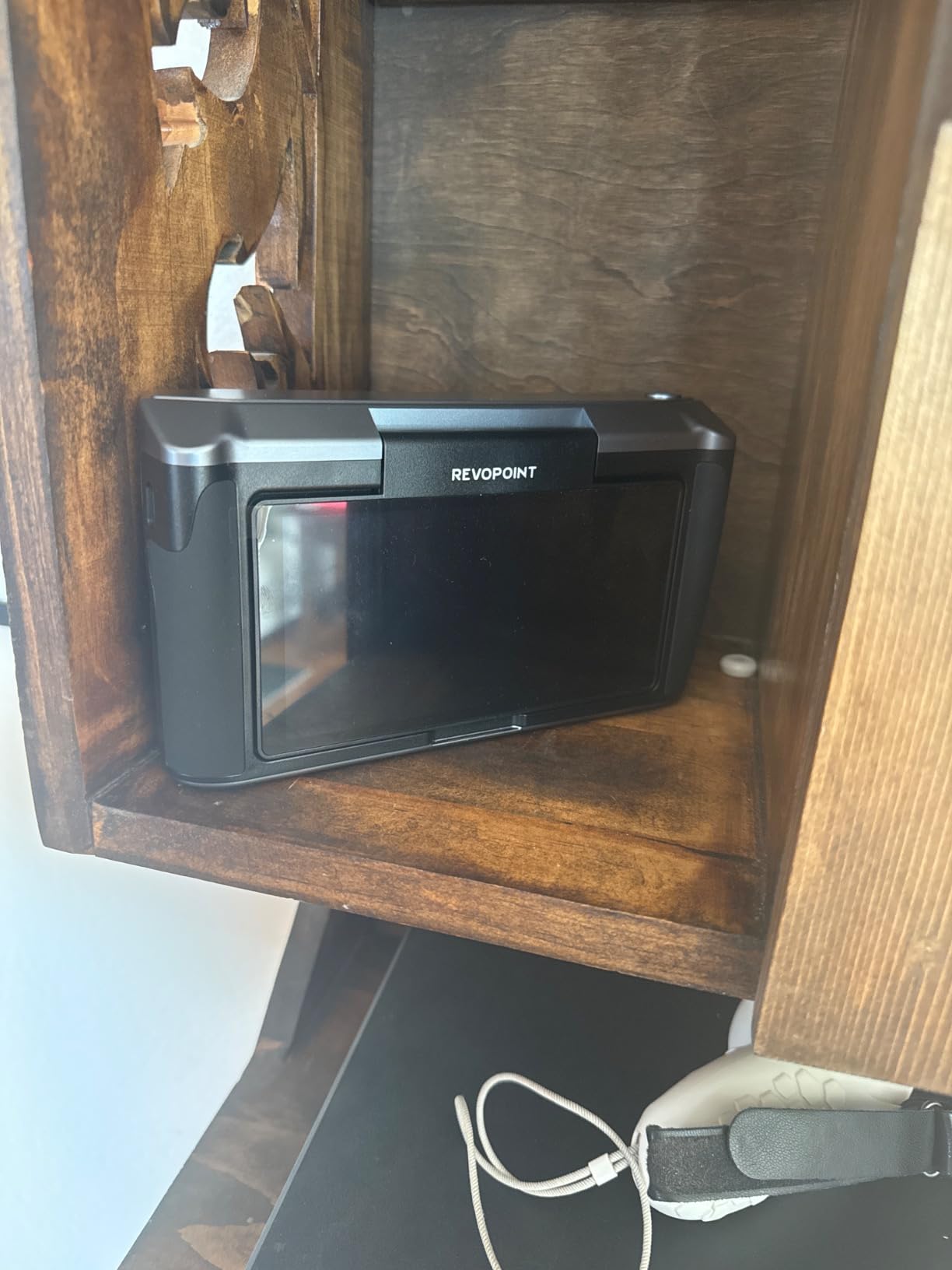
The MIRACO Plus is the only truly all-in-one scanner in this guide, and that changes where you can scan. It carries an 8-core 2.4 GHz processor with 32 GB of RAM, up to 10,000 frames and 256 GB of storage, so rendering happens on the device. There is a 6-inch 2K AMOLED screen that flips 180 degrees for low-angle work, and you can walk to a friend’s garage or a model show without a laptop bag.
Under the hood it is a hybrid machine. Quad depth cameras with Near and Far modes cover a huge object range, an infrared optical zoom switches between 1.5x and 2x magnification for close-up detail, and the class 1 infrared laser permits direct face scans. On the metrology side, the integrated kit with four carbon fiber scale bars and 208 coded targets delivers 0.02 mm plus 0.05 mm times distance in metres, and the new calibration board improves single-point cloud accuracy by 20 percent to 0.04 mm.
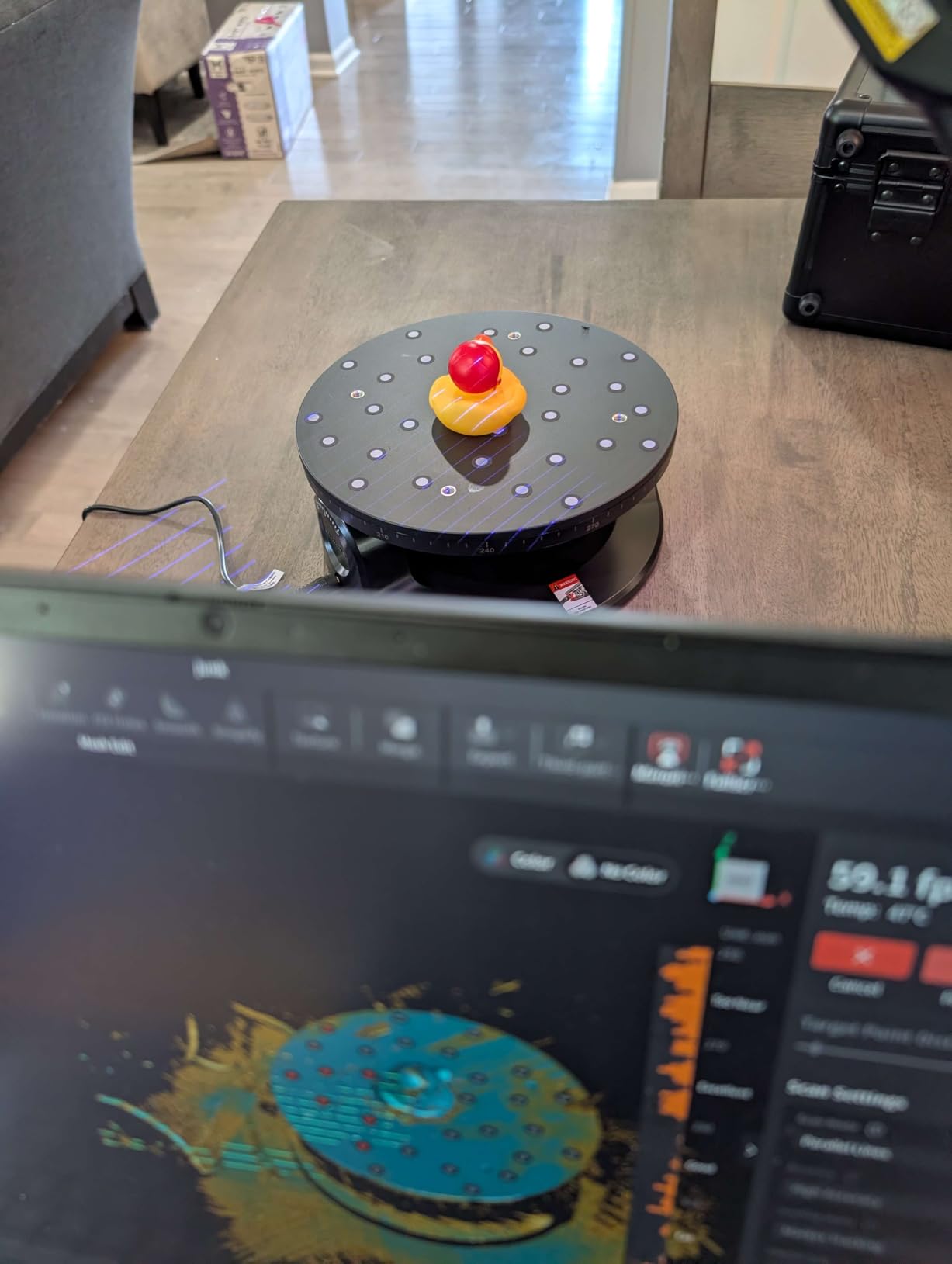
The 48MP RGB camera with flash LEDs produces what reviewers consistently call lifelike color models. That is the differentiator for anyone archiving miniatures, cosplay pieces or restored figures, where the paint job is half the reason you scanned it.
At 750 g with roughly two hours of scanning per charge and 65W fast charging, it is light enough to hold for a full session. Single-shot mode plus continuous capture up to 20 fps covers both careful tabletop work and faster passes on larger subjects.
Where it earns its place
On-device post-processing makes the scan-to-CAD loop fast and forgiving, which is exactly where hobbyists get stuck. Export formats are broad: PLY, OBJ, STL, ASC, 3MF, GLTF and FBX. Having 3MF built in means a clean handoff into a slicer without a conversion step.
The Near and Far modes, combined with infrared optical zoom, let one device handle coin-sized parts and much larger machinery. That range is unusually wide for a 750 g body.
What to watch out for
The software requires an x86_64 architecture. On a Mac, that means M1 Pro or higher with 8 GB or more of RAM; on Windows, a 12th generation i7 or better with 16 GB.
Tracking can struggle to hold on very small objects and produce duplicated scans, and setting up reference points for large objects is slow. Revo Design is sold separately, and the flip screen hinge is reported as floppy out of the box.
4. Creality CR-Scan Otter – Best for Cars and Large Objects
Creality CR-Scan Otter 3D Scanner for 3D Printing, Handheld 3D Printer Scanner with 4 Lens Stereo Vision 10-2000mm Range, Anti-Shake Tracking 24-Bit Full-Color for iOS Mac Windows Android
10mm to 2000mm range
4 stereo depth cameras
20 fps
Wi-Fi with bridge
Pros
- Dual long and short focal lenses cover 10mm to 2000mm objects
- Handles black and metal surfaces such as tires and bumpers without spray
- 24-bit full-color capture performs well in low light
- Works outdoors below 30000 lux
- One-Shot 3D imaging reduces tracking loss
Cons
- Feature and texture tracking is less reliable than marker tracking
- Applying and removing markers consumes a large share of scan time
- Wireless phone control needs a separately sold bridge accessory
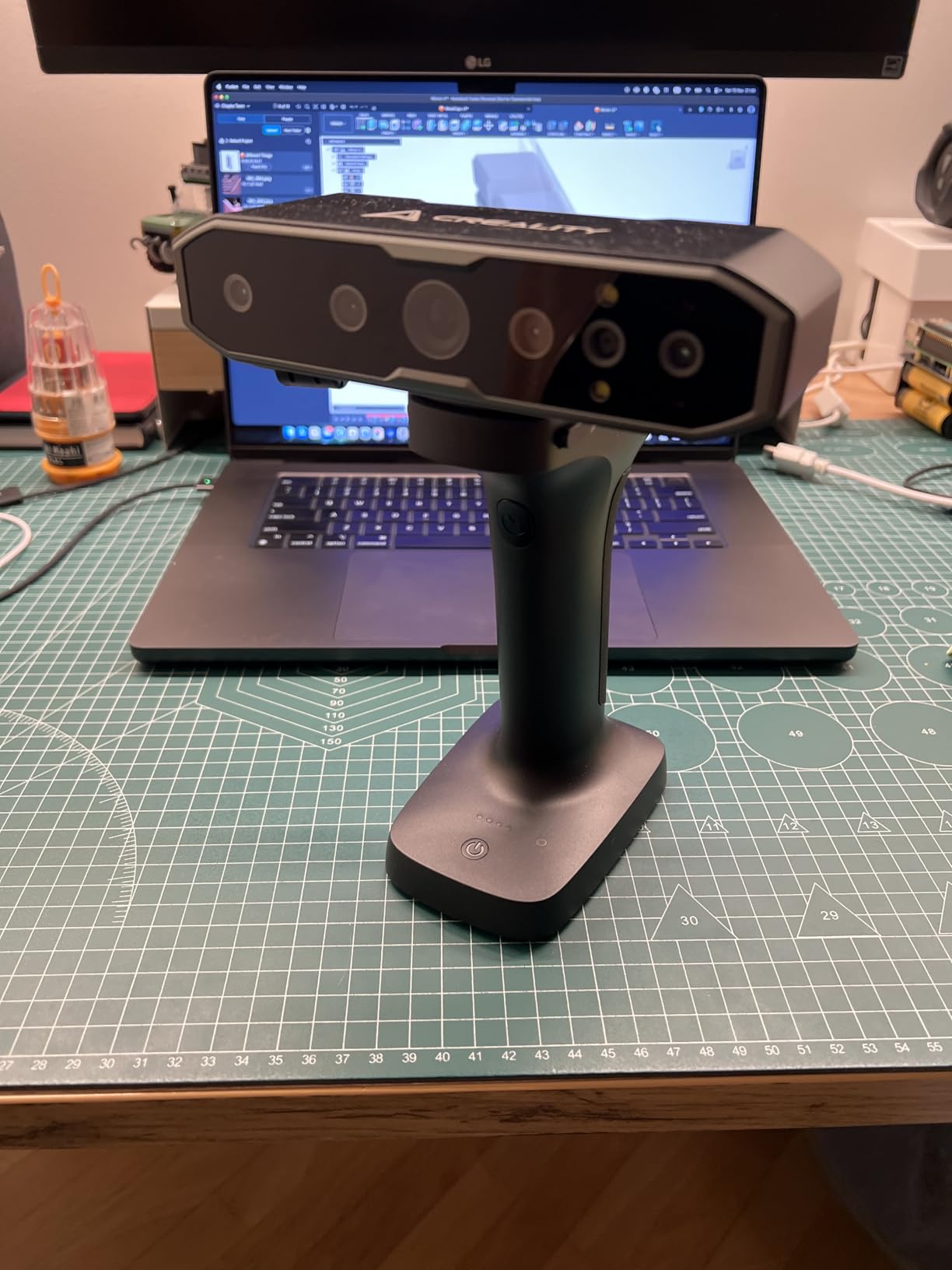
Two focal lengths in one body is the idea that makes this scanner interesting. The dual long and short focal lenses cover objects from 10 mm across to 2000 mm, so the same device handles a washer and a whole car. Underneath sit eight infrared LEDs, two white LEDs, four stereo depth cameras and one RGB camera running at up to 20 fps, with a scanning distance band of 110 mm to 1200 mm.
One-Shot 3D imaging stabilizes each frame to reduce tracking loss, which matters a lot when you are walking around a vehicle. The million-pixel RGB camera and its color mapping algorithm handle black and metal surfaces without spray, and the unit stays functional below 30,000 lux.
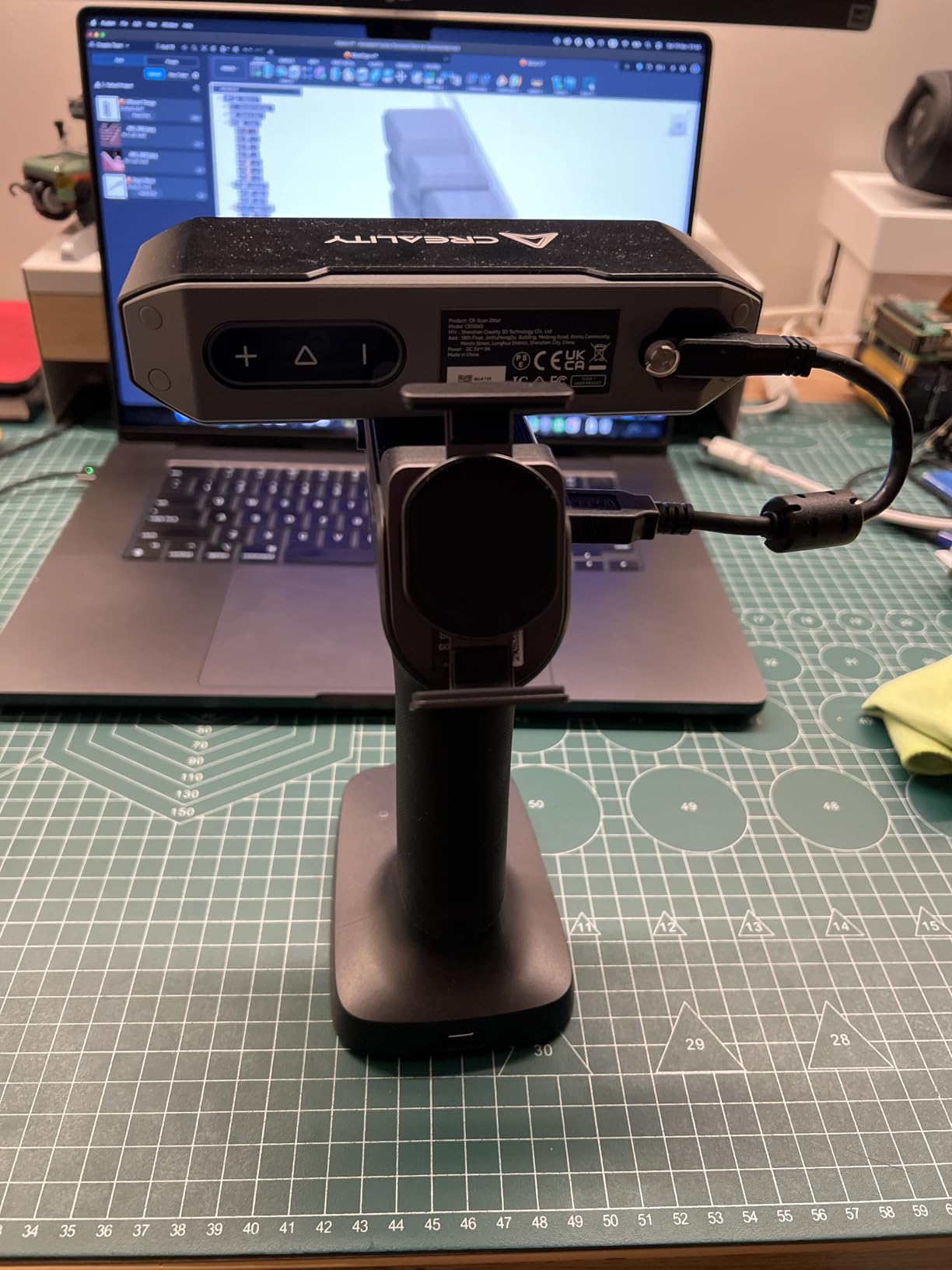
Owners scanning automotive parts praise the accuracy on small details once they get used to the technique, and the color capture holds up in a dim garage, which is exactly where most car work happens. Three touch-sensitive buttons handle scan start, pause and depth camera exposure without reaching for a keyboard.
Supported systems are Windows 10 or 11 64-bit, ideally an i7 Gen7 or better with an AMD GPU and 16 GB or more of RAM, or macOS on M1, M2 or M3 with 16 GB or more.
Why automotive hobbyists like it
The 10 mm to 2000 mm span means replacement trim, brackets, bumpers and interior pieces all come out of the same device. Being able to work outdoors below 30,000 lux means the driveway is a valid scanning site.
Three control buttons give you direct exposure control on the depth camera, which is how you rescue a scan of a curved glossy panel where the software would otherwise guess wrong.
The honest weaknesses
Feature and texture tracking is less reliable here than marker tracking, and applying plus removing markers eats a large share of your scan time on a big object. Owners also report difficulty on black objects and especially reflective black surfaces, and tracking loss partway through larger scans.
Scanning faces or hair can drop tracking. Wireless use on iOS and Android requires the separately sold Otter Scan Bridge, which runs at reduced frame rates and is reported to hang sometimes.
5. 3DMakerpro Mole – Best for Dark and Shiny Parts
3DMakerpro Mole Handheld 3D Scanner for 3D Printer, 0.05mm Accuracy & 0.1mm Resolution, 10FPS Scanning Lightning-Fast Speed with Anti-Shake Lenses, Portable 3D Scanners for Win10/MacOS
0.05mm accuracy
Infrared NIR source
Marker-free
13.7 oz
Pros
- Near-infrared illumination captures dark and black objects cleanly
- Marker-free capture saves setup time on large parts
- Optical anti-shake modules stabilize handheld scanning
- Compact 13.7 oz body suits portable field work
- JMStudio bundles alignment denoising and repair
Cons
- 0.05mm accuracy sits below the sub-0.03mm class
- Smaller installed base means fewer long-term owner reports
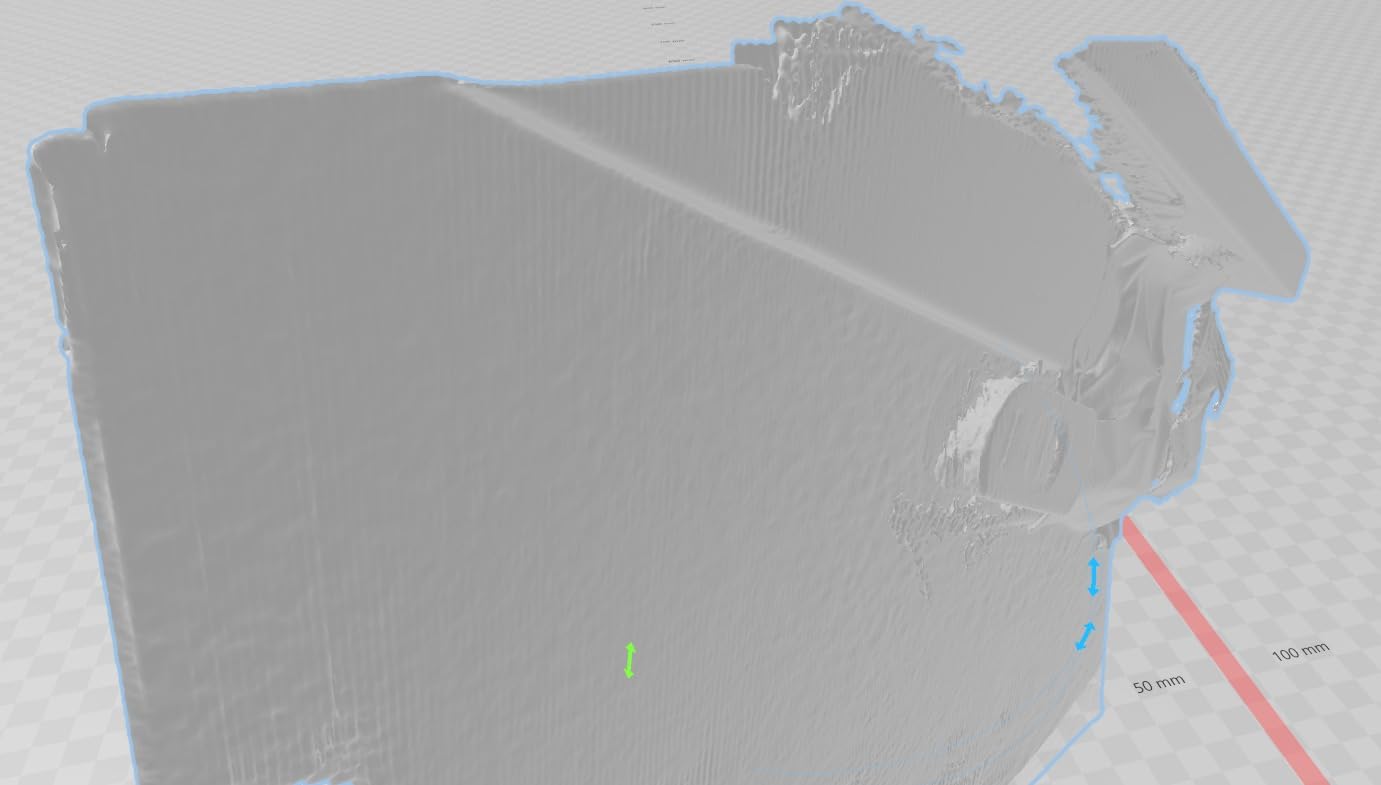
Illumination is everything when you scan black plastic, and this scanner leans hard into near-infrared. The invisible NIR light sources are eye-safe and work well under ordinary room lighting, and the NIR configuration is specifically tuned so black objects come through clearly. That is the whole reason this scanner exists as a product, and it works.
The stated spec is accuracy up to 0.05 mm with 0.1 mm resolution, running at 10 fps. Optical anti-shake modules keep the handheld capture stable, and the marker-free scanning algorithm handles large parts such as engine hoods, doors and bumpers without sticking targets to the panel first.
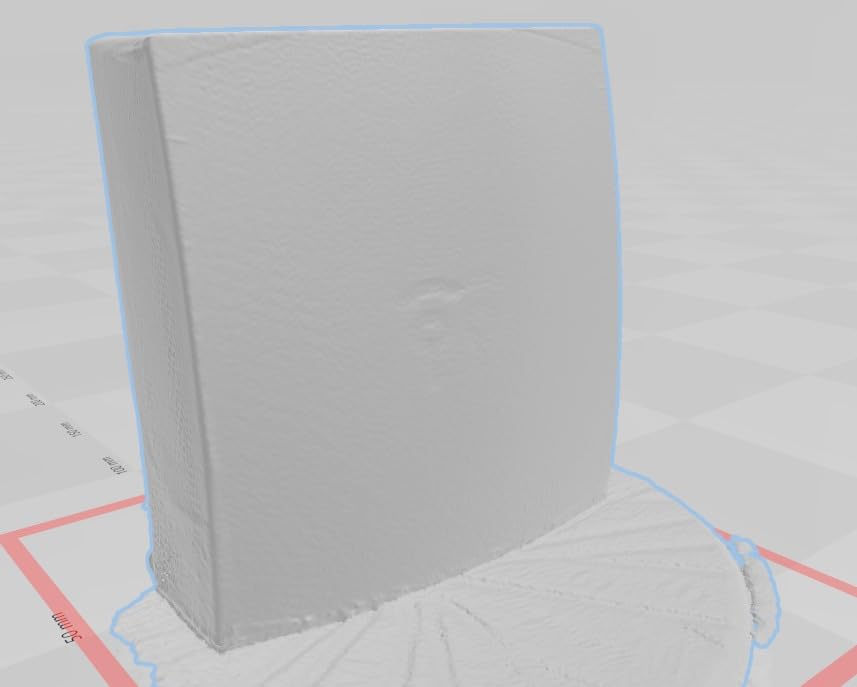
JMStudio is where this scanner quietly earns its value. Auto-alignment, denoising, simplification, repair and texture mapping all live in one application on Windows 10 or 11 and Mac, so a scan does not have to leave one tool and enter another before it reaches the slicer.
At 13.7 oz and 3.15 by 3.15 by 5.51 inches, it is the lightest full-size handheld here, which makes it the easiest to carry out to a car or into a garage.
Best-case scenarios
Black, matte, engine-bay parts are where this one shines. Tire sidewalls, dark interior trim and black plastic housings are exactly the surfaces that force a spray primer step on a white-light scanner.
Marker-free capture on large panels is a time saver. No decals to apply, no residue to clean off a finished surface, and no risk of adhesive pulling paint when you peel a marker off a restored body panel.
Where it falls short
At 0.05 mm accuracy it is a tier below the sub-0.03 mm machines in this guide. If you need a part to drop straight into an assembly without post-fit work, you would be better served by one of the blue laser models.
It is also a lower-profile listing in the category with a much smaller review base than the Revopoint models, so there is less long-term owner evidence to draw on. Fewer experiences means fewer discovered edge cases.
6. Creality Pika – Best Portable Scanner You Can Carry
Creality Pika 3D Scanner, Portable 0.03mm Accuracy Wireless 3D Scanner, 7 Parallel Blue Laser+NIR Sources, Fast Scan Speed, Scans 5mm-2000mm Objects, AI Hole-Filling & Body Completion, 8-core CPU
260 g body
Blue laser plus NIR
Wi-Fi 6
Dual 3350mAh batteries
Pros
- Seven parallel blue laser lines reach 0.03mm accuracy for fine detail
- Infrared structured light gives roughly one-minute full-body scans
- 260 g body with built-in Wi-Fi 6 means no laptop at the scan site
- Two hot-swappable batteries remove range anxiety
- AI retexturing and hole-filling reduce manual model repair
Cons
- Very new model with a small review base
- Some buyers under this listing received scan marker accessories
- Long-term reliability not yet established
This is the smallest and most genuinely wireless scanner in the guide. At 260 g and 100 by 60 by 42.5 mm, with built-in Wi-Fi 6, you scan a project and the file is on your phone or tablet without a laptop anywhere in the room. Two hot-swappable 3,350 mAh batteries mean you can swap rather than wait.
It pairs two light sources on purpose. Seven parallel blue laser lines run at 0.03 mm accuracy for precision parts and fine edges, while infrared structured light handles roughly one-minute full-body captures. The scan range spans 5 mm to 2000 mm, and outdoor scanning reaches 80,000 lux with the professional NIR filter.
The AI features target the actual pain of hobbyist scanning. AI retexturing, AI body completion and AI hole-filling handle exactly the three defects that make a mesh unprintable: flat untextured areas, missing limbs or undersides, and pinholes in the mesh. One-click export to STL, OBJ, PLY and ASC feeds mainstream printers directly.
Reviews rate it 4.8 out of 5, but read the sample size before you lean on that number. Nine reviews is a thin foundation, and part of the visible feedback under this listing concerns scan marker accessories rather than the scanner itself.
Where portability changes the outcome
No laptop requirement is a bigger deal than it sounds. A workshop, a garage or a model showbench rarely has a spare machine with an RTX-class GPU and 16 GB of RAM, and this scanner sidesteps the problem instead of asking you to solve it.
Outdoor capability at 80,000 lux with the NIR filter means scanning a garden ornament, a rock for a diorama or a vehicle panel on the driveway is a realistic job rather than a compromise.
Reasons for caution
This is a newly launched model with a very small review base, so long-term reliability is not yet established. Treat early ratings as promising rather than proven.
Verify exactly which variant you receive. Some buyers ordering under this listing reported receiving scan marker accessories, which is a sign that packaging changed after launch. Also note that the scanner is quite new, so accessory availability can be thin.
7. 3DMakerpro Moose Lite Premium – Best Value Starter Kit
3DMakerpro Handheld 3D Scanner for 3D Printing, 0.05mm Precision, 10FPS Scanning Speed, Compatible with Android/iOS/Win/MacOS, Moose Lite Premium
0.05mm precision at 10fps
Bundled tripod and turntable
Marker-free
Multi-platform
Pros
- Complete starter kit bundles the tripod and turntable most buyers add separately
- Sharp detailed scans well below premium laser scanner pricing
- AI visual tracking with automated model repair
- Re-scanning function resumes an interrupted scan
- Lifetime free software updates
Cons
- Camera-based rather than laser or lidar
- Fine surface detail limited compared with laser models
- Only four reviews so far
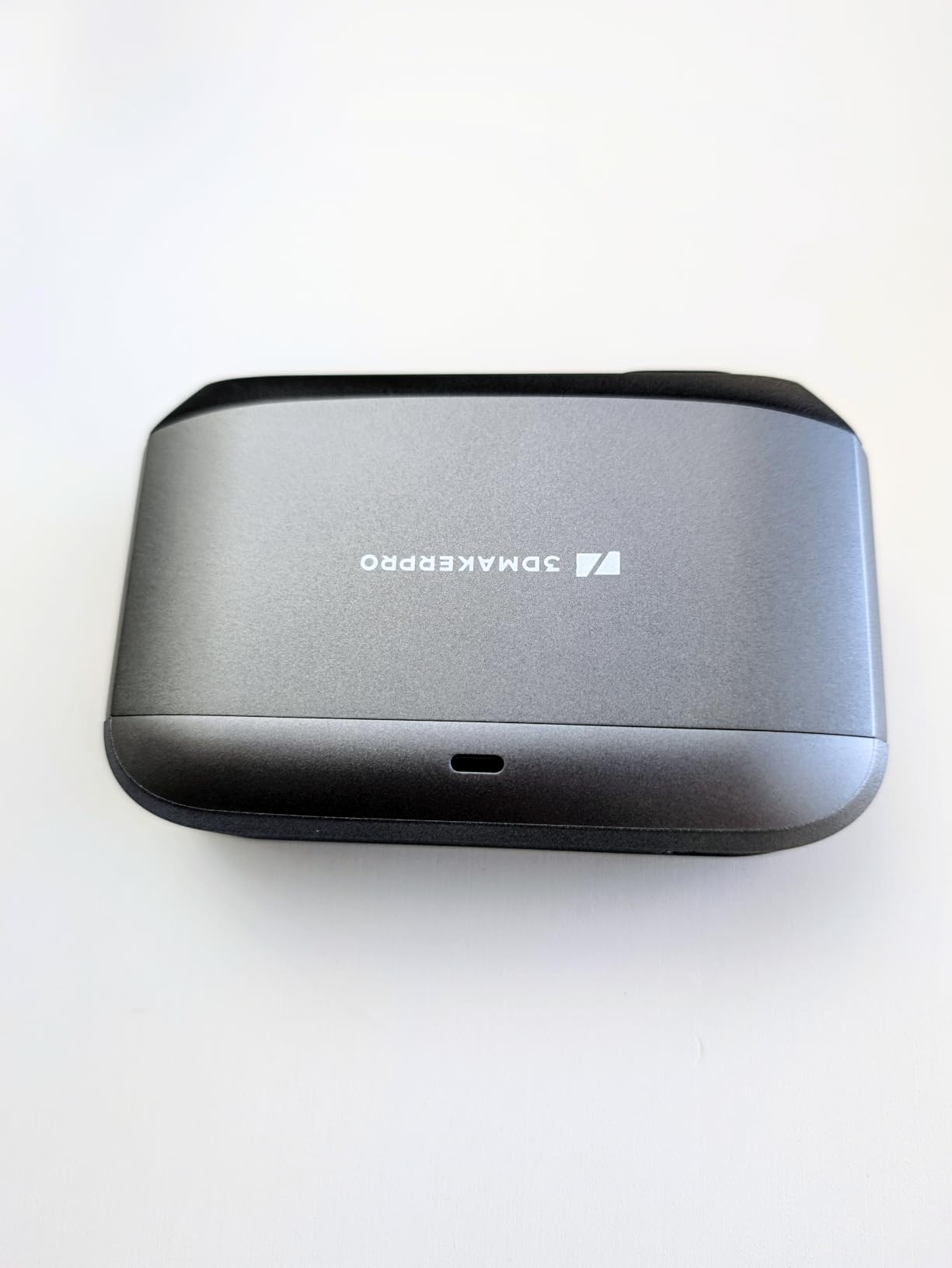
What stands out here is what arrives in the box. The Moose Lite Premium bundles a tripod and a turntable, which are exactly the two accessories most first-time buyers end up ordering a week after the scanner. If you have ever tried to scan a small object while holding the scanner in one hand and a phone light in the other, you know how much that steadiness matters.
The core spec is 0.05 mm precision at 10 fps, with AI visual tracking and automated 3D model repair, optical anti-shake modules, and a re-scanning function that continues after an interruption. Operation is marker-free. JMStudio handles the workflow, with lifetime free OTA upgrades.
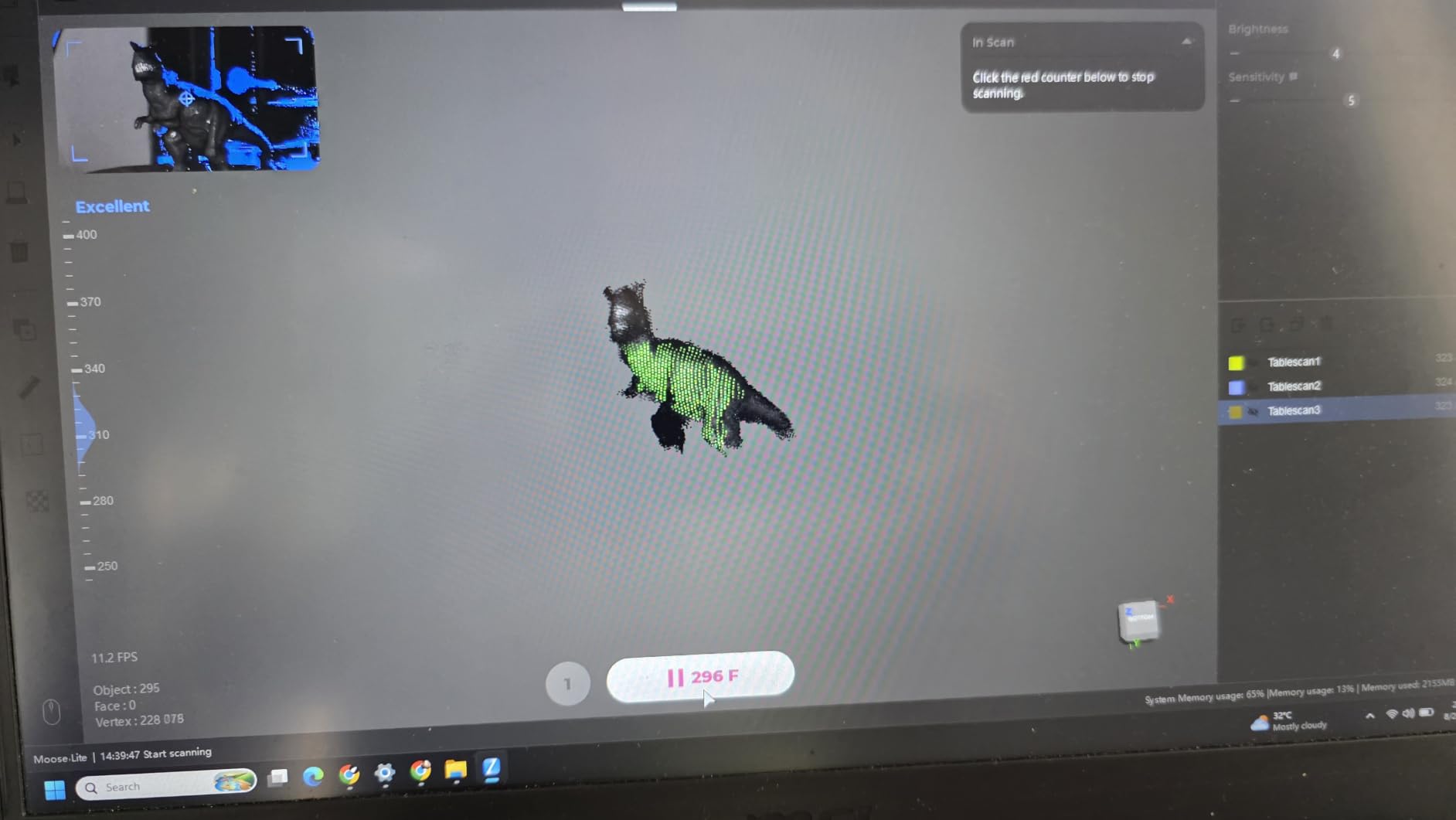
Compatibility is unusually broad: Android, iOS, Windows and MacOS. For a hobbyist who scans on a tablet in the workshop rather than a desktop tower, that flexibility is worth real money.
Why this is the value pick
The included tripod and turntable remove the two most common first-session frustrations. A turntable lets you get all sides of a small object with a consistent pass, and a tripod takes camera shake out of a tabletop capture entirely.
All four published reviews are five-star, describing sharp output that is good enough for printing or CAD work, with clean point cloud alignment on standard objects. That is exactly the experience you want on a first scanner.
What you give up at this price
It is camera-based rather than laser or lidar technology, so fine surface detail is limited compared with the blue laser models. If you need to resolve a scratch 0.05 mm wide, this is not the tool.
There is the usual learning curve in software, positioning, lighting and scan cleanup, and with only four reviews there is very little long-term owner feedback to draw reassurance from. That said, buyers report the same learning curve on scanners costing several times as much.
8. Creality Otter Lite – Best for Fast Real-Time Scanning
Creality Otter Lite Wireless 3D Scanner, Handheld High Precision 0.05mm 3D Scanner for 3D Printing, 30fps Real-Time Scanning, Compatibility (20mm³ to 2000mm³), Wi-Fi & Mobile Control
0.05mm accuracy
30 fps real-time capture
Built-in Wi-Fi
20mm to 2000mm
Pros
- 0.05mm accuracy across a 20mm to 2000mm object range
- 30 fps real-time scanning with a dedicated depth-computing chip
- Built-in Wi-Fi plus Lite Bridge battery handle for cable-free work
- Dual LED fill lights and DOE structured light handle low light
- Multi-angle stitching for complete 360-degree scans
Cons
- Only twelve reviews so the track record is thin
- A bridge accessory is needed for some wireless setups
Frame rate is this scanner’s argument, and it is a good one. Thirty real-time frames per second, handled by a dedicated depth-computing chip with single-frame 3D imaging, means the live preview updates fast enough that you can move around an object naturally instead of creeping. For tabletop gaming pieces, diorama elements and terrain tiles, that speed is the difference between a pleasant session and a chore.
Accuracy is 0.05 mm using infrared structured light, with an object range from 20 mm to 2000 mm. That covers a small figurine and a large prop with the same device.
Wireless is built in rather than bolted on. Built-in Wi-Fi with a Lite Bridge battery handle removes cable restrictions, and the Creality Scan app turns your smartphone into a real-time display and controller. DOE structured light with dual LED fill lights means low light is not a problem, and the unit stays functional to 30,000 lux.
When 30 fps genuinely helps
Fast scanning reduces the chance of a dropout mid-pass, and every dropout is work you repeat. It also makes full-color texture capture with multi-angle 360-degree stitching practical within a normal session.
Exports are OBJ, STL and PLY, and the package includes calibration tools and a portable case. If you already print on one of the mainstream slicers, that covers your handoff directly.
Limitations to keep in mind
Only twelve reviews exist, so the long-term track record is still thin even though current sentiment is strongly positive at 4.7 out of 5.
A bridge accessory is needed for some wireless setups. Also note that Creality’s software quality is the most common complaint in scanning communities about the brand overall, so test the software with an object you care about before committing to a long project. You can read our bench vise guide for the kind of stable holding setup that reduces how often you need to restart a pass.
9. 3DMakerpro Seal Lite – Budget Pick for Miniatures
3DMakerpro 3D Scanner Seal Lite, Small-Format 3D Scanners for Printing, Blue Led Light Source, Up to 0.02mm Accuracy, Mono Texture Scanning (Premium Version)
0.02mm accuracy
10mm to 300mm range
Blue LED source
Mono texture
Pros
- Blue LED source reaches 0.02mm accuracy and picks up tiny dents
- Built for small parts
- reverse engineering and fine-detail work
- Tripod and turntable included in the kit
- JMStudio includes alignment
- correction and export tools
Cons
- Mono texture only so no color scans
- Small 10mm to 300mm working range
- Indoor use recommended
- Needs a relatively powerful PC
This is the smallest, sharpest tool in the guide and it is deliberately narrow. A blue LED source at 400 to 500 nm wavelength delivers accuracy up to 0.02 mm, which is finer than several scanners costing considerably more, and the fine structured light picks up tiny dents and edge texture that coarser systems smooth away.
The trade-off is range. This scanner covers objects from 10 mm to 300 mm, with a recommended working distance of 180 to 280 mm. If your hobby is miniatures, model kits on the sprue, watch parts, tabletop tokens or small mechanical components, that range is exactly right. If you want to scan a chair, this is the wrong tool.
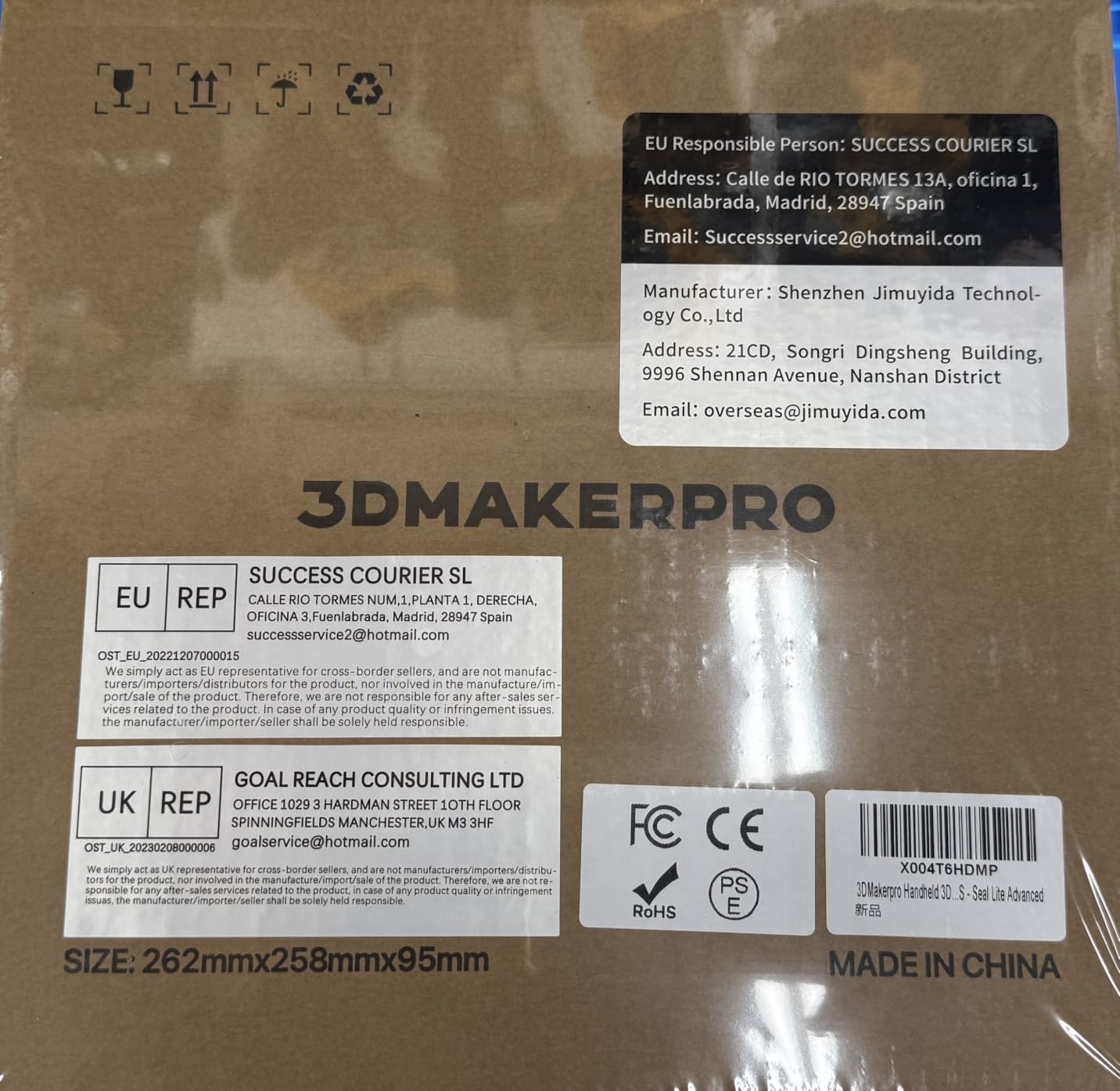
Scan-back and anti-shake features run at 10 fps. The kit includes a tripod, a turntable, a 65W charger, a data cable and a one-year warranty, which is a complete setup out of the box.
The sweet spot for this scanner
Small mechanical and automotive parts is where owner reviews report the strongest results. If you need a replacement bracket or a missing gear modeled from a worn original, the 0.02 mm figure is genuinely useful.
The bundled turntable and tripod matter here because small objects are the hardest to keep in frame. Both stabilise a session that would otherwise be a series of failed attempts.
What you trade away
Mono texture capture only, so there are no color scans. If the paint finish is part of why you scanned a miniature, that rules this scanner out.
Indoor use is recommended, and dark, shiny or transparent surfaces may need scanning spray or markers to register properly. It also needs a relatively powerful PC and has a real learning curve. Only six reviews exist on the listing, one of which is a single-star, so temper expectations accordingly.
10. Creality CR-Scan Raptor – Best for Reverse Engineering
Creality CR-Scan Raptor 3D Scanner, 60fps Blue Laser & NIR, 0.02mm Accuracy, 24-Bit Color, Scans 5-2000mm Objects, Anti-Shake Tracking for Windows macOS
0.02mm accuracy
7 blue laser lines
60 fps blue mode
5mm to 2000mm
Pros
- Seven parallel blue laser lines as thin as 0.1mm capture edges and fine features
- Marker tracking re-acquires quickly after a loss of lock
- Blue laser plus infrared modes let you match the light to the surface
- 24-bit color capture across a 5mm to 2000mm range
- Works on Windows and macOS
Cons
- Only four reviews and all quite recent
- Needs a high-performance PC with an Nvidia GPU
- Class 1 blue light means avoiding direct eye exposure
Reverse engineering is a measuring job, and this scanner is built like one. Seven parallel blue laser lines, each as thin as 0.1 mm, resolve edges and fillets accurately, and the stated accuracy reaches 0.02 mm. For measuring a worn bracket so the replacement actually fits, that line density is the whole point.
Blue laser mode runs up to 60 fps and infrared mode up to 20 fps. The 2-in-1 blue light and NIR arrangement gives marker-based and marker-free modes, and object range runs from 5 mm to 2000 mm across every axis. Narrow wavelength filtering on the industrial Class 1 blue light keeps ambient room light from polluting the capture.
The detail reviewers consistently praise is tracking recovery. Marker tracking re-acquires quickly after a lock loss, which several owners single out as better than other brands they have tried. Switching between blue laser and infrared lets you match the mode to the surface and the lighting conditions.
Why it fits measurement work
A 0.1 mm laser line is thin enough to define a sharp corner rather than rounding it off. That matters when the dimension you care about is a mating face or a slot width.
24-bit color capture across the full 5 mm to 2000 mm range means one archive file documents both a small component and a large assembly, with paint and markings intact for reference.
Before you buy
Only four reviews exist and all are recent, so reliability is not well established either way. Check whether a longer track record has developed since launch.
System requirements are real: an i7 Gen7 or better with an Nvidia 6 GB GPU and 16 GB RAM on Windows, or an Apple M, M2 or M3 Mac with 16 GB of RAM on macOS 11.7.7 or later. And because it uses industrial Class 1 blue light, avoid direct eye exposure during scanning.
How to Choose: Accuracy vs Precision vs Resolution vs Point Distance
These four terms get used interchangeably in listings, and they are not interchangeable at all. Misreading them is the most expensive mistake a hobbyist can make, because it leads to buying a scanner that cannot resolve the feature you actually need.
Accuracy is how close a measured point is to its true position. This is the number you want when you need a part to physically fit: a replacement hinge, a gear, a bracket. Volumetric accuracy measures the error across an entire working volume rather than a single centered frame, and it is usually the more honest figure.
Precision is how repeatable the scanner is. A scanner can be precise but not accurate, which means it returns the same wrong answer every time. For replication work where you scan an object and print a copy, precision matters as much as accuracy.
Resolution describes how fine the detail is that the sensor can separate, usually expressed as the smallest gap between two distinguishable features. A low resolution figure on a scanner simply means it will blur fine surface texture even if its position accuracy is excellent.
Point distance, sometimes called point spacing, is the gap between the individual points in the resulting point cloud. This is the one that surprises beginners. It is entirely separate from accuracy: a scanner can place points within 0.02 mm of the truth and still leave 0.5 mm gaps between them, producing a mesh full of holes on a curved surface.
The practical rule is that accuracy decides fit, point distance decides surface smoothness, and resolution decides whether your fine detail survives at all. Every one of the scanners in this guide publishes at least some of these, and the manufacturers that publish all of them, such as Revopoint with its volumetric formula, give you the most usable picture.
Scanning Technology Explained: Structured Light, Blue Laser, Infrared and Phone Photogrammetry
All these scanners are optical, but they differ in what they project onto the object and how they measure the result. Understanding the difference tells you which surface problems you will hit.
Infrared structured light floods the object with infrared LEDs and measures how the pattern deforms across the surface. It is eye-safe, works in ordinary room lighting, and generally struggles on black or reflective surfaces because dark surfaces absorb the very light being measured. The Creality Otter Lite and the 3DMakerpro Mole both sit here, and the Mole’s near-infrared configuration is specifically tuned to rescue dark objects.
Blue laser line scanning projects thin laser lines across the object and triangulates their position. Blue lasers are finer and handle flat, shiny and dark surfaces far better, which is why the Revopoint MetroX Pro, the Creality Pika and the CR-Scan Raptor use them. The trade-off is ambient light sensitivity and a stricter eye-safety posture.
Full-field blue structured light projects a dense pattern of lines across the entire field at once rather than sweeping. It is faster and marker-free, and it is the mode behind the MetroX Pro’s 7 million points per second figure.
Photogrammetry takes a different route entirely, capturing many overlapping photographs and solving the geometry from camera positions. It can be very accurate, but it needs fixed scale bars or coded targets, careful lighting and a long enough sequence of images. Some apps put a fixed cap on how many photos a single project accepts, which breaks real workflows on large objects.
Your phone can do a form of photogrammetry, and phones with LiDAR can add depth data, which helps with initial alignment. This is a genuinely useful zero-cost path for large, rough, textured objects like rocks, garden ornaments or terrain. Our rock tumbler guide readers often find this useful for capturing natural stones for printed dioramas.
It is not a replacement for a scanner on a shiny mechanical part. Photogrammetry depends on surface texture to find matching points, and a clean injection-moulded plastic part gives it almost nothing to work with. Use the phone for the rough and large, and a laser scanner for the precise and small.
Match the Scanner to the Object You Actually Want to Scan
This is the decision most guides skip, and it is the one that matters. Pick by object, not by price tier.
Miniatures, model kits and tabletop pieces. Go small-format and precise. The 3DMakerpro Seal Lite at up to 0.02 mm accuracy across a 10 mm to 300 mm range is built for exactly this, and the bundled turntable helps enormously with 30 mm figures. If you also want color, the Revopoint MIRACO Plus with its 48MP RGB camera is the alternative.
Car parts and body kit panels. You need range and dark surface handling. The Creality CR-Scan Otter covers 10 mm to 2000 mm with dual focal lenses and handles black and metal without spray, while the 3DMakerpro Mole’s marker-free NIR capture means no decals on a finished panel.
Reverse engineering replacement parts. Accuracy is everything. The Revopoint POP 4 at 0.03 mm and the Creality CR-Scan Raptor at 0.02 mm with 0.1 mm laser lines are the two strongest fits. Add the MIRACO Plus if you want the scan-to-CAD path to run on-device.
Cosplay props and large objects. Point distance and surface continuity matter more than micron accuracy. The Revopoint POP 4 scans up to a 2 meter cube, the MetroX Pro adds an auto turntable for large objects, and the Creality Pika’s roughly one-minute infrared full-body captures suit human-scale subjects.
Faces, busts and full bodies. Look for infrared face scanning and enough frame rate. The MIRACO Plus uses a class 1 infrared laser for direct face scans, and the Pika’s infrared structured light targets full-body capture. Expect difficulty with hair, and expect to accept it or mask it later.
Terrain, dioramas and natural objects. Frame rate and a bundled turntable win here. The Creality Otter Lite at 30 fps makes fast tabletop passes practical, and the Moose Lite Premium includes both a tripod and a turntable out of the box.
Software, Export Formats and What a Scan Costs You in Add-Ons
The hardware is the part you can compare on spec sheets. Software is where most hobbyist frustration actually lives, so it deserves real attention before you buy.
Every scanner here bundles its own application: Revo Scan 6 and Revo Metro on the Revopoint machines, JMStudio on the 3DMakerpro units, and Creality Scan on the Creality models. All of them do the core jobs of alignment, denoising, hole repair, decimation and export. The differences show up in auto-alignment quality on overlapping passes, which is precisely the pain point scanning forum users complain about most.
Export formats matter more than most buyers expect. STL is the universal handoff for printing but carries no color and no units. OBJ carries texture and scale. PLY holds point clouds and color. 3MF is the modern standard that stores units and multiple objects in one file. FBX and GLTF matter if your hobby extends into game assets or augmented reality.
For a pure scan-to-print hobby, OBJ and 3MF are the two you care about most. The MIRACO Plus exports PLY, OBJ, STL, ASC, 3MF, GLTF and FBX, the broadest set here. If your printer handles 3MF directly, keeping the scan in that format avoids a conversion step that can quietly rescale your model.
Total cost of ownership is where the sticker price misleads. Count the paid add-on software: Revo Design and Revo Measure are separate purchases on the Revopoint models, and Revo Design is also sold separately with the MIRACO Plus. Then count the accessories: scanning spray or spray primer for problematic surfaces, matte markers for contrast, a proper tripod, and a turntable if your scanner does not include one. The Seal Lite and the Moose Lite Premium both bundle a tripod and a turntable, which quietly lowers their real entry cost.
Finally, check the warranty. Revopoint lists two years on the POP 4, while Creality lists one year on the Otter models and 3DMakerpro includes a one-year warranty with the Seal Lite. On a device that will live on a shelf for months between hobby sessions, that difference matters.
Common Beginner Mistakes and How to Avoid Them
Almost every failed first scan comes down to one of a handful of fixable problems.
Scanning black, shiny or transparent surfaces raw. Black surfaces absorb light, mirror surfaces reflect it away and transparent surfaces simply do not return a usable pattern. The fix is either a scanner with infrared or blue laser modes tuned for those surfaces, which most of the picks here offer, or a thin coat of scanning spray or spray primer to give the sensor something to see. If you use primer on a finished surface, test on an inconspicuous area first.
Moving too fast. A scanner that tracks at 20 to 30 fps still needs a steady hand. Move at a walking pace, keep the scanner at a consistent distance, and overlap your passes generously. Optical anti-shake modules, present on the Mole and the Moose Lite Premium, help but do not replace technique.
Ignoring lighting. Bright directional light creates its own shadows that read as surface detail. Diffuse, even lighting beats a single bright lamp. For infrared scanners this matters less, which is why they tolerate ordinary rooms so well.
Relying on feature tracking on flat panels. Flat surfaces lack the corners and edges that tracking algorithms use to match one pass to the next. This is the single most common cause of failed large-part scans. Drop markers on flat panels, or choose a scanner with reliable marker tracking.
Skipping the cleanup step. Nearly every raw scan needs hole filling, decimation and a check for non-manifold geometry before slicing. The AI hole-filling and body completion tools on the Pika handle much of this automatically, and the JMStudio one-click repair does the same, but you should still inspect the mesh before committing filament and hours.
Expecting hair and fine fabric to work. Consumer scanners struggle with hair, fuzz and thin fabric. Budget time for manual cleanup, or mask those regions and model a simplified replacement.
Frequently Asked Questions
Are 3D scanners worth it for 3D printing?
For most hobbyists, yes, once you have a specific replication job. Scanning pays for itself quickly when you need a replacement part for something that is discontinued, want to copy a miniature you already own, or need a cosplay prop matched to your body. It is less compelling if you mostly design and print from scratch, because modeling directly in a CAD package gives cleaner geometry than any scan. The first scan also has a learning curve that will produce one bad model before it produces a good one.
Can I use my phone as a LiDAR scanner?
For rough, large, textured objects, yes. Phone photogrammetry apps solve geometry from many overlapping photos, and LiDAR adds depth data that helps with initial alignment, which is useful for scanning rocks, garden ornaments, terrain and other organic shapes. It works poorly on clean plastic, shiny metal or anything with little surface texture, because the algorithm needs texture to match points. For precise mechanical work, a dedicated handheld scanner remains the better tool by a wide margin.
Which 3D scanner is the best value for hobbyists?
The Revopoint POP 4 is our overall pick because it combines 0.03 mm single-frame accuracy, five scanning modes, a 10 mm to 2 m scan volume and a battery grip for cordless work in a single device. At the lower end, the 3DMakerpro Moose Lite Premium bundles a tripod and turntable, which most buyers would add separately, and the 3DMakerpro Seal Lite delivers 0.02 mm accuracy for small parts at a lower tier.
What is the best budget 3D scanner?
The 3DMakerpro Seal Lite is the strongest budget option, reaching up to 0.02 mm accuracy from a blue LED source across a 10 mm to 300 mm range, with a tripod and turntable included in the kit. Its limits are clear: mono texture only, a small working volume, indoor use recommended and a need for a relatively powerful PC. If you need color or larger objects, spend up on the Moose Lite Premium instead.
What are the common problems with 3D scanners?
The most common issues are tracking loss on flat or featureless surfaces, holes and noise in the mesh that need manual repair, and difficulty with black, shiny or transparent materials. Undersized hardware causes tracking failures on larger objects, and the PC matters: scanners that demand an Nvidia GPU class machine will fail or drop frames on a lightweight laptop. Many of these problems are reduced by choosing a scanner with blue laser or infrared modes and by slowing your scanning pace.
What are the disadvantages of using a 3D scanner?
Scans are almost never print-ready. They arrive as dense meshes with noise, holes and rough surfaces, so time goes into cleanup, hole filling, decimation and often manual retopology before slicing. Scanned parts usually need reorientation for a better print, and accuracy figures are not comparable across brands, so research can be frustrating. Hair and fabric defeat most consumer units, and paid software add-ons can add real cost beyond the scanner itself.
What are some tips and tricks for 3D scanning success?
Use diffuse, even lighting rather than a single bright lamp, and move the scanner slowly with generous overlap between passes. Spray or mark matte, high-contrast patches onto black or shiny surfaces, or pick a scanner with infrared or blue laser modes that handle them directly. Use markers on flat panels, since flat surfaces give tracking algorithms nothing to match. Rotate objects on a turntable for consistency, and always inspect and repair the mesh before sending it to your slicer.
Which software is used for 3D scanning technology?
Each brand bundles its own application: Revopoint uses Revo Scan 6 and Revo Metro with optional Revo Design and Revo Measure add-ons, 3DMakerpro uses JMStudio, and Creality uses Creality Scan. General-purpose tools such as MeshLab handle inspection, cleanup and decimation once a file leaves the bundled software. Scan-to-CAD conversion is usually a paid extra module, and aligning overlapping passes into a solid model remains the most manual part of the workflow.
Which 3D Scanner Should You Buy?
The Revopoint POP 4 is the best 3D scanner for hobbyists in 2026 for a simple reason: it covers the widest range of jobs without asking you to change hardware. Five lighting modes, a scan volume from a 10 mm cube to a 2 meter cube, published volumetric accuracy and roughly four hours of cordless work add up to a device that handles miniatures, car panels, cosplay props and terrain without a second purchase.
Choose differently only for a specific reason. If miniatures on the sprue are your hobby, the 3DMakerpro Seal Lite is sharper and simpler. If you want to walk around a vehicle, the Creality CR-Scan Otter handles the size range and dark surfaces. If black plastic is a constant problem, the 3DMakerpro Mole’s near-infrared configuration solves it. If you need color and no laptop, the Revopoint MIRACO Plus is the only truly self-contained option. If the object lives in a CAD workflow, the Creality CR-Scan Raptor’s thin laser lines are built for measurement.
Before any of those, check your computer. Most of these scanners want an i7 or Ryzen 7 class processor with 16 GB of RAM and a discrete GPU. A scanner is a tool that feeds a 3D printer, and the printer you already own sets the file format you need to land. Buy the scanner that matches your objects and your machine, then learn the cleanup step properly. That is where the real time goes, and it is where the difference between a frustrating hobby and a productive one comes from.