
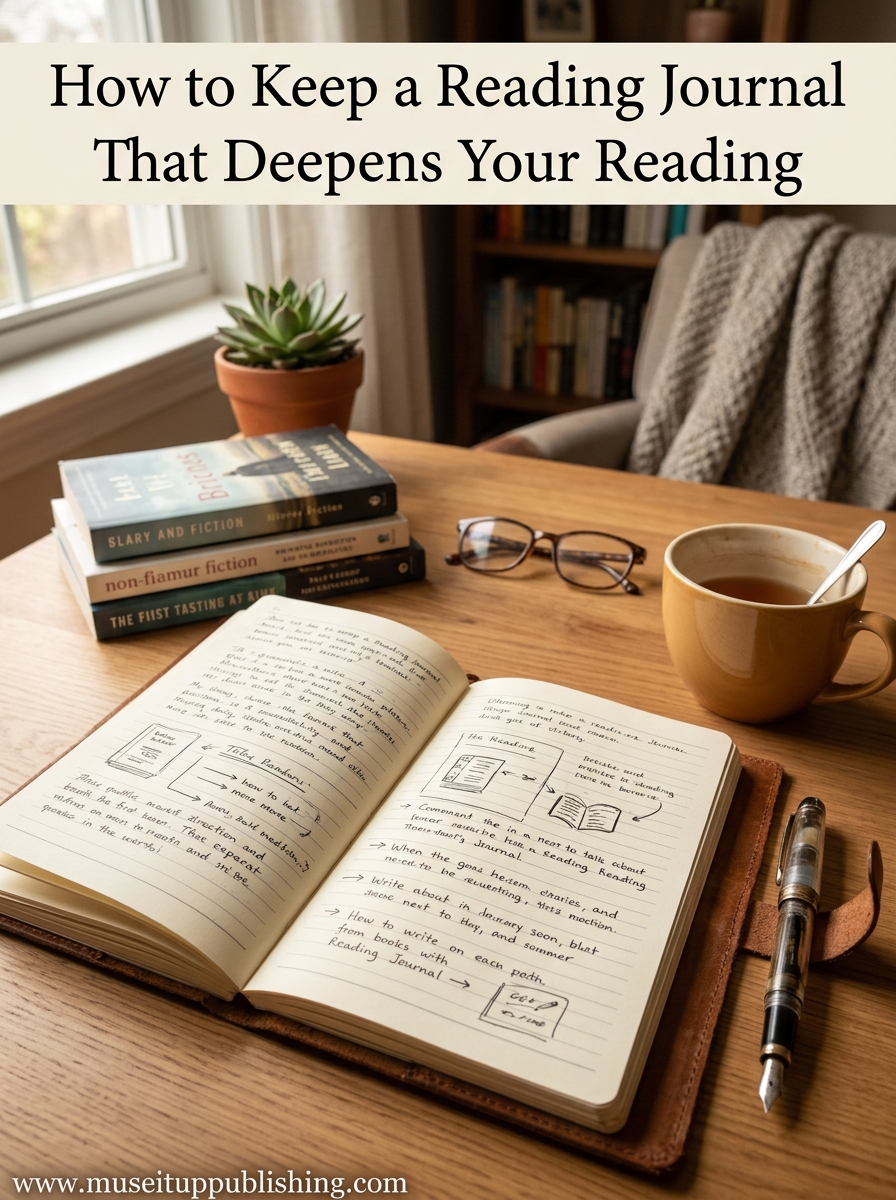
Think about the last book you finished. Can you remember three specific quotes from it? The exact way a plot twist made you feel? The questions it raised in your mind?
If you are drawing a blank, you are not alone. Most readers finish a book, set it on a shelf, and within a few weeks the details blur together. The characters fade. The insights slip away.
Learning how to keep a reading journal that deepens your reading changes that completely. Instead of passively consuming books, you actively engage with them. You remember more. You understand more. And you build a personal library of thoughts and reflections that grows richer every year.
In this guide, I will walk you through everything you need to know to start a reading journal that actually works. No perfectionism required. No fancy supplies needed. Just practical steps, real prompts you can use today, and techniques that turn casual reading into something far more meaningful.
Whether you read three books a year or thirty, a book journal can transform your relationship with what you read.
Table of Contents
What Is a Reading Journal?
A reading journal is a personal notebook or digital document where you record your thoughts, reactions, favorite quotes, and reflections about the books you read. It goes beyond a simple reading log that just tracks titles and dates. A reading journal captures your living, breathing response to what you read.
Think of it as a conversation with the book. You write down what surprised you, what confused you, what made you angry, and what made you think differently. Some entries might be a few sentences. Others might stretch for pages when a book really grabs you.
The key distinction is active versus passive reading. Passive reading is letting your eyes move across the page while your mind drifts. Active reading is engaging with the text. Asking questions. Noticing patterns. Connecting ideas to your own life. A reading journal is the tool that makes active reading a consistent habit rather than an occasional accident.
There is no single correct format. Some readers use structured templates with categories for every entry. Others prefer freewriting where they simply dump whatever comes to mind. Both approaches work because the value comes from the act of reflecting, not from following a specific system.
Why Keeping a Reading Journal Deepens Your Reading
When I first started keeping a reading journal, I expected it to be a nice way to remember what I read. What I did not expect was how much it would change the way I read in the first place. Knowing I would write about a chapter made me read it differently. I paid closer attention. I noticed things I would have skimmed past before.
This is not just anecdotal. There is real cognitive science behind why journaling deepens comprehension.
It Forces Active Engagement
Your brain processes information differently when you know you will need to do something with it. This is called the intention to learn effect. When you read with the knowledge that you will write about it afterward, your brain tags the information as important and routes it into deeper memory storage. You are not just receiving words. You are sorting them, evaluating them, and connecting them to what you already know.
You Remember Books Long After Finishing Them
Reddit users in the r/books community consistently report this benefit. One common theme in forum discussions is that journaling helps readers recall book details months or even years later. The act of writing creates a second memory pathway. You have the memory of reading the book and the memory of writing about it.
This matters because most readers have had the frustrating experience of loving a book, then struggling to explain why when someone asks a month later. A reading journal solves this problem permanently.
You Notice Patterns in Your Reading
After a few months of journaling, patterns start to emerge. You might realize you keep gravitating toward stories about displacement and belonging. You might notice that your favorite nonfiction books all share a common theme. These patterns are nearly impossible to see without writing things down.
This kind of self-awareness makes you a more intentional reader. Instead of picking books randomly, you start choosing them with purpose.
It Sharpens Your Thinking and Writing
Writing about what you read forces you to articulate vague feelings into specific words. You start to notice the difference between saying a book was good and being able to explain exactly why it worked. This skill transfers directly to your own writing, your professional communication, and your ability to think clearly about complex ideas.
As one Medium writer put it, a reading journal acts as a personal writing mentor. By analyzing how authors construct arguments, build tension, or develop characters, you absorb techniques you can use in your own work.
It Builds a Record of Your Intellectual Growth
Looking back at reading journal entries from a year or two ago is a surprisingly powerful experience. You see how your opinions have evolved. You notice books that changed your perspective. You rediscover ideas you had forgotten you ever encountered. No app or reading tracker can replicate this feeling of watching your own mind develop over time.
How to Start a Reading Journal: Step by Step
The biggest barrier to starting a reading journal is not lack of supplies or knowledge. It is the feeling that you might do it wrong. Forum discussions on r/Journaling reveal this over and over. People worry about format, about consistency, about whether their entries are good enough.
Here is the truth. There is no wrong way to keep a reading journal. The steps below will give you a framework, but treat them as suggestions, not rules.
Step 1: Choose Your Format
Decide whether you want a physical notebook or a digital journal. Both have distinct advantages, and the right choice depends entirely on your habits and preferences.
Physical journals slow you down in a good way. Writing by hand engages different neural pathways than typing, which can lead to deeper processing. You also get the tactile pleasure of a nice notebook and pen. On the downside, physical journals are not searchable, and you cannot easily back them up.
Digital journals offer searchability, backups, and the ability to organize entries with tags and folders. Apps like Notion, Evernote, or even a simple Google Doc work well. The tradeoff is that typing can feel less personal and more transactional than writing by hand.
My recommendation for beginners is to start with whatever feels easiest. If you already carry a notebook everywhere, use that. If you live on your laptop, go digital. You can always switch later.
Step 2: Pick a Consistent Time to Write
The readers who maintain a reading journal habit are the ones who attach it to an existing routine. Write for five minutes right after you finish a chapter. Write while drinking your morning coffee. Write before bed as a wind-down ritual.
The specific time matters less than the consistency. Pick a trigger that already exists in your day and attach journaling to it.
Step 3: Create a Simple Template
A template removes the blank-page problem that stops many beginners. You do not need anything elaborate. A basic entry template might include the book title and author, the date, a few favorite quotes, and one or two thoughts about what you read.
Keep your template minimal at first. You can always expand it later once you develop the habit.
Step 4: Write Your First Entry
Start with whatever book you are currently reading. Do not wait for a new book to begin. Write about the last chapter you finished. What stood out? What surprised you? What did you not understand?
Aim for just a few sentences. The goal is to start, not to produce a literary essay.
Step 5: Number Your Books
Give each book a number as you start it. This is a simple trick from experienced reading journal keepers that creates a sense of progression and momentum. Seeing book number 47 feels different from just seeing another title on a list.
Numbering also makes it easy to cross-reference. You might write in a later entry that a current book reminds you of book number 23.
Step 6: Decide How Much to Record
Be honest with yourself about how much detail you will actually maintain. Some readers write a paragraph per book. Others write pages. Neither is better than the other. Choose a level of detail you can sustain without journaling becoming a chore.
If you are not sure, start small. A few notes per book is infinitely better than a blank journal because you were too intimidated to write.
Step 7: Let Go of Perfection
Your reading journal is for you. It does not need perfect grammar, beautiful handwriting, or profound insights. Some entries will be short and uninspired. That is completely fine. The value comes from the consistency of the practice, not from any individual entry being a masterpiece.
As the team at Notebook Therapy puts it, do not stress about perfection. Your journal is a personal space, not a published document.
What to Include in Your Reading Journal
One of the most common questions in reading communities is simply, what do you actually write in there? The answer is whatever helps you engage more deeply with the book. But if you want concrete ideas, here are the elements that experienced reading journal keepers rely on most.
Book Details
Start with the basics. Title, author, genre, and the dates you started and finished reading. This creates a clear record and lets you track your reading pace over time. Some readers also include the page count and publisher.
Favorite Quotes
Write down passages that strike you. Do not just copy them. Add a note about why each quote resonated. Did it capture something you have felt but never articulated? Did it make you see something from a new angle? The annotation is where the deep engagement happens.
Over time, your collected quotes become a personal anthology of the ideas and language that matter most to you.
Character Notes
For fiction, jot down observations about characters. How do they change? What motivates them? Which character felt most real to you and why? You do not need to analyze every character. Just capture the ones that leave an impression.
Themes and Questions
What is the book really about beneath the surface? What questions does it raise? Writing about themes helps you move beyond plot summary into genuine analysis. For nonfiction, this is where you engage with the author’s arguments and decide whether you agree.
New Vocabulary
When you encounter words you do not know, write them down. Add the definition and the sentence where you found it. This builds your vocabulary naturally over time without flashcards or memorization drills.
Personal Connections
How does the book connect to your own life? Does it remind you of an experience, a person, or another book? These personal connections are what make a reading journal uniquely yours. No one else will have the same associations.
Your Rating and Overall Impression
Give the book a rating if you want, but more importantly write a sentence or two summarizing your overall reaction. This is the entry you will return to most often when you look back through your journal.
Recommended For
Note who you would recommend this book to. A friend who loves that genre. Your book club. Someone going through a particular life experience. This creates a personal recommendation network that becomes incredibly useful over time.
Fiction vs Nonfiction: Different Approaches
Most reading journal guides treat all books the same way. But fiction and nonfiction engage your brain differently, and your journaling approach should reflect that.
For Fiction
Focus on the experience of reading. How did the book make you feel? Which scenes stayed with you? Were the characters believable? Did the ending satisfy you? Pay attention to the author’s craft choices like pacing, point of view, and dialogue.
Fiction journaling is often more emotional and intuitive. You are tracking your response to a story, not analyzing data.
For Nonfiction
Focus on the argument. What is the author’s main claim? What evidence do they provide? Do you find it convincing? How does it compare to other things you have read on the topic?
Nonfiction journaling is more analytical. You are evaluating ideas, testing them against your own knowledge, and deciding what to incorporate into your thinking.
Having both approaches in your toolkit makes your reading journal more dynamic and useful across every genre.
How to Deepen Your Reading Through Journaling
Keeping a basic reading log is straightforward. But if your goal is to genuinely deepen your reading, there are specific techniques that take your journaling practice further.
Write While You Read, Not Just After
Instead of waiting until you finish a book to write about it, pause after significant chapters or sections and jot down your immediate reactions. This captures your thinking at the moment, before hindsight rewrites your impressions. You might be surprised by what you expected to happen versus what actually did.
This technique is especially valuable for mystery novels, argument-driven nonfiction, and any book where your evolving understanding is part of the experience.
Use Specific Prompts
When you do not know what to write, prompts get you unstuck. Here are several you can rotate through.
What surprised me most in this section?
What would I ask the author if I could?
How does this book connect to something I have already read?
What is one idea from this book that I want to remember a year from now?
What did I disagree with or push back against?
Having a set of go-to prompts means you never face a blank page without a way in.
Try the 3-2-1 Reflection Method
After finishing a book, write down three things you learned, two quotes that stood out, and one question the book raised for you. This structured approach forces you to distill your reading into its most important takeaways. It works equally well for fiction and nonfiction.
Review Your Past Entries Regularly
This is the step most reading journal guides skip, and it is also where the deepest growth happens. Set aside time every few months to read back through your journal entries. You will start to see connections between books that you did not notice while reading them individually.
You might realize that three books you read over the past year all addressed the same theme from different angles. You might notice that your taste has shifted in ways you did not expect. You might rediscover a quote or idea that feels even more relevant now than when you first wrote it down.
This review process turns your reading journal from a collection of individual entries into a coherent intellectual narrative. It is the difference between having a box of photographs and having an album that tells the story of your reading life.
Connect Books to Each Other
As your journal grows, actively create connections between entries. When a new book reminds you of an older one, note it. Write about how they compare. This cross-pollination of ideas is where genuine intellectual growth happens. You are no longer reading isolated books. You are building an interconnected web of ideas and references.
Tips for Maintaining Your Reading Journal
Consistency is the single biggest challenge that reading journalers face. Forum discussions make this clear. People start with enthusiasm and abandon the practice within weeks. Here is how to avoid that fate.
Keep Your Journal Accessible
If your journal is buried in a drawer or buried under browser tabs, you will not use it. Keep a physical notebook next to wherever you read most often. Keep a digital journal pinned or bookmarked for one-tap access. Reduce friction to zero.
Set a Minimum, Not a Maximum
Decide on a minimum entry size that feels almost too easy. Three sentences. One quote and one thought. Whatever is so small that skipping it would feel silly. On days when you have more to say, write more. But the minimum keeps the habit alive during busy or uninspired stretches.
Do Not Try to Catch Up
If you miss a few days or even a few weeks, do not try to go back and fill in entries for books you have already finished. Just start again with whatever you are reading now. Guilt about missed entries kills more reading journals than any other factor.
Embrace Messiness
Cross things out. Write in the margins. Use abbreviations. Let some entries be just a single word or a dashed-off impression. A messy journal that you actually use is worth a hundred beautiful journals that sit untouched because they feel too precious to write in.
Make It Enjoyable
If you are using a physical journal, choose a notebook you genuinely like opening. Use a pen that feels good to write with. If digital, customize the formatting so it feels like your space. The small pleasure of the physical act of journaling is what sustains the habit long-term.
Common Mistakes to Avoid
Beyond consistency tips, a few common pitfalls trip up new reading journalers.
Do not try to summarize the entire plot. You already read the book. Your journal should capture your reaction, not retell the story.
Do not force yourself to write about books you did not enjoy. A one-sentence entry saying a book was not for you is a complete and valid journal entry.
Do not compare your journal to what you see on social media. The elaborate decorated reading journals on Pinterest and Bookstagram are beautiful, but they are not a standard you need to meet.
FAQs
What is the 3-3-3 journal method?
The 3-3-3 journal method involves writing three things you are grateful for, three things that would make today great, and three affirmations. While designed as a daily mindfulness practice, some readers adapt it for reading journals by noting three takeaways, three favorite moments, and three questions from each book.
What is the 5 finger rule for reading?
The 5 finger rule is a simple way to check if a book is at the right reading level. Open to any page and have the reader hold up a finger for each unfamiliar word. Zero or one finger means the book is too easy, four or five means it may be too difficult, and two to three fingers suggests a good match that will stretch the reader without causing frustration.
How do you keep a reading journal?
To keep a reading journal, choose a notebook or digital format, write entries for each book you read including the title, author, favorite quotes, and your personal reflections, and maintain the habit by writing consistently after reading sessions. Keep entries simple, write about your reactions rather than summarizing plot, and review past entries periodically to track your growth.
What is the 3-2-1 method of journaling?
The 3-2-1 method is a structured reflection technique adapted for reading journals. After finishing a book or chapter, write down three things you learned, two quotes or moments that stood out, and one question the book raised for you. This format forces you to distill your reading into its most important elements and works well for both fiction and nonfiction.
Start Your Reading Journal Today
Learning how to keep a reading journal that deepens your reading is not about finding the perfect notebook or the ideal template. It is about making a simple commitment. The commitment to engage with what you read instead of letting it pass through you.
Start with the book you are reading right now. Write down one quote and one thought about it. That is your first entry. Tomorrow, do it again.
The readers who get the most from a reading journal are not the ones with the most elaborate systems or the most beautiful handwriting. They are the ones who simply show up consistently and write honestly about what they read.
Your future self will thank you. A year from now, you will be able to open your journal and remember not just what you read, but who you were when you read it. That is something no reading app or star rating can ever give you.