
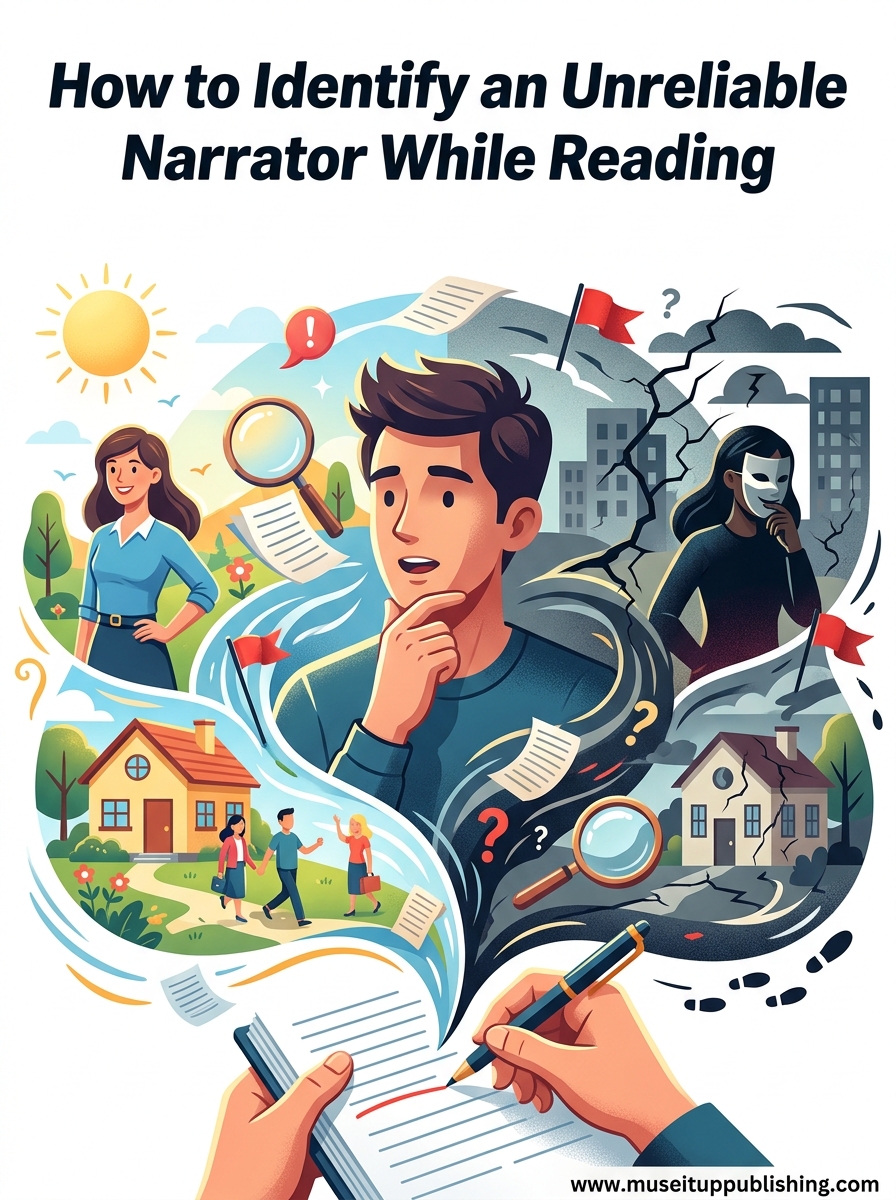
Have you ever finished a novel and realized the person telling you the story was lying the entire time? That sudden shift, that moment where everything clicks into a different shape, is one of the most thrilling experiences a book can deliver. But catching an unreliable narrator in the act while you are still reading requires a different set of skills than simply turning pages.
Learning how to identify an unreliable narrator while reading transforms the way you experience fiction. Instead of being swept along and surprised at the end, you start noticing the cracks, the pauses, and the careful omissions that hint something is off. You become an active participant in uncovering the truth rather than a passive recipient of it.
I have spent years reading psychological thrillers, literary fiction, and mysteries where narrator credibility is up for grabs. Along the way, I developed a practical system for spotting the warning signs in real time. This guide breaks down every signal, type, and strategy you need to catch a misleading narrative before the final twist lands.
Whether you are a book club member trying to stay ahead of the discussion, a literature student working on analysis, or simply a reader who loves the cat-and-mouse game between author and audience, this guide will sharpen your instincts and deepen your appreciation for one of fiction’s most powerful literary devices.
Table of Contents
What Is an Unreliable Narrator?
An unreliable narrator is a narrator in fiction whose account of the story cannot be fully trusted due to factors like bias, mental state, deliberate deception, or limited knowledge. The term was first coined by literary critic Wayne C. Booth in his 1961 book “The Rhetoric of Fiction,” and it has since become one of the most widely discussed concepts in narrative theory.
The key idea is that the narrator’s version of events diverges from what actually happened in the story world. This gap between the narrator’s account and objective reality is what creates the tension, surprise, and intellectual engagement that readers feel when the deception is revealed.
Not every narrator who makes mistakes or holds opinions is unreliable in the literary sense. A character can be biased, forgetful, or opinionated and still function as a broadly reliable narrator. True narrative unreliability involves a pattern of distortion significant enough that readers must question the entire foundation of the story being told.
Authors build reader trust first, establishing the narrator as a credible voice, before slowly introducing inconsistencies that undermine that trust. This gradual erosion is what makes the technique so effective and so difficult to detect on a first read.
How to Identify an Unreliable Narrator While Reading
Spotting an unreliable narrator while reading requires active engagement with the text. You are not just following the plot but evaluating the storyteller itself. Here are the core strategies I use to catch narrator unreliability in real time.
1. Track what other characters say. When the narrator describes events or people, pay close attention to how other characters react. If the narrator claims someone was hostile but every other character treats the narrator warmly, that disconnect is a red flag. Dialogue from secondary characters often serves as a reality check against the narrator’s interpretation.
2. Watch for contradictions across chapters. Unreliable narrators frequently contradict earlier statements, sometimes subtly. A detail mentioned in chapter three might be described differently in chapter twelve. Keeping mental notes of key facts, or even jotting them down, helps you catch these slips as they happen.
3. Notice what the narrator avoids saying. Selective disclosure is one of the most powerful tools of the unreliable narrator. When the story glides past certain time periods, skips over emotionally charged moments, or deflects questions before they are asked, the narrator may be hiding something.
4. Evaluate the narrator’s emotional state. Extreme emotions, paranoia, obsession, or detachment from reality all signal that the narrator’s perceptions may be distorted. A narrator experiencing a psychological crisis sees the world through a cracked lens, and the reader must account for that distortion.
5. Look for unreliable narration markers. Some authors leave deliberate breadcrumbs, phrases like “I must have imagined it,” “that is how I remember it,” or “maybe I was wrong.” These hedging statements are not casual throwaway lines. They are the narrator indirectly admitting that their account might not hold up under scrutiny.
The Five Types of Unreliable Narrators
Literary scholars have categorized unreliable narrators into several distinct types, each with different motivations and mechanisms for distorting the truth. Understanding these classifications helps you predict what kind of unreliability you are dealing with and adjust your reading strategy accordingly.
1. The Picaro. This narrator is a braggart and exaggerator who embellishes stories to make themselves look better. The picaro lies for entertainment or self-aggrandizement, and their unreliability is often playful rather than sinister. Think of a charming rogue who stretches the truth for a good story.
2. The Madman. The madman narrator suffers from a psychological condition that distorts their perception of reality. This could be schizophrenia, severe trauma, paranoia, or another mental health issue. Edgar Allan Poe’s narrator in “The Tell-Tale Heart” is the classic example, insisting on their sanity while describing behavior that clearly suggests otherwise.
3. The Clown. The clown narrator uses humor, irony, and playful deception to avoid revealing the truth. They may be making a point about the absurdity of a situation or simply enjoy pulling the reader’s leg. Their unreliability is performative and often self-aware.
4. The Naif. The naif is unreliable because of limited knowledge, youth, or inexperience rather than deliberate deception. A child narrator who does not fully understand adult situations is unreliable because they interpret events through an incomplete framework. The naif is not lying but simply cannot provide an accurate account due to cognitive limitations.
5. The Liar. The liar is the most straightforward type. This narrator knows the truth and deliberately conceals or distorts it. The liar may be protecting themselves, manipulating other characters, or playing a long game with the reader. Amy Dunne in Gillian Flynn’s “Gone Girl” is the quintessential liar narrator, crafting a false diary entry to mislead both the reader and the characters within the story.
Some narrators blur the lines between categories. A character might begin as a naif and gradually become a liar, or a clown whose jokes mask a deeper psychological disturbance. These hybrid types are often the most rewarding to analyze because their unreliability evolves as the story progresses.
Key Signals That Reveal Narrator Unreliability
Beyond the broad strategies above, specific textual signals can alert you to narrator unreliability. These are the literary fingerprints that authors leave when they want attentive readers to start asking questions.
Intratextual contradictions occur when the narrator’s own account conflicts with itself. A character might describe a room one way in chapter two and differently in chapter fifteen. These internal inconsistencies are the strongest signal that the narrator is either lying, confused, or unstable.
Memory gaps and temporal confusion show up as missing time, jumbled chronology, or vague descriptions of important events. When a narrator says “I do not remember what happened next” at a narratively convenient moment, that gap is rarely accidental. Authors use these blanks to hide critical information.
Extratextual signals come from outside the narrator’s direct account. The book’s title, chapter epigraphs, structural choices, and even the cover design can hint that the narrator is not telling the full story. If the book is framed as a confession, a journal, or a testimony, that framing device itself signals that you should read with suspicion.
Overly detailed justifications are another telltale sign. When a narrator provides excessive explanation for small actions or obsessively defends their decisions without being asked, they are often trying to pre-emptively counter an accusation. This defensive posture suggests they know their version is open to challenge.
Emotional flatness or inappropriateness can indicate a disconnect between the narrator and reality. If a character describes a traumatic event with clinical detachment or reacts to tragedy with suspicious calm, their emotional processing may be compromised. This does not automatically make them unreliable, but it warrants attention.
Why Do Authors Use Unreliable Narrators?
Authors choose unreliable narration for several compelling reasons, and understanding their motivations helps you appreciate the technique rather than feel manipulated by it.
First, unreliable narrators create suspense and surprise. By controlling what information reaches the reader and when, the author can build tension across hundreds of pages and deliver a twist that recontextualizes everything that came before. The shock of realization is a powerful emotional payoff that straightforward narration cannot achieve.
Second, unreliable narrators offer psychological depth. Real human beings are not omniscient narrators of their own lives. We misremember, rationalize, and filter events through our biases. A narrator who does the same feels more authentically human than one who reports everything with perfect accuracy.
Third, the technique invites reader participation. When you cannot fully trust the narrator, you must actively piece together the truth alongside or against the story being told. This transforms reading from a passive experience into a collaborative act of interpretation, which is one reason book clubs and literature classes love unreliable narrators.
Finally, unreliable narrators serve thematic purposes. They can explore topics like the unreliability of memory, the subjectivity of truth, the dangers of unchecked bias, or the ways trauma reshapes perception. The technique itself becomes a statement about how stories are constructed and why perspective matters.
Genre plays a significant role here. Psychological thrillers and crime fiction use unreliable narrators to create mystery and misdirection. Literary fiction uses them to explore consciousness and identity. Coming-of-age stories use naive narrators to show the gap between youthful understanding and adult reality. Knowing the genre helps you calibrate your expectations for narrator reliability.
Your Unreliable Narrator Detection Checklist
No competitor in the current search landscape offers a practical, use-while-reading checklist for unreliable narrator detection. So here is one you can bookmark and return to with any book. Run through these questions periodically as you read, especially at the end of each major section or chapter.
Checklist for detecting an unreliable narrator:
1. Does the narrator’s version of events match how other characters react and behave?
2. Are there details or events the narrator glosses over, rushes past, or refuses to discuss?
3. Does the narrator ever contradict something they previously stated as fact?
4. Is the narrator experiencing mental health issues, substance use, or extreme emotional distress?
5. Does the narrator use hedging language like “I think,” “as far as I know,” or “if I recall correctly”?
6. Are other characters suspicious of, angry at, or afraid of the narrator without clear justification?
7. Does the narrator have a clear motive to lie, such as protecting themselves or someone else?
8. Does the story’s structure, framing, or title suggest a subjective rather than objective account?
9. Does the narrator describe their own behavior in ways that seem inconsistent with their actions?
10. Do you feel a nagging sense that something does not add up, even if you cannot identify what?
Trust that last instinct. Experienced readers often sense narrator unreliability before they can articulate why. Your subconscious picks up on contradictions and omissions faster than your conscious mind can process them. When something feels off, slow down and pay closer attention.
I recommend keeping a small notebook or notes app handy while reading books known for unreliable narrators. Jot down key claims the narrator makes, then check them against later chapters. Patterns emerge quickly when you have a written record to reference.
Unreliable vs. Unlikable: A Critical Distinction
One of the most common points of confusion in reader discussions, especially on forums like Reddit’s r/books, is the difference between an unreliable narrator and an unlikable one. These are not the same thing, and conflating them leads to misreadings.
An unlikable narrator can be perfectly reliable. They might be cruel, selfish, or morally repugnant, but they report events accurately. Humbert Humbert in Vladimir Nabokov’s “Lolita” is despicable, and his account is clearly shaped by his monstrous desires, but his unreliability is layered on top of his moral repugnance rather than being synonymous with it. He is both unlikable and unreliable, but those qualities operate independently.
A biased narrator holds strong opinions or perspectives that color their account, but they may not be actively distorting facts. A narrator who hates a coworker will describe that person negatively, but if they accurately report what happened, they are biased rather than unreliable. The distinction matters because labeling a biased narrator as unreliable dismisses their perspective without engaging with it.
True unreliability involves a pattern of factual distortion, omission, or perception-altering conditions significant enough that the foundational truth of the story is in question. Ask yourself: if I removed the narrator’s personal feelings, would the events still make sense? If the answer is no, you are likely dealing with an unreliable narrator. If the answer is yes, you may simply have a biased or unlikable one.
Famous Unreliable Narrators (Spoiler-Free)
Studying well-known examples is one of the fastest ways to train your detection skills. Here are some of the most discussed unreliable narrators in fiction, analyzed without spoilers so you can still enjoy the reading experience.
“Gone Girl” by Gillian Flynn. This novel features dual narrators, and part of the brilliance is how the two accounts initially seem to corroborate each other before diverging. Flynn uses diary entries, shifting timelines, and deliberate misdirection to keep readers off balance. The moment of realization is among the most famous in modern thriller fiction.
“Fight Club” by Chuck Palahniuk. The narrator’s account becomes increasingly surreal and disjointed, and the story’s logic starts to fray at the edges. Palahniuk uses insomnia, dissociation, and dark humor to create a narrative voice that feels authentic even as it becomes untethered from reality. The book telegraphs its unreliability through dreamlike sequences that blur the line between waking and sleep.
“The Girl on the Train” by Paula Hawkins. The protagonist Rachel is an alcoholic with significant memory gaps, making her a textbook impaired narrator. Hawkins uses blackouts, fragmented memories, and the observations of other characters to create a web of uncertainty. The reader knows Rachel cannot remember key events, which creates suspense around what actually happened.
“The Turn of the Screw” by Henry James. This classic Gothic novella features a governess whose account of supernatural events at a country estate may reflect genuine hauntings or her own psychological breakdown. James deliberately leaves the question unresolved, making the story one of the earliest and most debated examples of narrator unreliability in English literature.
“Shutter Island” by Dennis Lehane. U.S. Marshal Teddy Daniels arrives at a hospital for the criminally insane to investigate a disappearance, but his investigation becomes increasingly disorienting. Lehane uses the island’s isolation, contradictory testimony from staff, and Teddy’s own wartime memories to destabilize the reader’s confidence in what is real.
These examples span different genres and eras, but they share common techniques: information gaps, perceptual distortion, and a gradual buildup of evidence that the narrator’s account is compromised. Reading any of them with the checklist above will sharpen your ability to spot similar patterns in other books.
FAQs
How to determine if a narrator is unreliable?
Look for contradictions in the narrator’s account, memory gaps, selective omission of key events, reactions from other characters that do not match the narrator’s version, and perceptual distortion caused by mental state or emotional bias. If these signals appear repeatedly, the narrator is likely unreliable.
What are the five types of unreliable narrators?
The five classic types are the Picaro (exaggerator and braggart), the Madman (perception altered by mental illness), the Clown (uses humor and deception playfully), the Naif (limited knowledge or inexperience), and the Liar (deliberately conceals or distorts the truth). Some narrators blend multiple types.
How do I hint at an unreliable narrator in my own writing?
Use subtle contradictions in early chapters, have other characters react differently than the narrator expects, introduce hedging language, show the narrator avoiding certain topics, and create perceptual gaps that careful readers will notice. Build trust first, then slowly erode it with accumulating inconsistencies.
What are some common unreliable narrator traits?
Common traits include defensiveness when challenged, excessive detail in unnecessary areas, vagueness about important events, emotional responses that do not match the situation, isolation from other characters who might contradict them, and a tendency to rationalize questionable behavior.
Conclusion
Learning how to identify an unreliable narrator while reading turns every book into a more interactive and rewarding experience. You stop accepting the story at face value and start engaging with it as a puzzle to be solved. The signals are always there if you know where to look: contradictions, omissions, hedging language, emotional distortion, and the reactions of characters around the narrator.
Keep the detection checklist handy, study the five narrator types so you can classify what you encounter, and remember the difference between unreliable and merely unlikable. The more you practice these skills, the faster your instincts will sharpen and the earlier you will catch the signs.
Your next step is simple. Pick up a book known for its unreliable narration, whether that is “Gone Girl,” “The Girl on the Train,” or a classic like “The Turn of the Screw.” Read actively, track the signals, and enjoy the deeper layer of engagement that comes from reading like a detective.