
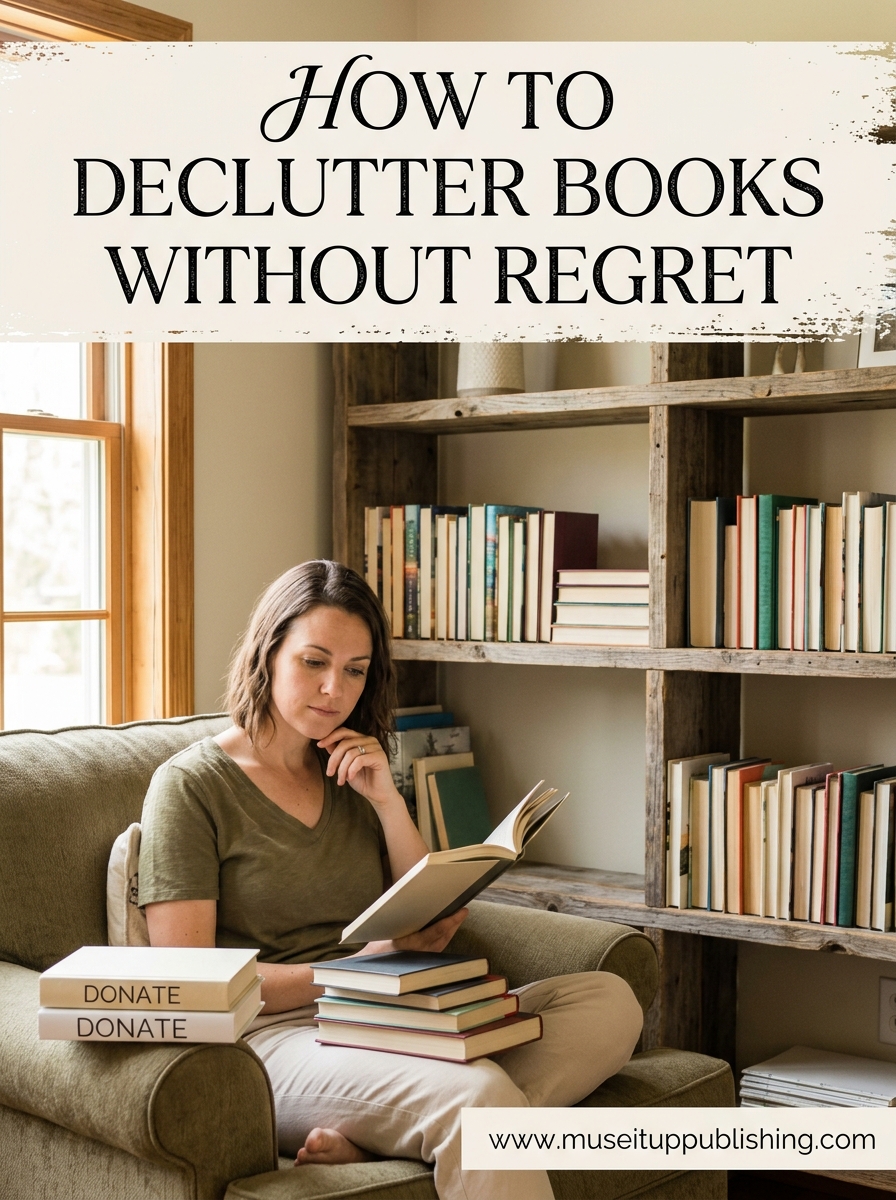
If you are staring at overflowing bookshelves and feeling a knot in your stomach every time you think about letting go, you are in exactly the right place. Learning how to declutter your books without regretting it later is not about becoming a minimalist who owns thirty books and judges everyone else. It is about building a collection that reflects who you are right now, not who you were five years ago or who you hope to become someday.
I have been there myself. My shelves were packed with novels I loved at twenty, reference books from a career I left, and an embarrassing stack of “I’ll definitely read this someday” titles that I bought on sale and never opened. The guilt was real. But what I discovered after finally decluttering was something many Reddit users on r/declutter echo: the fear of regret is almost always worse than the actual letting go.
Here is the truth that nobody tells you. According to a Good Housekeeping survey, books and media actually rank near the bottom of items people regret decluttering. Clothing, sentimental items, and unexpectedly useful things top the regret list. Books? Most people say they wish they had done it sooner.
In this guide, I will walk you through a complete, regret-free method for decluttering your book collection. We will cover the emotional blocks, a step-by-step process, decision rules like the 90-90 rule and the 50 page rule, what to do with the books you let go of, and how to keep your shelves from filling right back up.
Table of Contents
Why Decluttering Books Feels So Hard (The Emotional Truth)
Books are not like old Tupperware or broken electronics. They carry emotional weight that makes decluttering them genuinely difficult. Understanding why is the first step to doing it without regret.
Books become identity markers. When you own a shelf full of literary classics, you might feel like “the kind of person who reads Tolstoy.” Letting go of those books can feel like letting go of a piece of who you are. But here is the thing: you are still that person even without the physical book on your shelf. The reading you did shaped you. The book sitting unread for six years is just paper and ink.
Then there is aspirational guilt. That stack of self-improvement books, the language learning guides, the cookbook you bought after watching a cooking show. These books represent who you wanted to become. Getting rid of them can feel like admitting defeat, like you are giving up on learning Italian or mastering sourdough bread.
Forum discussions on Reddit reveal this pattern over and over. Book lovers describe their shelves as “monuments to past intentions.” One user put it perfectly: “I was keeping books for the person I thought I should be, not the person I actually am.” That shift in perspective changes everything about how you approach decluttering.
Sentimental attachment is the third emotional hurdle. Books given as gifts, inherited from a loved one, or purchased during a meaningful time in your life carry memories that have nothing to do with the story inside. You are not holding onto the book. You are holding onto the person or the moment.
The fear of regret ties all of this together. A study referenced by Good Housekeeping found that about 32% of people regret decluttering something. But books rank low on that list. The fear of regret is real, but the actual regret for books is rare. Keep that in mind as we move through the process.
How to Declutter Your Books Without Regretting It Later: A 7-Step Method
This is the framework I use, combining techniques from professional organizers, KonMari consultants, and real experiences from book lovers who have successfully downsized their collections. Each step builds on the previous one, so work through them in order.
Step 1: Pull Every Book Off the Shelves
This step sounds dramatic, and it is. But it works. Take every single book off your shelves and pile them on the floor or a large table. Yes, all of them.
The reason this matters is that books become invisible when they sit in the same spot for years. Your eyes glaze over them. You stop seeing what is actually there. By physically removing every book, you force yourself to look at each one with fresh eyes.
As you pull books, do not start making decisions yet. Just get them all into one place. This also gives you a chance to clean your empty shelves, which is a satisfying bonus. If you have books in multiple rooms, gather them all so you can see the full scope of your collection at once.
Step 2: Sort Into Three Simple Piles
Now that every book is in front of you, create three categories: Keep, Maybe, and Let Go. The Keep pile is for books you love, reference often, or plan to read within the next few months. The Let Go pile is for books you know you will never read again or never read at all. The Maybe pile is where the magic happens.
Work quickly through this first pass. Trust your gut. If a book immediately sparks a positive feeling or you know you will reread it, it goes in Keep. If you pick up a book and feel nothing, or feel a twinge of guilt, it goes in Let Go. If you hesitate, it goes in Maybe.
Do not overthink this stage. The decision questions come next. Right now, you are just doing a rapid first sort to break the paralysis that comes from facing hundreds of books at once.
Step 3: Apply the Decision Questions
Take your Keep and Maybe piles and run each book through a set of honest questions. These questions are designed to cut through guilt and aspirational thinking.
Ask yourself: Have I read this book? If yes, will I realistically read it again? If no, when will I actually read it? Be specific. “Someday” is not a real answer.
Ask: Does this book reflect who I am today? A book you loved at twenty might not resonate at forty. That is not a failure. That is growth.
Ask: If I saw this book in a shop today, would I buy it? This is one of the most powerful questions I have found. It instantly reveals whether a book still has a place in your current reading life. Multiple Reddit users credit this single question with helping them declutter dozens of books without regret.
Ask: Is the information in this book outdated or easily available online? Reference books, textbooks, and how-to guides age fast. If you can Google the information in thirty seconds, the book is taking up shelf space for no reason.
Step 4: Use the Maybe Box Technique
The Maybe pile is where most people get stuck. You do not want to keep these books, but you cannot quite bring yourself to let them go. This is where the Maybe Box comes in.
Take a cardboard box and put all your Maybe books inside. Tape it shut or put it in a closet, out of sight. Write the date on the box. Set a calendar reminder for 30 to 60 days later.
If during that month you find yourself wanting a specific book, pull it out and keep it. But here is what actually happens for most people: you forget what is in the box entirely. When the reminder goes off, you open the box and realize you did not think about a single one of those books.
Reddit users who tried this method report being genuinely surprised by how little they missed. The books they thought they needed were just taking up space. The Maybe Box gives you permission to let go without the finality of an immediate decision.
Step 5: Apply the 90-90 Rule for Decluttering Books
The 90-90 rule is a decluttering principle that works especially well for books. Here is how it works: if you have not touched or read a book in the last 90 days, and you cannot honestly say you will read it in the next 90 days, let it go.
This rule is powerful because it creates a clear, measurable boundary. Instead of asking vague questions about whether a book “might be useful someday,” you are checking against a specific timeframe. Ninety days is roughly three months. If a book sat untouched for three months and you have no concrete plan to read it in the next three, it is not serving your current life.
There is one important exception. Reference books you actively use for work or study do not need to pass the 90-90 test if they serve a regular, practical purpose. A cookbook you cook from monthly, a field guide you reference each season, a professional manual you consult for work. These are tools, not aspirational purchases.
Step 6: Apply the 50 Page Rule for Unread Books
The 50 page rule is simple and liberating. If you start reading a book and it has not captured your interest by page 50, you have permission to stop and let it go.
Life is too short for books that do not grab you. Many avid readers feel obligated to finish every book they start. That obligation creates a backlog of unread books on your shelves, because starting a new one means committing to finishing it. The 50 page rule removes that barrier.
For books already on your TBR (to-be-read) pile, the rule works in reverse. If a book has been sitting unread for months and you cannot even get excited enough to read the first 50 pages, it is probably not going to happen. Give yourself permission to pass it along to someone who will actually enjoy it.
This rule also applies to books you started and abandoned months ago. If you dog-eared a page somewhere around chapter three and never went back, that book is telling you something. Listen to it.
Step 7: Let Go Without Guilt
This final step is about mindset more than action. You have done the work. You have sorted, questioned, tested, and decided. Now you need to actually move the books out of your house.
The most common mistake at this stage is leaving the donation box sitting by the door for three weeks. Every time you walk past it, you second-guess your decisions. Books migrate back onto shelves. The decluttering unravels.
Prevent this by planning your exit strategy before you start. Know where your Let Go books are going. Box them up and put them in your car the same day. Schedule a pickup or plan a drop-off run. The faster those books leave your house, the less time you have to reconsider.
And here is a comforting thought to carry with you: books are meant to be read, not to sit on shelves collecting dust. When you pass a book along, you are giving it a second life with someone who might actually read it. That is not a loss. That is generosity.
How to Handle Sentimental and Aspirational Books
Some books need special handling because they carry emotional weight that goes beyond their content. Let us break down the two trickiest categories.
Sentimental books include gifts from loved ones, books inherited after someone passed away, and books purchased during significant life moments. These are the hardest to let go of because the book represents the person or the memory.
For gifted books, ask whether the gift-giver would want you to feel guilty about their present. Most people give books hoping you will enjoy them. If the book served its purpose, the gift was successful. If it did not, that is okay too. The gesture matters more than the physical object.
For inherited books, consider keeping one or two that have genuine meaning and letting the rest go. A single book from a loved one’s collection on your shelf can honor their memory without requiring you to store their entire library. Taking a photo of the full collection before letting books go can help preserve the memory without keeping every physical copy.
Aspirational books are the trickier category because they are rooted in who you want to become rather than who you are. The “I will learn Italian” textbooks. The “I will start running” marathon guides. The “I will cook every recipe” encyclopedic cookbooks. These books represent hope, and letting them go can feel like giving up.
Here is an honest reframe. If you have owned an aspirational book for more than a year and have not made meaningful progress with it, the book is not helping you achieve that goal. It is just making you feel guilty every time you see it. Letting it go does not mean abandoning the dream. It means acknowledging that the book was not the right tool, or the timing was not right, and that is perfectly fine.
One Reddit user described this beautifully: “I kept a guitar instruction book for ten years without learning guitar. Letting it go was not giving up on music. It was accepting that a book on a shelf does not equal a skill learned.”
What to Do With Books When Decluttering
Once you have your Let Go pile, you need a plan for where those books go. Having a clear destination makes letting go much easier because you know your books will find good homes. Here are the best options.
Donate Your Books
Donating is the most popular choice among book lovers, and for good reason. It feels good, it helps others, and it keeps books out of landfills.
Your local public library is a great first stop. Many libraries accept donations for their collection or for book sales that raise funds. Call ahead to ask about their current donation policies, as some libraries have specific guidelines about what they accept.
Little Free Libraries are those charming book-sharing boxes you see in neighborhoods. If you have one nearby, dropping off a few books at a time is a wonderful way to share with your community. Take a book, leave a book. Your unwanted novel might become someone else’s new favorite.
Other donation options include thrift stores, schools, community centers, prisons, nursing homes, and hospitals. Each has different needs, so think about what types of books would be most appreciated. Children’s books are always in demand at schools and daycares. Large print books are valued at nursing homes. Paperbacks are welcome at prisons, though they often have strict guidelines about hardcovers.
Sell Books for Cash or Credit
If you have books in good condition, selling them can offset the cost of new books you actually want. Used bookstores offer cash or store credit. One Reddit user reported making the equivalent of about $125 from a single decluttering session by trading in books at local shops.
Online options include book buyback services and marketplace apps. These let you scan barcodes or enter ISBNs to get instant price quotes. You will not get rich, but you might earn enough to buy a few new titles that you are genuinely excited about.
For valuable or collectible books, consider listing them individually on marketplace sites. First editions, signed copies, and out-of-print titles can fetch significantly more than standard used books.
Gift Books to Friends and Family
One of the most meaningful ways to let go of books is to pass them directly to someone you know will enjoy them. Think about your friends and family. Is there someone who would love that novel you finished? A coworker who would appreciate that career book? A niece who would devour that young adult series?
Gifting books this way creates connection. Instead of your book sitting on a thrift store shelf, it goes directly to a person who will read and appreciate it. Plus, it gives you something to talk about the next time you see them.
Recycle or Dispose of Damaged Books
Not every book can be donated or sold. Books with water damage, broken spines, mold, or missing pages should be recycled rather than passed along. Most recycling programs accept paperback books. Hardcovers may need to have the covers removed first, depending on your local facility.
It can feel wrong to throw away a book. But a damaged book that no one will read is just clutter. Recycling it responsibly is better than letting it take up space indefinitely.
How to Organize After Decluttering
Now that you have a curated collection of books you genuinely want to keep, it is time to put them back on your shelves in a way that feels intentional and beautiful.
Start by pulling all your books to the front edge of the shelf. This simple trick, recommended by Houzz, makes a huge visual impact. Books pushed to the back look messy and neglected. Books pulled forward look deliberate and cared for, even if your shelves are nothing fancy.
Choose an organization system that works for your brain. Genre grouping is the most popular approach for fiction lovers. Alphabetical by author works for large collections. Chronological or by-color systems can look beautiful but may make specific books harder to find. There is no wrong answer as long as you can find what you want.
Leave breathing space on your shelves. A shelf that is packed tight from wall to wall feels overwhelming and leaves no room for new additions. Empty space gives your collection room to breathe and makes each book feel chosen rather than crammed in.
Consider face-out displays for a few favorites. Standing a book upright with the cover facing out turns it into a mini art piece. This works especially well for books with beautiful covers, cookbooks, or anything you are currently reading. It adds visual interest and breaks up the row of spines.
Do not stress about matching sizes or having perfectly aligned shelves. Mixed sizes look natural and lived-in. Pack books in snugly and pull them forward, and they will look great regardless of varying heights.
Maintenance Tips to Prevent Your Collection From Growing Back
Decluttering once is an achievement. Keeping your collection curated is a lifestyle. Here is how to maintain your newly decluttered shelves for the long term.
Adopt the one-in-one-out rule. For every new book you bring home, one book leaves. This does not mean you cannot grow your collection. It means every addition is a conscious choice, not an accident. When you buy a new novel, pick one from your shelf to pass along. The math keeps your shelves stable.
Use your library card aggressively. Libraries are the original book-sharing service. If you read a book once and do not need to own it, borrow it instead. This is especially effective for novels you know you will not reread and for nonfiction you just want to skim.
Schedule a mini-declutter twice a year. Pick a weekend in spring and fall to scan your shelves for books that have slipped through the cracks. A regular light pass prevents the slow accumulation that leads to another overwhelming purge down the road.
Be honest at the point of purchase. Before buying a new book, ask: Where will this live? When will I read it? Is this a book I will want to keep after reading? If you cannot answer confidently, consider borrowing instead of buying. Many decluttering relapses start with impulse purchases that seemed like good ideas at the time.
Go digital for certain categories. E-books and audiobooks take up zero shelf space. If you read certain genres exclusively for entertainment and do not feel the need to physically own them, digital formats can dramatically reduce physical accumulation. Many readers keep physical copies of books they truly love and go digital for everything else.
FAQs
What is the 90-90 rule for decluttering?
The 90-90 rule says that if you have not used or read an item in the last 90 days and cannot honestly say you will use it in the next 90 days, it is time to let it go. For books specifically, if a title has sat untouched on your shelf for three months and you have no concrete plan to read it in the next three, it is a strong candidate for donation or selling.
What is the 50 page rule for books?
The 50 page rule gives you permission to stop reading any book that has not captured your interest by page 50. Life is too short to force yourself through books you are not enjoying. For unread books on your shelf, if you cannot even get excited enough to start the first 50 pages after months of owning it, it is a sign to let it go.
What to do with books when decluttering?
You have several options for books you no longer want. Donate them to libraries, Little Free Libraries, schools, thrift stores, or community centers. Sell them to used bookstores for cash or credit, or list them on marketplace apps. Gift them directly to friends and family who would enjoy them. Recycle any books that are too damaged to pass along.
How do I declutter without regrets?
To declutter without regret, use the Maybe Box technique by boxing up uncertain books for 30 to 60 days to see if you actually miss them. Take photos of books before letting them go to preserve the memory. Apply the shop test by asking if you would buy the book again today. Know where your books are going so they find good homes. Start small and build confidence with easier categories first.
Why is it so hard to declutter books compared to other things?
Books carry emotional weight that most objects do not. They serve as identity markers, representing who we are or want to be. They hold aspirational guilt for unread goals. They carry sentimental value when gifted or inherited. And the fear of regretting the decision creates analysis paralysis. Understanding these emotional blocks is the first step to overcoming them.
How many books should I keep?
There is no magic number. The right collection size is the one where every book on your shelf has a reason for being there. Some people are happy with fifty carefully chosen titles. Others want five hundred. Focus on quality and intention rather than an arbitrary count. Your shelves should hold books you love, reference, or genuinely plan to read soon.
Final Thoughts on Decluttering Your Books
Decluttering your books without regretting it later comes down to one core principle: be honest with yourself. The books on your shelves should reflect who you are today, not who you were years ago or who you think you should become.
The 7-step method we covered gives you a clear path forward. Pull everything off the shelves. Sort into three piles. Apply decision questions honestly. Use the Maybe Box for books you are unsure about. Apply the 90-90 rule for forgotten titles. Apply the 50 page rule for unread ones. And let go without guilt, knowing your books will find new readers.
Remember that the fear of regret is almost always worse than the regret itself. Real-world experience from book lovers who have been through this process confirms it over and over. Most people wish they had decluttered sooner. Many report reading more afterward because a curated collection is less overwhelming than an overstuffed shelf.
Your bookshelves should bring you joy, not stress. When every book on your shelf is one you chose with intention, your reading life transforms. You stop feeling guilty about what you have not read and start getting excited about what you will read next.
Start small if you need to. Even ten books off your shelf is progress. Pull out a box, pick a single shelf, and begin. You might be surprised by how good it feels.