
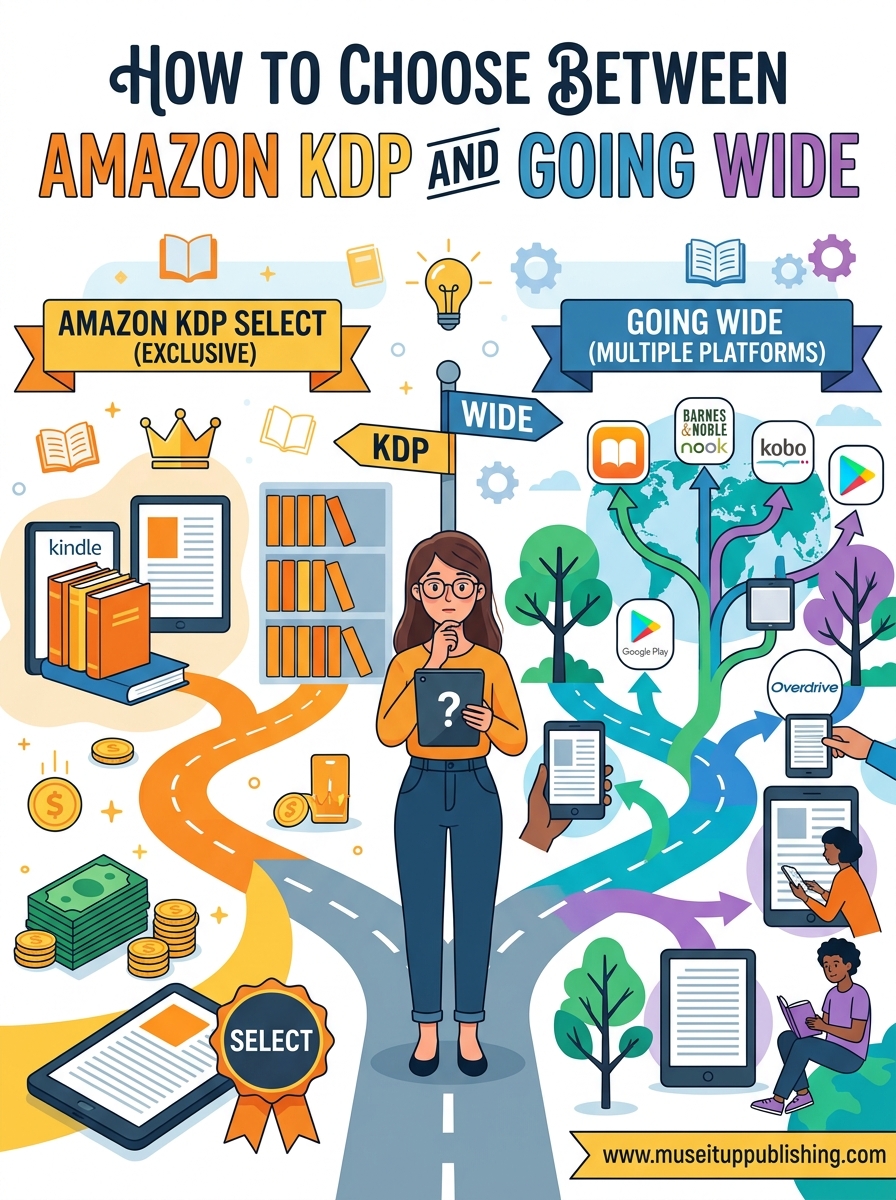
Every self-published author hits the same crossroads: stay exclusive with Amazon through KDP Select, or go wide and distribute to multiple retailers. It is one of the biggest decisions in your publishing career, and the right answer depends on your genre, your goals, and how much control you want over your income.
Learning how to choose between Amazon KDP and going wide means understanding what each path offers, what each costs you, and how your specific situation tips the scale. Our team has studied author income reports, forum discussions, and platform data to build a decision framework you can actually use.
In this guide, we break down both options in plain language, compare royalties and reach, share real author experiences from Reddit and the KDP Community forums, and give you a printable decision checklist at the end. By the time you finish reading, you will know which path fits your books.
Table of Contents
What Is KDP Select?
KDP Select is Amazon’s exclusive self-publishing program. When you enroll a book in KDP Select, you agree to make the digital version available exclusively through Amazon for a 90-day term. That term auto-renews unless you turn it off.
In exchange for that exclusivity, your book gets added to Kindle Unlimited, Amazon’s subscription reading service with millions of subscribers. Readers can borrow your book as part of their subscription, and you earn money based on how many pages they read, measured in KENP (Kindle Edition Normalized Pages).
You also unlock promotional tools that Amazon reserves for KDP Select enrollees. These include Free Book Promotions and Kindle Countdown Deals, both of which can drive ranking spikes and visibility on the Amazon store. You also qualify for 70% royalty pricing on books priced between $2.99 and $9.99.
The trade-off is simple but significant. While enrolled, you cannot sell your ebook anywhere else. Not on your website, not on Kobo, not on Apple Books, not through any other retailer. If Amazon finds your book available elsewhere during an exclusivity period, they can terminate your KDP account.
What Does Going Wide Mean?
Going wide means distributing your ebook to multiple retailers without an exclusivity agreement. Instead of locking your book into Amazon alone, you make it available on Kobo, Apple Books, Barnes & Noble, Google Play Books, Scribd, and dozens of other stores around the world.
You can do this two ways. First, you can upload directly to each platform, managing separate accounts on Kobo Writing Life, Apple Books for Authors, Barnes & Noble Press, and Google Play Books. Second, you can use an aggregator, a service that distributes your book to many retailers from a single upload.
Popular aggregators include Draft2Digital, PublishDrive, and Smashwords. Draft2Digital charges no upfront fee and takes roughly 10% of your retail price. PublishDrive operates on a subscription model. Each aggregator has slightly different retail partners, royalty splits, and features, so the choice matters.
Going wide also opens the door to library distribution. Through platforms like OverDrive and Libby, libraries can purchase your ebook for lending. Some authors report library income as a meaningful secondary stream, especially for non-fiction and literary fiction. This is an angle most KDP-only authors never explore.
The key difference from KDP Select is freedom. You are not locked in. You can pull a book from one retailer and leave it on another. You can experiment with pricing per platform. You retain full control over where your book lives and how it is sold.
KDP Select Pros and Cons
Pros of KDP Select
Kindle Unlimited access is the single biggest draw. KU has millions of active subscribers, and many of them read voraciously in genres like romance, fantasy, thriller, and sci-fi. For authors in those genres, KU borrows can account for 60 to 70% of total income, based on what authors report in forums.
You get promotional tools that wide authors cannot access on Amazon. Kindle Countdown Deals create urgency with limited-time price drops. Free Book Promotions can push your book up the free rankings and generate reviews. These tools feed the Amazon algorithm, which rewards recent activity with more visibility.
The 70% royalty tier on Amazon is the highest rate Amazon offers for ebooks priced between $2.99 and $9.99. Combined with KU page reads, a single book can generate income from both sales and borrows simultaneously.
Simplicity is underrated. One platform, one dashboard, one set of reports. For authors juggling writing, marketing, and a day job, the convenience of managing everything in one place is a real benefit. You upload once and Amazon handles distribution, delivery, and customer service.
Amazon’s discoverability engine is powerful. When a book gains traction on Amazon, the recommendation algorithm can push it to new readers automatically. Many authors report that their biggest sales spikes came not from their own marketing but from Amazon showing their book to similar readers.
Cons of KDP Select
The 90-day exclusivity lock-in is the core drawback. During each enrollment period, you cannot sell your ebook anywhere else. If you want to run a promotion on BookBub that requires wide availability, you cannot. If a reader asks for your book on Kobo, you have to say no.
Single-platform risk is real and frightening. Several authors have shared stories of losing their Amazon accounts to sudden policy enforcement actions. When your entire income depends on one platform, losing access means losing everything overnight with no immediate backup.
KENP payout rates fluctuate. The per-page rate is determined by Amazon each month based on the size of the KU Global Fund and total pages read. Authors have watched their per-page income drop without warning, making KU income unpredictable compared to direct sales.
You miss non-Amazon readers entirely. A meaningful percentage of readers do not use Amazon for ebooks. They shop on Kobo, Apple Books, or Barnes & Noble by choice or by region. With KDP Select exclusivity, those readers simply cannot buy your book in their preferred store.
Amazon controls your pricing and promotions. You operate within Amazon’s rules, Amazon’s pricing structure, and Amazon’s promotional calendar. If Amazon changes its terms, you adapt or you leave.
Going Wide Pros and Cons
Pros of Going Wide
Income diversification is the strongest argument for going wide. When your book is on five or more retailers, a dip on one platform does not sink your business. Authors who went wide after years on KDP frequently describe the feeling as finally breathing again.
You reach readers who never use Amazon. Kobo has a strong presence in Canada and parts of Europe. Apple Books reaches iOS users globally. Barnes & Noble captures the Nook audience in the US. Google Play Books reaches Android users worldwide. Each platform has its own loyal customer base.
Library distribution through OverDrive and Libby is a genuine revenue stream that most KDP-only authors overlook. Libraries pay for ebooks, and library readers can become loyal fans who then buy your other titles. For non-fiction especially, library sales can be substantial.
International markets open up in ways Amazon does not always serve well. Kobo partners with local retailers in France, Germany, Japan, and other countries. Going wide means your book appears in stores that local readers actually browse.
You keep full control. Set your own prices per platform. Run promotions when you want. Pull a book from one store without affecting others. Experiment with bundling, permafree strategies, and direct sales through your own website or services like Patreon and Kickstarter.
Cons of Going Wide
Manual management takes time. If you upload directly to each platform, you are maintaining accounts on five to ten different dashboards. Updates, price changes, and metadata edits must be repeated across stores. Using an aggregator reduces this burden but adds a layer between you and each retailer.
You lose Kindle Unlimited enrollment. This is the trade-off that stops most authors from going wide. If your genre thrives on KU, leaving it means walking away from a proven income source. For romance and fantasy authors, this can mean a significant income drop.
Amazon pays only 35% royalty on wide books priced under $2.99 or over $9.99, and the 70% tier works differently for wide distribution. You also miss Amazon’s KDP Select promotional tools, which means fewer levers to pull for ranking spikes.
Wide distribution has a slower ramp. Sales build gradually as algorithms on each platform learn about your book. Authors who went wide report that it took three to six months to see meaningful traction on non-Amazon platforms.
Each platform has its own quirks. Kobo has different metadata preferences than Apple Books. Barnes & Noble handles pre-orders differently than Google Play. Learning each ecosystem takes effort and patience.
Royalty Comparison: KDP Select vs Going Wide
The royalty math is where the decision gets concrete. On Amazon KDP Select, you earn 70% on ebooks priced between $2.99 and $9.99, plus KU page reads at the current KENP rate. On Amazon without KDP Select, you still earn 70% in that price range, but you do not get KU income.
On other platforms, the royalty picture is competitive. Kobo pays 70% on most titles. Apple Books pays 70% with no price tier restrictions. Barnes & Noble pays 65% on Nook sales. Google Play Books pays 52%. Draft2Digital passes through the retailer’s royalty minus roughly 10%.
Here is where genre matters. A romance novel priced at $4.99 on Amazon might earn $3.49 per sale plus significant KU income from borrowers who read 300 pages. The same book on Kobo earns $3.49 per sale but nothing from a subscription pool that is much smaller than KU.
For non-fiction priced at $9.99 or higher, the calculus shifts. Non-fiction readers are less likely to subscribe to KU. They buy selectively. Each sale going wide is worth more, and the 70% rate on Apple Books and Kobo means you keep just as much per unit sold.
The real question is total revenue, not per-unit rate. An author earning $2,000 a month from KU page reads alone would need significant wide sales across multiple platforms to match that. An author earning $500 a month from KU might match or exceed it by going wide if their genre travels well.
Genre-Specific Recommendations
Romance and fantasy authors should strongly consider KDP Select. These genres dominate Kindle Unlimited borrows. Forum data shows romance and fantasy authors often see 60 to 70% of their income from KU page reads. Leaving KU for these genres usually means a substantial income drop.
Thrillers and mysteries are a middle ground. They perform well on KU but also have loyal audiences on Kobo and Apple Books. Many thriller authors use a hybrid approach: enroll the first book in a series in KDP Select for discoverability, then go wide with later books to capture non-Amazon readers.
Non-fiction authors generally earn more going wide. Non-fiction readers buy deliberately, rarely subscribe to KU, and the higher price points make each sale more valuable. A $14.99 business book earns more per unit on Apple Books at 70% than it does buried in a KU borrow pool.
Literary fiction and memoir fall somewhere between. These readers value library availability and independent bookstores. Going wide with library distribution through OverDrive can be surprisingly lucrative for literary titles that might struggle in KU’s volume-driven ecosystem.
Children’s books and illustrated titles benefit from wide distribution because parents and educators shop across platforms, especially Apple Books and Google Play. School and library markets are also more accessible when you are not locked into Amazon exclusivity.
Decision Framework: How to Choose
Use this checklist to work through your decision. Answer each question honestly based on your current situation, not where you hope to be someday.
Step 1: Identify your genre. If you write romance, fantasy, or romantasy, KDP Select likely serves you better. If you write non-fiction, literary fiction, or children’s books, going wide probably earns more over time.
Step 2: Count your titles. Authors with one or two books often benefit from KDP Select’s discoverability boost. Authors with a backlist of five or more titles gain more from wide distribution because each platform multiplies your catalog’s earning potential.
Step 3: Assess your marketing capacity. KDP Select lets you lean on Amazon’s algorithm. Going wide requires you to drive your own traffic, at least initially. If you have no marketing plan, KDP Select’s built-in tools give you a head start.
Step 4: Evaluate your risk tolerance. If the thought of losing your Amazon account keeps you up at night, going wide provides peace of mind. If you trust Amazon and value simplicity, KDP Select removes complexity.
Step 5: Consider a hybrid approach. Many successful authors use both strategies. Enroll a series starter in KDP Select for 90 days to build an audience, then let exclusivity lapse and go wide. Use KU for front-list discoverability and wide distribution for backlist stability.
Step 6: Plan your transition. If you start with KDP Select, set a calendar reminder before each 90-day renewal. That gives you a decision point every three months. If you decide to go wide, turn off auto-renew, wait for the period to expire, and then distribute through an aggregator like Draft2Digital.
How to Transition from KDP Select to Going Wide
The transition is simpler than most authors fear. First, log into your KDP dashboard and uncheck the auto-renew box on your KDP Select enrollment. Your book remains exclusive until the current 90-day period ends.
Once the exclusivity period expires, your book is free to distribute elsewhere. Sign up for an aggregator account (Draft2Digital is the most popular starting point for first-time wide authors). Upload your book, set your pricing, and select the retailers you want to reach.
Expect a three to six month ramp on new platforms. Sales will start slow as each platform’s algorithm learns about your book. Use this time to optimize metadata, gather reviews on each store, and run platform-specific promotions. Many aggregators offer promotional tools that work across multiple retailers.
Keep your Amazon listing active. Going wide does not mean leaving Amazon. You simply publish on Amazon without KDP Select enrollment, which means you still earn 70% on sales priced between $2.99 and $9.99, you just lose KU income and promotional tools.
Library and International Opportunities
Library distribution is one of the most overlooked revenue streams for self-published authors. Through OverDrive and Libby, your ebook becomes available to public library systems worldwide. Libraries pay per copy, and some pay per checkout depending on the model.
Draft2Digital and PublishDrive both offer library distribution as part of their retail network. Apple Books also supports direct library sales in some regions. For non-fiction and literary fiction, library income can represent 10 to 15% of total wide revenue, according to author reports.
International markets are another advantage of going wide. Kobo has deep penetration in Canada, France, and the Netherlands. Apple Books reaches iOS readers in every country Apple operates. Google Play Books serves Android users globally. Amazon is dominant in the US and UK but less so in many other markets.
Authors who went wide frequently mention that their international sales surprised them. A book that performed modestly on Amazon found a devoted audience on Kobo Japan or Apple Books Germany. Going wide transforms your book from a single-market product to a global one.
FAQs
What is KDP Select?
KDP Select is Amazon’s exclusive self-publishing program requiring 90-day exclusivity in exchange for Kindle Unlimited access, 70% royalty rates on books priced $2.99 to $9.99, and promotional tools like Free Book Promotions and Kindle Countdown Deals.
What does going wide mean in self publishing?
Going wide means distributing your ebook to multiple retailers like Kobo, Apple Books, Barnes u0026amp; Noble, and Google Play without an exclusivity agreement. You can upload directly to each platform or use an aggregator like Draft2Digital to reach many stores from a single upload.
Which is better KDP Select or wide?
KDP Select is better for romance and fantasy authors who benefit from Kindle Unlimited borrows. Going wide is better for non-fiction authors and those who want income diversification. The best choice depends on your genre, catalog size, and marketing capacity.
Can I publish on KDP and other platforms at the same time?
Yes, but only if you do not enroll in KDP Select. Standard KDP distribution is non-exclusive. You can sell on Amazon and other retailers simultaneously. KDP Select adds Kindle Unlimited access but requires 90-day exclusivity that prevents selling elsewhere.
What are the disadvantages of KDP Select?
The main disadvantages are the 90-day exclusivity lock-in, single-platform income risk, unpredictable KENP payout rates, loss of non-Amazon readers, and dependence on Amazon’s rules and pricing structure.
Is Kindle Unlimited worth it for authors?
Kindle Unlimited is worth it for authors in high-borrow genres like romance, fantasy, and thriller. Authors in these genres often report 60 to 70% of income from KU page reads. For non-fiction or niche genres, KU income is typically much lower.
How do I transition from KDP Select to going wide?
Turn off auto-renew in your KDP dashboard, wait for the current 90-day period to expire, then distribute through an aggregator like Draft2Digital. Keep your Amazon listing active without KDP Select enrollment so you still earn 70% on sales.
What is the best aggregator for publishing wide?
Draft2Digital is the most popular choice for new wide authors because it charges no upfront fee and distributes to major retailers. PublishDrive offers a subscription model. Smashwords is strong for direct sales and library distribution. The best choice depends on your retail and feature needs.
Conclusion: Making Your Amazon KDP vs Going Wide Decision
Choosing between Amazon KDP and going wide is not a one-time, permanent decision. It is a strategy you can revisit every 90 days with KDP Select or adjust anytime when you are wide. Start where your genre and catalog size point you, track your results, and adjust as your career grows.
How to choose between Amazon KDP and going wide ultimately comes down to three factors: your genre, your appetite for risk, and your willingness to manage multiple platforms. Romance and fantasy authors usually thrive in KU. Non-fiction and literary authors usually earn more going wide. Hybrid authors use both.
Take the decision checklist from this guide, answer each question for your situation, and commit to a path for your next 90 days. The best distribution strategy is the one you actually understand and can execute confidently.