
I still remember the moment my personal book collection outgrew a single shelf. What started as a handful of thrift store finds had quietly become a few hundred volumes stacked on every flat surface in my apartment. My partner gently suggested I either build a proper home library or stop buying books entirely. I chose the library.
Learning how to build a home library on a small budget taught me that you do not need thousands of dollars or a dedicated room. You need a strategy, patience, and a willingness to hunt for deals. A study published in the journal Social Science Research found that growing up in a home with as few as 80 books is associated with measurable improvements in literacy, numeracy, and digital skills later in life. That means every book you add to your shelves matters.
This guide walks through every step I took and every trick I picked up along the way, from scoring free books through community programs to building shelving for a fraction of retail prices. Whether you live in a studio apartment or a small house, you can absolutely create a home library you love without overspending.
Table of Contents
Why a Home Library Matters
A home library is more than just a storage system for books. It is a daily invitation to read, learn, and unplug. Research from the University of Nevada, Reno found that children who grow up in homes with book collections achieve, on average, 3.2 more years of schooling than children from bookless homes, regardless of family income or parents’ education level.
For adults, a visible collection of books in the home encourages more reading time. When books are within arm’s reach, you are far more likely to pick one up instead of scrolling your phone. A home library also creates a personal sanctuary, a quiet corner that signals to everyone in the household that reading is valued.
The best part is that building this kind of resource does not require wealth. It requires consistency and the willingness to use the strategies outlined in this guide. Let’s start with the single most impactful step: finding books for free.
Where to Find Free Books for Your Home Library
Free books are everywhere once you start looking for them. These sources represent the fastest way to build volume in your collection without spending a dime, and I have personally used every one of them.
Little Free Libraries
Little Free Libraries are small, neighborhood book-exchange boxes that operate on a simple rule: take a book, leave a book. There are over 175,000 registered Little Free Libraries worldwide. Use the official map at littlefreelibrary.org to find ones near you.
I mapped out a walking route through my neighborhood that hits six Little Free Libraries. On a good week, I find two or three books worth keeping. The trick is to check them often because popular titles disappear fast. Always carry a book or two to swap so you are contributing to the system as well.
Dolly Parton’s Imagination Library
If you have children under five, Dolly Parton’s Imagination Library mails one free book per month directly to your home from birth until age five. The program is available in participating regions across the United States, Canada, the United Kingdom, Australia, and Ireland.
This is one of the highest-quality free book programs available. The selections include award-winning titles and diverse authors. Check eligibility and sign up at imaginationlibrary.com.
PJ Library and Other Faith-Based Programs
PJ Library sends free Jewish-themed children’s books to families raising Jewish children, from birth through age 12. Similar programs exist for other communities and faiths. These programs are funded by philanthropic organizations, meaning the books arrive at no cost to you and are yours to keep permanently.
Reach Out and Read
Reach Out and Read is a national program where pediatricians give free books to children ages six months through five years at well-child visits. If your pediatrician participates, your child receives a new book at every checkup. That is up to ten free books before kindergarten.
Public Library Giveaways and Summer Reading Programs
Many public libraries host annual or seasonal book giveaways where they clear out donated duplicates, withdrawn titles, and surplus inventory. Call your local branches and ask when their next giveaway is scheduled. You can also check if your library participates in summer reading programs that reward participants with free books.
One library near me holds a “Free Books Friday” the first Friday of every month. I once walked out with thirty gently used children’s books in a single visit. These programs exist, but you have to ask because they are rarely advertised.
Book Swaps and Exchange Events
Community book swaps are gatherings where people bring books they no longer want and trade them for new reads. Check local community centers, coffee shops, schools, and libraries for organized swap events. You can also start your own informal swap with a group of friends or neighbors.
Online, the BookMooch platform lets you list books you want to give away and earn points to request books from other members. You pay media mail shipping for books you send out, but the books you receive cost nothing beyond your earned points.
Freecycle, Buy Nothing Groups, and Online Classifieds
Join your local Freecycle group or Buy Nothing project group on Facebook. These communities are built around giving items away for free. Post a polite request explaining you are building a home library and many people are happy to pass along boxes of books they were planning to donate anyway.
I put out a request in my Buy Nothing group and received over 100 books in one week from three different neighbors clearing out their shelves. People moving house are especially generous sources. Watch for moving sales and end-of-month listings.
Friends, Family, and Coworkers
Let people know you are building a library. Most readers have books they have finished and are happy to pass along. I received an entire box of hardcover novels from a coworker who was downsizing before a cross-country move. The simple act of mentioning my project at a dinner party led to three different friends offering book donations.
Low-Cost Book Sources That Won’t Break the Bank
Once you have tapped into free sources, the next tier is books that cost between 25 cents and a few dollars. These sources consistently offer the best ratio of quality to price for serious collection-building.
Library Book Sales
Library book sales are the single best source of inexpensive books I have found. Most public libraries run sales once or twice a year, often through their Friends of the Library organization. Pricing typically ranges from 50 cents for paperbacks to two dollars for hardcovers.
Here is the key strategy: go on the final day of the sale. Many libraries run “bag day” on the last afternoon, where you pay a flat fee of five to ten dollars and fill as many bags as you can carry. I once paid eight dollars and left with 47 books, which works out to about 17 cents per book. Some libraries even offer a “box day” where you fill an entire cardboard box for a single price.
Get on your library’s email list so you receive advance notice of sale dates. The best titles go to people who show up early on opening day, but the best deals go to people who show up late on closing day.
Thrift Stores and Goodwill
Goodwill, Salvation Army, and local thrift shops almost always have a book section. Prices typically range from 50 cents to two dollars per book. The selection is random, but that randomness is part of the fun. Thrift store shelves reward regular visits because inventory turns over quickly.
Some thrift stores offer discount days. My local Goodwill runs a half-price sale on certain color tags each week. On those days, books drop to 25 or 50 cents each. Ask the staff what days the best deals happen and whether they restock on a particular schedule.
Used Bookstores and Online Sellers
Used bookstores let you browse curated selections, which saves time compared to thrift store hunting. Many also offer store credit for books you trade in. Bring in books you no longer want and walk out with new titles for a fraction of retail.
Online, ThriftBooks and Better World Books are the two most popular used book retailers. Both offer free shipping on qualifying orders, frequent discount codes, and loyalty programs. ThriftBooks runs a reading rewards program that gives you a free book after you spend 500 dollars, but the real value is in their 4-for-20-dollar paperback deals and daily discounts of 10 to 15 percent.
Better World Books funds global literacy programs with every purchase, so your spending supports a good cause while building your library. Both sites allow you to filter by condition so you can choose between “like new” and “acceptable” depending on your budget.
Yard Sales, Garage Sales, and Estate Sales
Yard sales and garage sales are goldmines for cheap books. Sellers want to get rid of everything, and books are usually priced to move at 25 cents to one dollar each. Estate sales can yield entire collections of well-cared-for hardcovers, often at deeply discounted prices on the sale’s final day.
Use sites like estatesales.net and craigslist.org to find sales in your area. Arrive early for the best selection or late in the day for the deepest discounts, when sellers are packing up and willing to negotiate. I built a significant portion of my classic literature collection from a single estate sale where I paid 20 dollars for three grocery bags of hardcovers.
Online Marketplaces
Facebook Marketplace, OfferUp, and Craigslist frequently list bulk book lots. Searchers who are moving or downsizing often sell boxes of 50 to 200 books for 10 to 40 dollars total. Always inspect the books in person if possible, and negotiate politely. A 25-dollar box of 100 books works out to 25 cents per title.
Budget-Friendly Shelving Solutions
Once you have books, you need somewhere to put them. Shelving is the second biggest expense after the books themselves, but it does not have to be. Here is how to keep those costs down while still creating something sturdy and attractive.
IKEA Billy Bookcases and Similar Affordable Options
The IKEA Billy bookcase is the go-to budget shelving solution recommended by readers across multiple online communities, and for good reason. Each unit costs roughly 40 to 60 dollars, holds a surprising number of books, and assembles in under 30 minutes. The Billy system includes extension units, corner pieces, and doors so you can customize a wall of shelving for a fraction of what custom built-ins would cost.
Target, Walmart, and Amazon offer similar budget bookcases. Look for solid backing panels and adjustable shelves, both of which improve stability when the unit is fully loaded with heavy books. Always anchor bookcases to the wall for safety, especially if you have children or pets.
Secondhand and Free Furniture Sources
Before buying new shelving, check Facebook Marketplace, Craigslist, and Freecycle for used bookcases. People give away or sell bookcases cheaply when they move, redecorate, or downsize. I found two nearly new solid wood bookcases for 15 dollars each from a family moving overseas. A fresh coat of paint made them look brand new.
Habitat for Humanity ReStore locations sell donated furniture and building materials at a fraction of retail. Inventory varies by location, but you can often find sturdy bookcases, shelving components, and even lumber for DIY projects.
DIY Shelving From Reclaimed Materials
If you are handy with basic tools, building your own shelves from reclaimed wood and simple brackets can save a significant amount of money. Visit ReStore, salvage yards, or online classifieds for free or cheap lumber, old doors, and salvaged planks.
The simplest DIY approach uses metal L-brackets mounted to wall studs with a plank of wood laid across them. Each shelf costs about 8 to 12 dollars in materials, holds heavy hardcovers without sagging, and looks clean and modern. This approach works particularly well for narrow walls and awkward spaces where standard bookcases will not fit.
Crates, Brackets, and Creative Alternatives
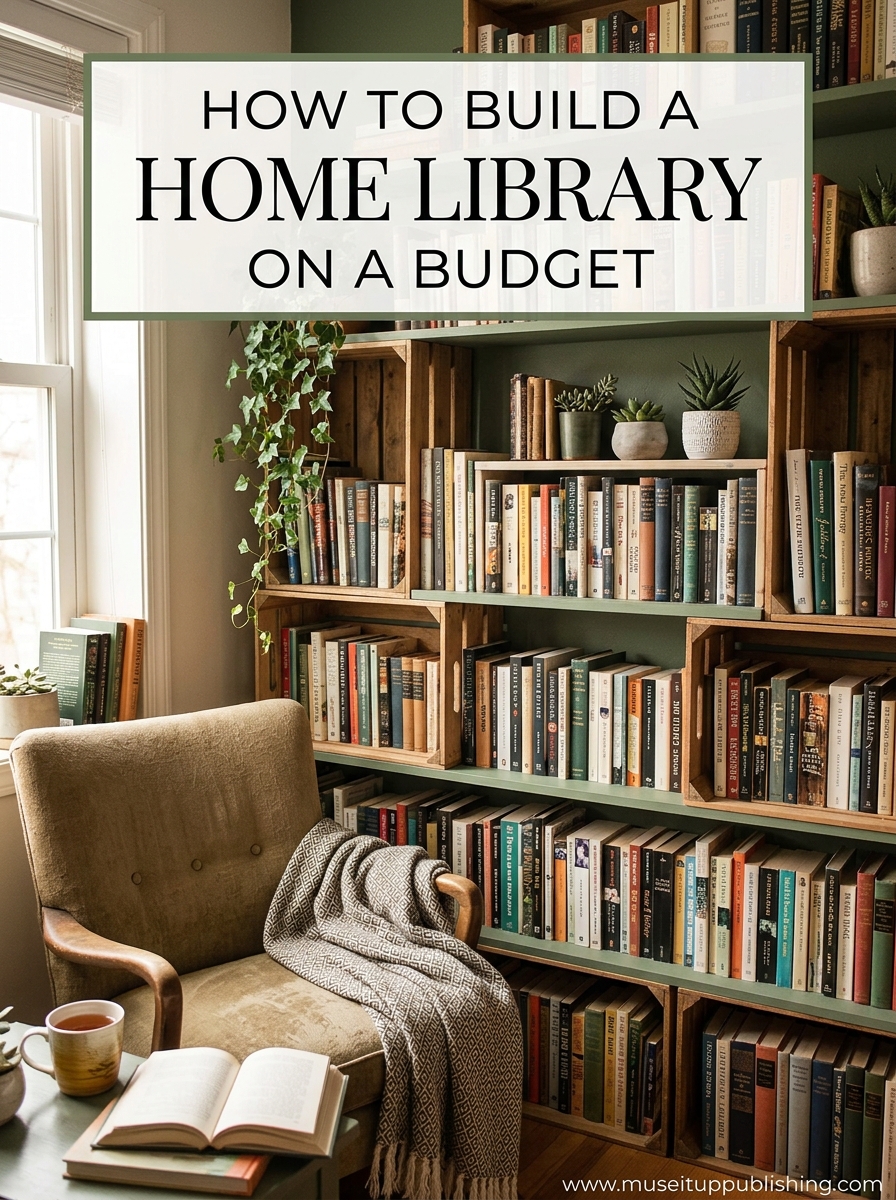
Wooden crates from craft stores or salvage yards can be stacked and screwed together to create modular shelving. Milk crates, when zip-tied or bolted together, make surprisingly sturdy and customizable book storage that works well in dorm rooms, kid spaces, or casual settings.
Floating shelves made from pre-cut boards and hidden bracket hardware offer a minimalist look that makes books appear to float on the wall. These work beautifully in living rooms and bedrooms where you want shelving to feel intentional rather than utilitarian.
Maximizing Book Storage in Small Spaces
Not everyone has a spare room for a library. If you are working with a small apartment or a single wall, these strategies will help you store more books without making the space feel cramped.
Go Vertical
The most underused storage space in any home is vertical. Standard bookcases are about 30 inches tall, but most ceilings are 8 feet or higher. Tall, narrow bookcases or shelving that extends to the ceiling can triple your storage capacity in the same footprint. Add a small step stool so you can safely reach the top shelves.
Use Multi-Purpose Furniture
Furniture with built-in storage does double duty in small spaces. A storage ottoman or bench with a lift-top lid can hold a surprising number of books while serving as seating. Coffee tables with lower shelves, window seats with storage underneath, and beds with built-in drawers all provide hidden book storage without taking up extra floor space.
Exploit Corners and Unused Spaces
Corners, the space above doorways, and the area under stairs are often wasted space that can become book storage. Corner shelves, doorway-spanning shelves, and under-stair shelving units turn dead zones into useful library space. Even the gap between a bookcase and the wall can be filled with a slim rolling cart that holds paperbacks.
Stack Smart and Cull Regularly
Horizontal stacking on top of vertically shelved rows can increase capacity by 30 to 50 percent on each shelf. Use this technique for oversized books and hardcovers. At the same time, be honest about what you actually want to keep. Every few months, pull out books you have read and will not reread, then donate or swap them to make room for new finds.
Organizing and Cataloging Your Collection
Once your library grows past 100 or so books, organization becomes essential. A simple system helps you find what you want and prevents accidental duplicate purchases.
Free Cataloging Apps
Several free apps let you scan book barcodes with your phone to build a digital catalog automatically. Libib, Goodreads, and Book Buddy all offer free tiers that let you track your collection, sort by category, and search for titles. LibraryThing offers a free account for up to 200 books, which is plenty when you are just starting out.
Scanning takes only a few seconds per book, and having a searchable digital list means you can check whether you already own a title before buying it at a book sale. I cataloged my entire 400-book collection in a single weekend using the Libib app.
Sorting Systems That Work
There is no single right way to organize books, but a few systems work well for home libraries. Fiction can be sorted alphabetically by author or by genre. Nonfiction works well grouped by subject, such as history, science, cooking, and biography. Many home library owners keep a special section for favorites, signed copies, or books they plan to read next.
For children’s books, consider sorting by age range or reading level. This makes it easy for kids to find books they can read independently and helps parents pull appropriate bedtime stories quickly.
Book Care Basics
Protecting your investment matters, especially when you have spent time hunting down deals. Keep books away from direct sunlight, which fades covers and damages spines. Avoid damp areas that encourage mold. Dust shelves regularly and store books upright, not leaning, to prevent spine damage.
For valuable or fragile books, consider archival dust jackets or slipcases. These are inexpensive and add years to the life of a well-loved volume. Never use standard tape to repair torn pages, as it yellows and damages paper over time. Archival repair tape is affordable and safe for long-term use.
Sample Budget Breakdown: A 200-Book Starter Library
Here is a concrete example of what it costs to build a starter home library for a family, based on real prices I have paid over the past two years of collecting.
For the books themselves, 50 books from a library bag day at 10 dollars total, 40 books from thrift stores at an average of 1 dollar each, 30 books from a Facebook Marketplace bulk lot at 25 dollars total, 30 free books from Little Free Libraries and Buy Nothing groups, 20 children’s books from Dolly Parton’s Imagination Library at no cost, and 30 books from yard sales at 50 cents each. That is 200 books for roughly 100 dollars.
For shelving, two IKEA Billy bookcases at 50 dollars each total 100 dollars. Anchoring hardware and a basic level cost about 10 dollars. Paint for a refresh, if you bought secondhand shelves, runs about 15 dollars. A step stool for reaching top shelves costs around 20 dollars.
Grand total for a 200-book home library with shelving and accessories: approximately 245 dollars. That works out to about 1.23 dollars per book including the shelving, or roughly 50 cents per book if you already have shelves. Not bad for a library that would cost thousands to assemble buying everything new at retail.
Frequently Asked Questions
Is it cheaper to buy or build bookshelves?
Building your own bookshelves is cheaper if you already own basic tools and have access to inexpensive lumber. A DIY shelf using pine boards and metal brackets costs about 10 to 15 dollars per shelf. However, if you need to buy tools or have limited DIY experience, affordable ready-made options like the IKEA Billy bookcase at 40 to 60 dollars are often the better value.
How much does it cost to build a home library?
A starter home library of 200 books with basic shelving can be built for about 200 to 300 dollars using thrift stores, library sales, and free community sources. Without any budget at all, you can still build a collection of 50 to 100 books entirely for free using Little Free Libraries, Buy Nothing groups, and literacy programs.
Can I build a little library myself?
Yes. A Little Free Library can be built from a simple wooden box, an old cabinet, or even a repurposed mailbox mounted on a post. The Little Free Library organization offers free building plans on their website. You can register your library for about 40 dollars to receive an official charter sign and appear on the world map.
Does owning 1000 books make your home a library?
There is no official threshold that converts a book collection into a library. A home library is simply a personal collection of books organized for reading and reference. Some people consider 500 or more books a library, while others count any intentionally curated collection. The value is in the access to books, not the count.
How can I build a home library with no money?
You can build a meaningful home library for free using Little Free Libraries, Buy Nothing groups, Freecycle, public library giveaways, and literacy programs like Dolly Parton’s Imagination Library. For shelving, watch for free furniture giveaways on local classifieds and social media groups. People frequently give away bookcases when moving or redecorating.
Start Building Your Library Today
Building a home library on a small budget is entirely doable when you combine free community resources, strategic thrift store visits, library book sales, and affordable shelving. Start with one source this week. Join a Buy Nothing group, map your local Little Free Libraries, or call your library to ask about their next book sale. Every book you bring home adds value to your life and your space.
Once you understand how to build a home library on a small budget, the process becomes a rewarding hobby rather than a financial strain. The books you collect will serve you and your family for years, and the reading habits they inspire are priceless. Happy hunting.