
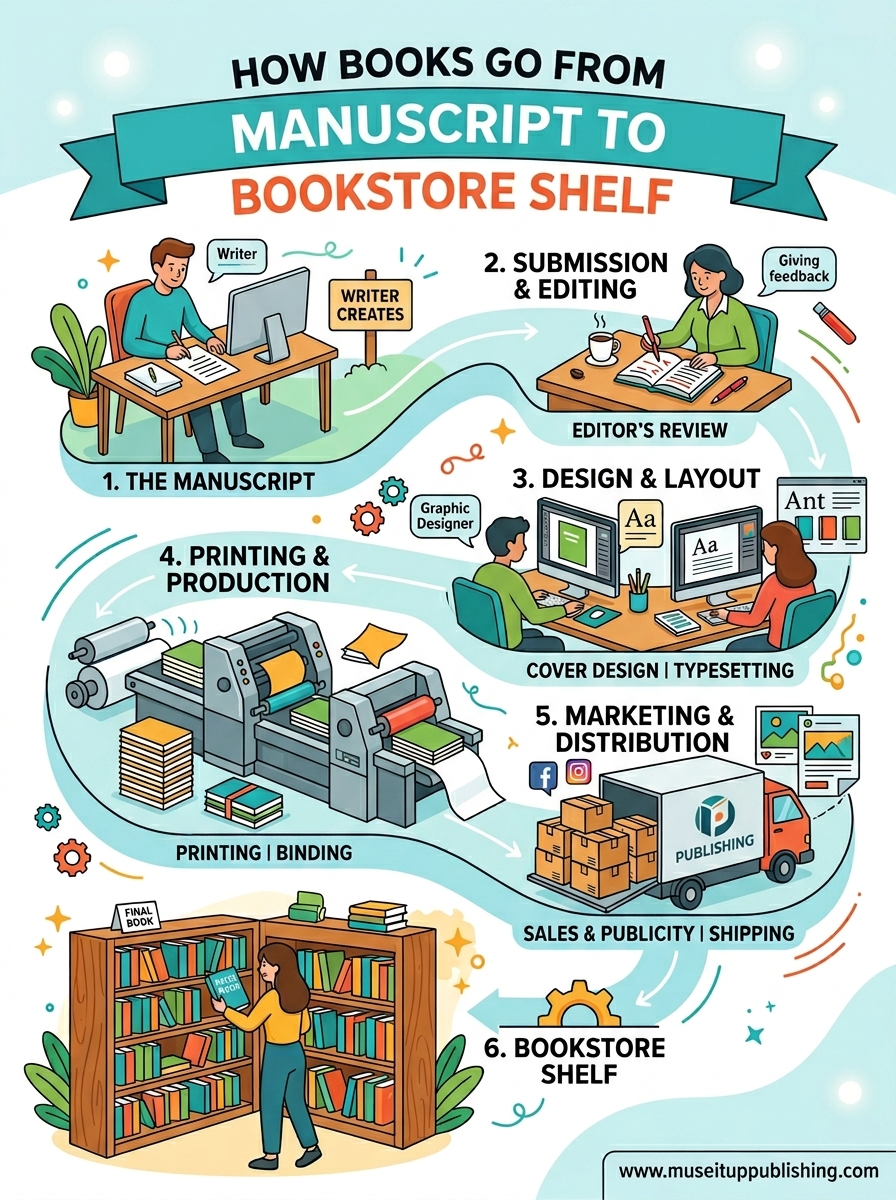
Most readers assume a finished book lands on a bookstore shelf within a few weeks of being written. The reality is far more deliberate. When you understand how a book actually goes from manuscript to bookstore shelf, you discover a sprawling, multi-team effort that typically spans 12 to 18 months, sometimes longer, from the moment a publisher says yes to the day a reader picks up a copy.
I have spent years inside the publishing industry, and even seasoned authors are surprised by how many hands touch a manuscript before it becomes a finished book. The book publishing process involves literary agents, acquisitions editors, copy editors, designers, production managers, sales representatives, publicists, and distributors, each playing a distinct role in a carefully choreographed timeline.
In this guide, I break down every stage of the journey in plain language. Whether you are an aspiring author curious about what happens after a book deal, a reader who wants to understand the industry, or a writer deciding between traditional and self-publishing, you will leave knowing exactly how a book goes from manuscript to bookshelf and why every step matters.
Table of Contents
Stage 1 The Manuscript and Finding a Literary Agent
Every published book begins as a manuscript, but a finished draft is only the starting line. Before a major publisher ever sees those pages, most authors need a literary agent to open the door. The major traditional publishers in the United States, including the so-called Big Five, generally do not accept unagented submissions. An agent acts as the gatekeeper, advocate, and negotiator who pitches your work to acquiring editors.
Finding representation is its own gauntlet. An author writes a query letter, often personalizes it for dozens of agents, and waits. Response rates are low. One famously rejected author was turned down 23 times before finding success, and plenty of now-bestselling books endured similar rejection streaks before landing an agent. When an agent does offer representation, they typically suggest revisions before the manuscript ever goes out on submission to publishers.
For nonfiction authors, the process looks slightly different. Instead of a completed manuscript, the author often pitches a book proposal that includes a sample chapter, an outline, a competitive analysis, and an author platform summary. The agent evaluates whether the concept is marketable enough to sell before a single additional chapter is written.
Once an agent and author agree to work together, the real submission process begins. This stage can take anywhere from a few weeks to over a year. The agent identifies editors whose tastes align with the project and sends the manuscript or proposal in carefully targeted batches. Some projects sell quickly in a bidding war. Others quietly find a home after months of waiting. Either way, no book reaches a bookstore without first surviving this matchmaking phase.
Stage 2 Acquisitions and the Book Deal
When an editor at a publishing house reads a manuscript and loves it, that passion alone is not enough to buy the book. The editor must convince an entire acquisitions team that the project is worth a financial investment. This happens at an acquisitions or editorial board meeting, where the editor presents the manuscript alongside a profit and loss analysis, comparable title sales, and a marketing rationale.
The acquisitions meeting is where commerce meets craft. The editor argues for the book’s literary merit and commercial potential while representatives from sales, marketing, and finance scrutinize the numbers. If the team agrees to make an offer, the agent negotiates the deal terms, which may include an advance against royalties, royalty rates, subsidiary rights splits, and delivery deadlines for the final manuscript.
Once contracts are signed, the book officially exists as an acquired title on the publisher’s list. The author receives their advance, typically paid in installments tied to milestones like contract signing, manuscript delivery, and publication. From this moment, the clock starts ticking on the long road to bookstore shelves.
It is worth noting that the editor who acquired the book becomes the author’s primary partner for everything that follows. One editor is assigned to guide the author through the entire process, from substantive revisions to jacket copy approval to publication day. This relationship is central to how the book evolves between acquisition and release.
Stage 3 Setting the Publication Date
One of the first decisions after a book deal is signed is the publication date, and it is not arbitrary. Publishers organize their catalogs around seasonal lists, typically Spring, Fall, and sometimes Summer and Winter. A book’s placement on a particular list depends on genre trends, retail buying cycles, and how much time the editorial and production teams need to prepare the manuscript.
Most traditionally published books are scheduled 12 to 18 months out from acquisition. That timeline is not padding or bureaucracy. Every downstream deadline, from when edits are due to when advance reader copies must be printed, works backward from the on-sale date, often abbreviated OSD. The OSD is the linchpin that holds the entire schedule together.
If the OSD shifts, everything shifts. Sales catalogs are printed months in advance, retailer preorder data is submitted to systems weeks ahead, and warehouse logistics are planned around specific arrival windows. This is why publication dates rarely move once set, and why delays, when they happen, ripple across multiple departments and external partners.
The publication season also influences how a book is marketed. Fall lists tend to receive the biggest push because holiday shopping drives the largest sales volume. A literary novel slotted for a quiet January release faces a very different commercial landscape than one positioned as a Summer beach read. Timing, in publishing, is strategy.
Stage 4 Developmental Editing
With the publication date set, the editorial process begins. The first and most substantial round is developmental editing, sometimes called structural or substantive editing. This is where the editor and author grapple with the big questions. Does the plot hold together? Are the characters believable? Is the pacing right? Does the argument land for nonfiction?
The developmental editor typically delivers an editorial letter, a detailed document that can run anywhere from five to thirty pages. This letter outlines broad concerns, suggests structural changes, and identifies scenes or chapters that need reworking. For some books, the editor may also mark up the manuscript directly with margin comments.
Authors then revise, sometimes extensively. I have seen manuscripts undergo complete restructuring at this stage, with subplots cut, point-of-view changes, and entire chapters rewritten or reordered. This phase can take anywhere from a few weeks to several months depending on the scope of revisions and the author’s other commitments.
Forum discussions among published authors frequently highlight how overwhelming this round can feel. Many debut authors are surprised by how many drafts they go through before the manuscript is considered final. The developmental edit is where the book is truly shaped, and the changes here are far more fundamental than anything that follows in later editing rounds.
Stage 5 Line Editing and Copy Editing
Once the structure is solid, the manuscript moves into finer editing territory. Line editing focuses on the sentence level. The line editor examines voice, rhythm, word choice, and paragraph flow, polishing the prose without changing the author’s fundamental style. This is the stage where a clunky paragraph gets tightened, a repetitive phrase gets varied, and a flat dialogue exchange gains energy.
After line editing comes copy editing, which is a different discipline entirely. The copy editor is the manuscript’s fact-checker and consistency guardian. They verify timelines, flag continuity errors, enforce a house style guide, correct grammar and punctuation, and ensure that character names are spelled the same way throughout. If a character’s eye color changes between chapter three and chapter twelve, the copy editor catches it.
These two rounds are often confused, but they serve distinct purposes. Line editing is about artistry and readability. Copy editing is about accuracy and consistency. Some publishers combine them or outsource copy editing to freelancers, but both functions must happen before the manuscript is locked for production.
The author reviews the copy editor’s changes and either accepts them or queries back. This is the last chance to make substantive textual changes without significant cost or schedule disruption. Once the manuscript moves into typesetting, every correction becomes more expensive and more complicated to implement, so publishers want the text as clean as possible before that handoff.
Stage 6 Cover Design and Jacket Art
While the text is being finalized, the design team begins work on what may be the single most commercially important element of the entire book: the cover. Cover design is not a solo artistic exercise. It is a collaborative, sometimes contentious process that involves the designer, the acquiring editor, the marketing team, the sales team, and occasionally the author.
The process typically begins with a cover brief, a document that distills the book’s themes, target readership, comparable titles, and visual references. The designer creates multiple concepts, which are then reviewed at a cover meeting. These meetings can be surprisingly political, with different stakeholders advocating for different directions based on their sense of what will sell.
Authors often have less control over the cover than they expect. Most publishing contracts give the publisher final say on jacket art, though editors generally seek author input and try to avoid designs the author actively dislikes. Still, forum discussions reveal that cover design is one of the most common sources of friction between authors and publishers, particularly for debut authors who feel a strong personal attachment to how their work is visually represented.
The finished cover is not just art. It is a marketing instrument that must look compelling as a thumbnail on an online retailer, legible on a bookstore shelf from several feet away, and on-brand within its genre. A science fiction cover communicates differently than a literary fiction cover, and the design team is always thinking about how the jacket signals the right reader to pick up the book.
Stage 7 Production, Typesetting, and Proofreading
With the text locked and the cover underway, the manuscript enters production. The first production step is typesetting, also called interior design or page layout. A typesetter flows the copy-edited text into designed pages with proper margins, fonts, chapter openings, and front and back matter. The result is a set of pages that looks like the finished book interior.
One technical detail that surprises people outside the industry is that interior page count must be designed in multiples of 16, or sometimes 8 or 32, depending on the binding method. This is because books are printed on large sheets of paper that are folded into signatures, and each signature must contain a fixed number of pages. If a manuscript ends on page 281, the typesetter may need to either trim content or add blank pages to reach the next valid signature count.
Once the book is typeset, it goes through proofreading. The proofreader works on the typeset pages, called galleys or page proofs, catching errors that may have been introduced during layout. They check for widows and orphans, misaligned text, incorrect page references in the table of contents, and any remaining typos. This is the final editorial pass before the files are sent to the printer.
Corrections at this stage are costly because every change can shift text from one page to the next, potentially disrupting the entire signature structure. Publishers therefore limit late corrections to true errors, not stylistic preferences. By the time proofreading concludes, the book is essentially finished and waiting for its production slot at the printer.
Stage 8 The Launch Meeting and Sales Team
Roughly six to nine months before publication, the book is presented at an internal launch meeting. This is a critical moment that many authors do not fully understand. At the launch meeting, the acquiring editor stands before the entire publishing team, sales representatives, marketing staff, publicists, and executives, and pitches the book as if selling it to a buyer.
The goal of the launch meeting is to generate internal enthusiasm. Sales representatives need to believe in the book before they can convince retail buyers to stock it. If the room responds well, the book gets more attention from every department. If the response is lukewarm, the book may receive a smaller marketing push and a more modest print run, regardless of its literary quality.
After the launch meeting, the sales team goes to work. Sales representatives present the publisher’s upcoming list to buyers at major retail accounts, chain bookstores, independent bookstores, big box retailers, and online platforms. These buyers decide how many copies to order based on the sales rep’s pitch, past performance of similar titles, and their own market sense.
This is how books actually get into bookstores. It is not a mysterious distribution algorithm. It is a human conversation between a sales representative and a retail buyer, often supported by a printed seasonal catalog. The buyer commits to a quantity, and that order, aggregated across all retail accounts, informs the print run. A book with strong preorders may get a larger initial print run and better in-store placement. A book with weak preorder interest may see a smaller run and limited shelf presence.
Stage 9 Advance Reader Copies and Marketing
Several months before publication, the publisher produces advance reader copies, commonly called ARCs or galleys. These are early, often uncorrected, paperback versions of the book distributed to reviewers, booksellers, librarians, and influencers. The purpose is to generate buzz, secure prepublication reviews from outlets that require long lead times, and build word of mouth before the book is available for sale.
ARCs are also a tool for the sales team. When a bookseller reads an ARC and falls in love with a debut novel, they may hand-sell it to customers, recommend it to other store staff, or feature it in a display. This kind of grassroots advocacy is one of the most powerful sales drivers in publishing, and it cannot be bought. It must be earned through the quality of the book itself.
Meanwhile, the marketing and publicity teams execute their campaign plans. Publicity focuses on earned media, securing reviews, interviews, op-ed placements, and podcast appearances. Marketing focuses on paid and owned channels, including social media advertising, email newsletters, retailer co-op placements, and author website support. The line between the two functions blurs in practice, but the division of labor helps publishers manage a large list of titles simultaneously.
One recurring theme in author forums is how modest marketing budgets are for most books. The reality is that only a small percentage of any publisher’s list receives a major marketing investment. Most books get a defined, often modest, campaign and depend heavily on the author’s own platform and effort. Authors who understand this going in are better positioned to advocate for their work and supplement the publisher’s efforts with their own outreach.
Stage 10 Publication Day and Bookstore Shelves
After all the editing, design, production, sales pitches, and marketing buildup, the on-sale date finally arrives. Books are shipped from the printer to distribution warehouses and then to retail accounts in the weeks leading up to the OSD. Most books arrive in stores a few days before the official publication date so they are on shelves and in inventory systems when the OSD hits.
Publication day itself is both exciting and anticlimactic. There is no single moment when a book appears everywhere simultaneously. Books trickle onto shelves as individual stores process their shipments. Online retailers update their listings. Reviews that were embargoed until the OSD go live. The author may have launch events, interviews, or social media pushes scheduled, but the day itself is more of a starting line than a finish line.
The first week of sales matters disproportionately. Retailers and publishers alike treat the opening week as a signal of the book’s commercial trajectory. Strong first-week numbers can trigger reorder momentum, additional marketing investment, and even bestseller list placement. Weak opening numbers can quietly consign a book to a short shelf life, as retailers make space for the next season’s titles.
After publication, the work continues. The author promotes, the publicist chases late reviews, and the sales team monitors reorder patterns. Some books build slowly through word of mouth and climb over months. Others peak in the first few weeks and fade. The path from here is unpredictable, but the journey from manuscript to this point has been long, deliberate, and the product of dozens of professionals working in concert.
Beyond the Bookstore: Rights, Audiobooks, and Foreign Sales
The journey does not end at the bookstore shelf. Publishers actively pursue subsidiary rights, which include film and television adaptations, foreign language translations, serialization rights, and book club licensing. The rights team, sometimes in-house and sometimes working through co-agents, pitches the book to international publishers, production companies, and other media buyers.
Foreign sales can extend a book’s reach dramatically. A novel acquired by publishers in a dozen countries gains readership and revenue that the original publisher alone could never generate. These deals are often negotiated at international book fairs like Frankfurt and Bologna, where rights professionals meet face to face to trade catalogs and strike deals.
Audiobook production is another parallel track. An audiobook publisher, which may be a division of the same company or a licensed partner, produces the audio version. This involves casting a narrator, scheduling studio recording sessions, directing the performance, and engineering the final audio files. Audiobook production timelines run alongside the print schedule, and in many cases the audio edition releases simultaneously with the hardcover.
For hardcover titles, a paperback edition typically follows 9 to 12 months after initial publication. The paperback release is itself a mini-launch, with its own marketing push and a fresh chance to reach readers who missed the hardcover. Some books find their largest audience in paperback, proving that the publishing journey is less a straight line and more a series of waves.
FAQs
How long does it take from manuscript to bookstore shelf?
Traditional publishing typically takes 12 to 18 months from the time a book deal is signed to the day the book appears on bookstore shelves. This timeline accommodates multiple rounds of editing, cover design, production, sales presentations to retailers, and marketing lead time. Some books move faster, but most debut and midlist titles follow this window.
Do you need a literary agent to get published?
For major traditional publishers in the United States, including the Big Five, yes. These houses generally do not accept unagented submissions. A literary agent submits your manuscript to acquiring editors, negotiates your contract, and advocates for your interests throughout the publishing process. Small and independent presses may accept direct submissions without an agent.
What are the four types of book editing?
The four main editorial stages are developmental editing, which addresses big-picture structure and story; line editing, which refines sentence-level voice and flow; copy editing, which fixes grammar, consistency, and factual accuracy; and proofreading, which catches errors on the final typeset pages before printing.
How do books get into bookstores?
Books reach bookstore shelves through a sales process. The publisher’s sales representatives present upcoming titles to retail buyers, who decide how many copies to stock based on the pitch, comparable title performance, and their own market judgment. Strong preorder interest and positive advance reader copy responses can influence larger orders and better in-store placement.
How many books do you need to sell to make $100,000?
It depends entirely on the royalty structure and retail price. At a typical hardcover royalty rate of 10 percent on a $26 book, an author earns roughly $2.60 per copy, meaning approximately 38,000 copies sold would generate $100,000 in royalties before agent commissions and taxes. Trade paperback and ebook royalty rates differ and change the math significantly.
What is the 90/10 rule for authors?
The 90/10 rule in publishing generally refers to the idea that 90 percent of a book’s commercial success comes from the author’s own marketing efforts and platform, while only 10 percent comes from the publisher’s direct promotional spend. The exact ratio is debated, but the principle underscores that authors who actively promote their work tend to outperform those who rely solely on their publisher.
The Full Journey, From Manuscript to Bookstore Shelf
Understanding how a book actually goes from manuscript to bookstore shelf reveals an industry built on patience, collaboration, and long lead times. The book publishing process involves a literary agent finding the right editor, an acquisitions team betting on commercial potential, an editor shaping the manuscript through multiple rounds, a design team crafting the cover, a production team preparing print-ready files, a sales team convincing retailers to stock it, and a marketing team building awareness before publication day.
Every stage serves a purpose, and skipping any one of them weakens the final product. The 12 to 18 month timeline is not bureaucratic inertia. It is the minimum runway needed to do justice to a manuscript and give it a real chance in a competitive retail environment. Whether you are a writer navigating your first book deal or a reader who simply loves books, knowing this process deepens your appreciation for what it takes to put a finished title into someone’s hands.