
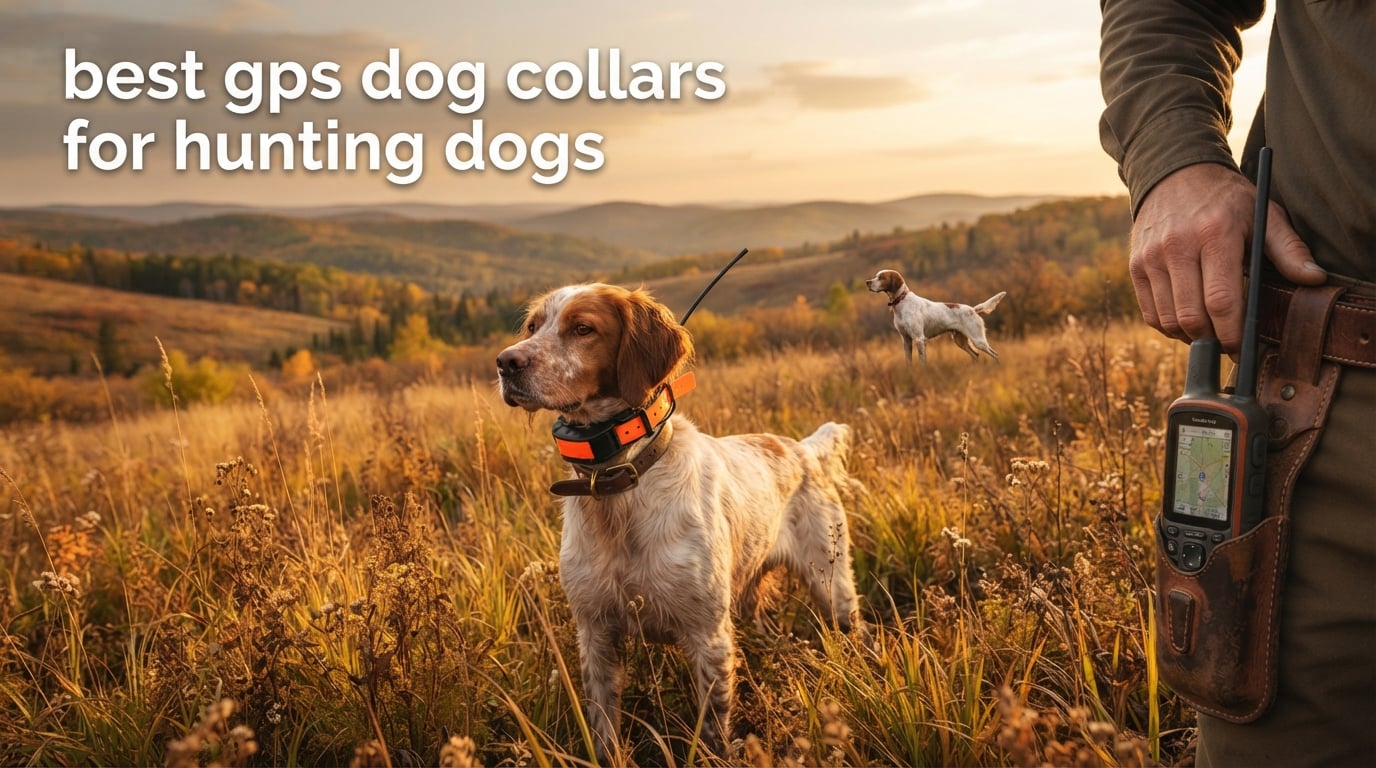
A GPS dog collar for hunting is a collar that fixes your dog’s position from satellites and relays it to a handheld receiver over VHF radio, independent of cell coverage, so you can see where the dog is, how far it has ranged, and when it is on point or treed. That last part is why hunting country is the hardest place to use a pet tracker. Timber, cattail slough and rolling public land are exactly where cellular trackers quit, and a collar that loses signal at the tree line is a collar that failed at the one job you bought it for.
We spent 2026 season sorting through the best gps dog collars for hunting dogs, and the honest answer is that the best general-purpose pet tracker and the best hunting collar are frequently not the same device. Everything in this roundup works without cell service, which is the first filter we applied and the one most products sold as “dog GPS” fail outright.
The second filter was the one hunters actually argue about on forums like Gun Dog Forum and r/Huntingdogs: does the collar need a handheld receiver, does it need your phone, and does it need a monthly subscription? Those three questions eliminate most of the category before range or battery life even enters the conversation. If you want a broader look at tracking hardware for bigger dogs outside the hunting context, our guide to dog GPS trackers for large dogs covers the everyday-walk use case in more detail.
What follows is ranked by dog type and terrain rather than by brand tier, because a collar that works beautifully for a close-range Brittany in post-oak cover can be useless to a hound that runs four miles into a drainage. All range and battery figures below are manufacturer-published, and we say so wherever a number is quoted rather than measured.
Table of Contents
Top 3 Best GPS Dog Collars for Hunting Dogs (2026)
If you want the short answer first: the Dogtra Pathfinder 2 is the most complete hunting system in this group, the Garmin TT 15 Mini is the best fit for pointing breeds and smaller dogs, and the Garmin Alpha TT 25 is the strongest all-round performer for big-running dogs. All three work with no cell service, and none requires a subscription.


Best GPS Dog Collars for Hunting Dogs in 2026
Here is the full lineup at a glance. Every collar below runs on its own radio or satellite link rather than a cell tower, and the “handheld” column in our buying guide explains which ones still force you to carry a second device.
| Product | Specifications | Action |
|---|---|---|
 Dogtra Pathfinder 2 Dogtra Pathfinder 2 |
|
Check Latest Price |
| Garmin TT 15 Mini |
|
Check Latest Price |
| Garmin Alpha TT 25 |
|
Check Latest Price |
 SpotOn Nova GPS Dog Fence Collar SpotOn Nova GPS Dog Fence Collar |
|
Check Latest Price |
 Aorkuler GPS Dog Tracker 2 Aorkuler GPS Dog Tracker 2 |
|
Check Latest Price |
 Weenect Dog XT Weenect Dog XT |
|
Check Latest Price |
 Garmin Alpha 200i / TT 15 Bundle Garmin Alpha 200i / TT 15 Bundle |
|
Check Latest Price |
 SportDOG TEK Series 2.0 Collar SportDOG TEK Series 2.0 Collar |
|
Check Latest Price |
 Dogtra PATHFINDER2 Additional Receiver Dogtra PATHFINDER2 Additional Receiver |
|
Check Latest Price |
 eMACROS Dog GPS Tracker eMACROS Dog GPS Tracker |
|
Check Latest Price |
1. Dogtra Pathfinder 2 – Best Overall GPS Dog Collar for Hunting Dogs
Dogtra Pathfinder 2 GPS Dog Tracker e Collar 9 Mile Long Range LED Light No Monthly fees Free App Waterproof Smartwatch Control Satellite Real Time Tracking Multiple Dogs Smartphone Required
9 mile range
Up to 21 dogs
No monthly fees
LED locate light
Pros
- No subscription with free Mapbox maps and offline downloads
- 9 mile range that holds up in brush and open terrain
- E-collar corrections plus tone
- vibration and LED locate light
- Works with a phone
- a smartwatch or the connector alone
Cons
- GPS fix is accurate to roughly 30 feet rather than exact
- GPS connector is required and sold separately
- Power button is fiddly and slips into pairing mode
The Pathfinder 2 is the system we kept reaching for during this roundup, and the reason is unglamorous: it does the two things hunting country demands and refuses to charge you a monthly fee for the privilege. The collar reports position over its own radio link at up to a 9 mile advertised range, and the app gives you general, satellite and terrain map views with offline downloads, so a canyon with no bars is not a canyon with no map.
Track up to 21 dogs at once, which matters more than the number suggests. Most handlers run two to four, but a coon hunter with a real pack will push ten or more, and the Dogtra app handles that grid without the dog list stuttering. Owners of pointing breeds and hard-charging dogs consistently call out that the tracking holds in heavy brush where a phone-only tracker would simply be showing you the last cached position.
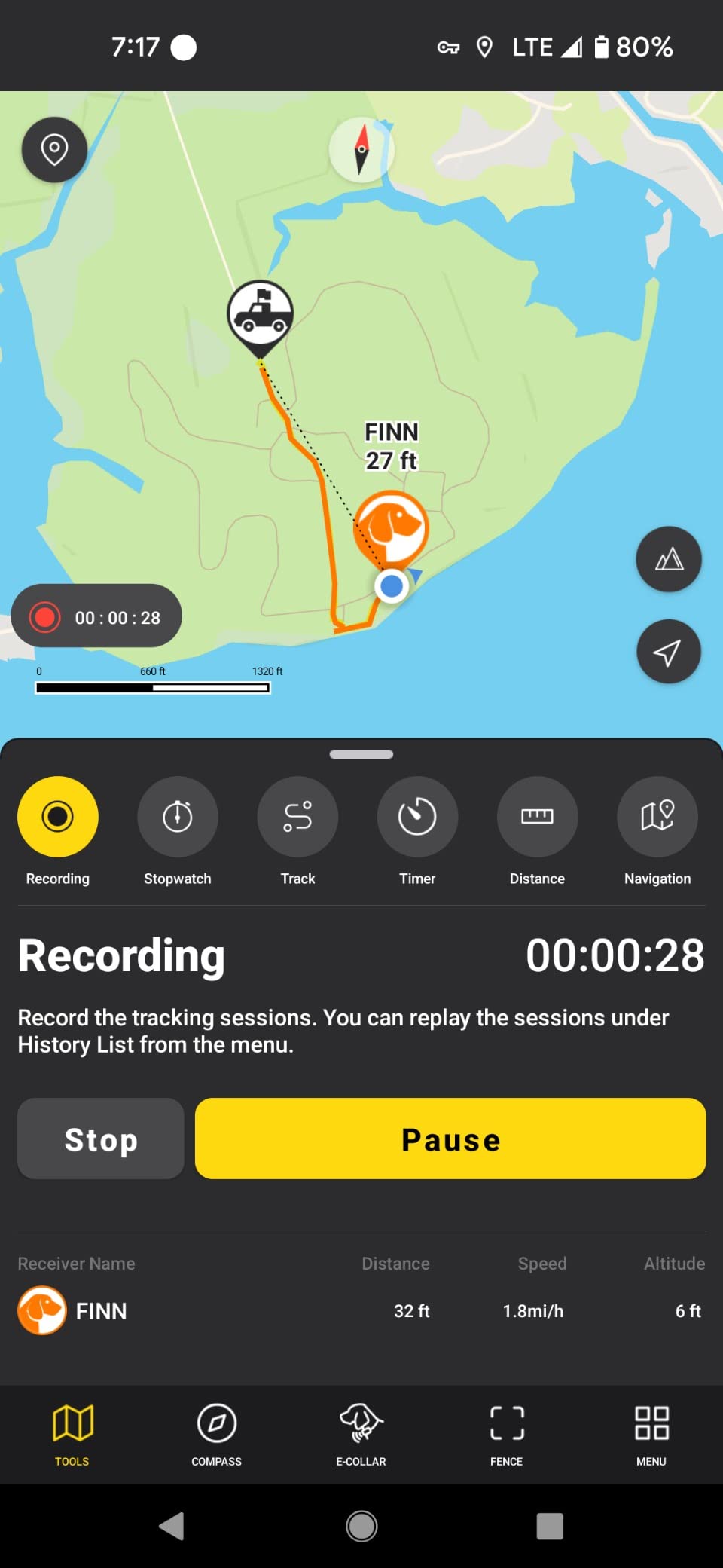
The correction side is what separates this from a pure tracker. You get nick, constant and audible tone modes, pager vibration, an LED locate light for finding a dog in downed timber after dark, and a battery-saving sleep mode you can trigger when the dog is sitting on point and not moving. For a new pup learning to range, having the recall cue and the correction in the same device on the same screen is genuinely useful rather than a convenience.
It also logs the areas your dog covered during a run, which sounds like a gimmick until you are trying to figure out whether the dog is working the CRP edge or running the creek bottom. Several owners mention using the recording function to recount a hunt afterward.
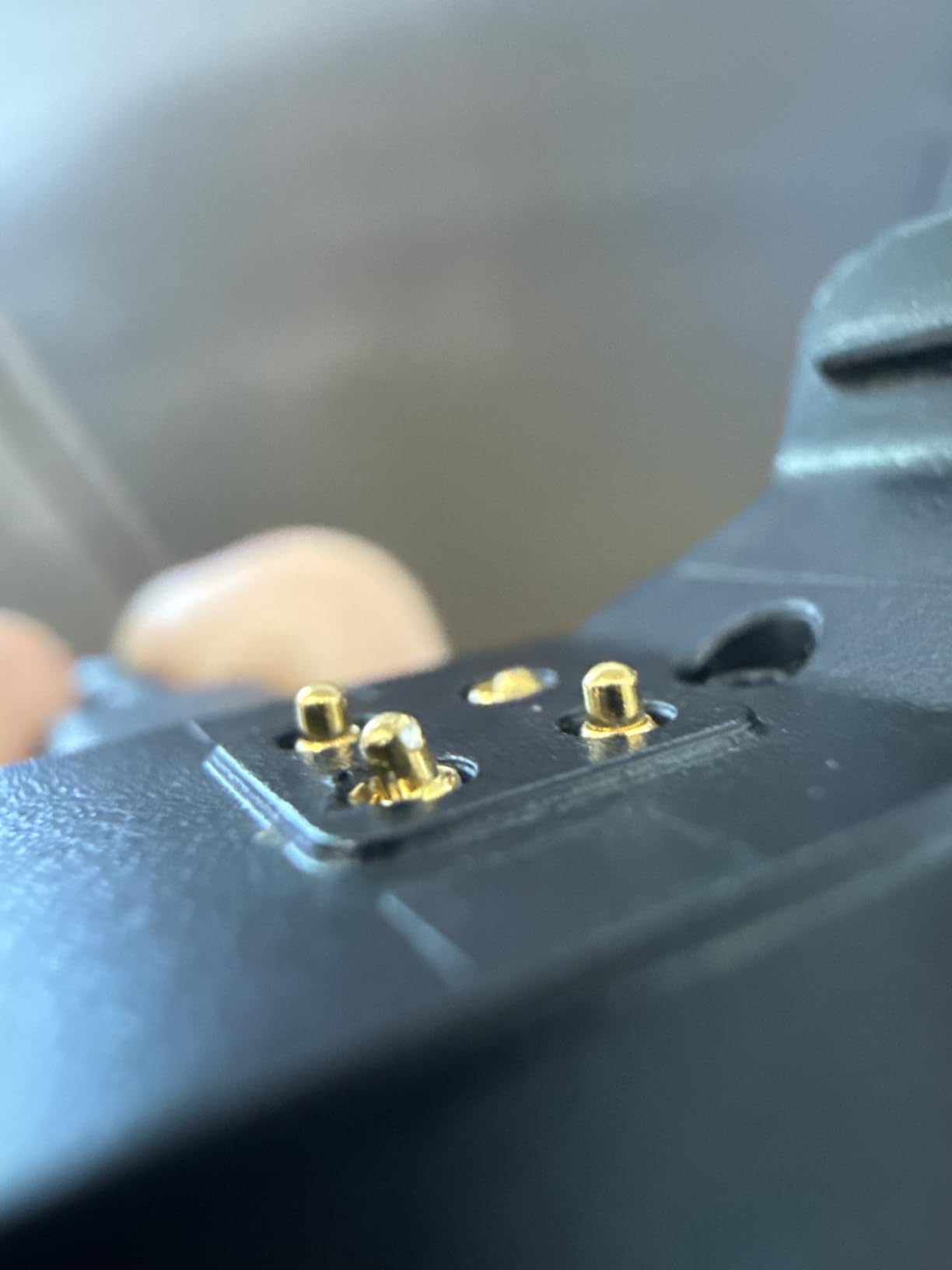
The compromises are real and worth stating plainly. Owners report the position fix lands within roughly 30 feet rather than on the exact spot, which is fine for tracking a running dog and useless if you are trying to confirm a bird dog is holding point. The GPS connector is required for operation and is not included with the collar, so budget for it as part of the system. And the power button requires a deliberate press, because holding it too long drops the unit into pairing mode.
If your dog is small enough that a 9 ounce collar bothers it, or you want the last word on stimulation levels, look at the Garmin collars below. For everything else, this is the one we would buy.
How the Pathfinder 2 handles a full day in the field
The app runs a live map with a trail behind the dog, and at a 2.5 to 5 second refresh you can watch a dog work a field edge and decide when to call it in. That refresh rate is also the biggest battery variable: leave it on the fastest setting and you will drain the collar faster than a full day of steady ranging warrants.
For multi-day hunts, the sleep mode and the offline map downloads are the two features that actually change the planning. Download your operating area before you leave the truck, put the collar to sleep when the dog is resting, and the system behaves far more like a piece of hunting equipment than a pet gadget.
What to check before you buy
Confirm the connector is in the box before you leave, because it is the single most common complaint on this product and it is a separate purchase. Then confirm your dog’s neck falls inside the strap adjustment range and that the antenna sits high on the neck rather than low where it can catch on brush.
Finally, decide honestly whether you are willing to carry your phone. The Pathfinder 2 is one of the few hunting-capable systems where a phone is genuinely optional, and hunters who refuse to carry one rate that flexibility higher than they rate raw range.
2. Garmin TT 15 Mini – Best GPS Dog Collar for Pointing Breeds and Small Dogs
Garmin 010-01486-00 TT 15 Mini Dog Device
7.5 oz collar
Necks from 9.5 inch
16-30 hour battery
GPS and GLONASS
Pros
- Lightest and smallest collar here at 7.5 oz
- Fits necks as small as 9.5 inch
- Vibration recall works well in dense cover
- Sleep mode conserves battery between hunts
Cons
- Shorter battery and less range than the full size TT 15
- GPS track is noisier in multi-dog use
- Handheld not included and strap sold separately
This is the collar for the Brittany, the setter, the small pointing pup and the older dog whose neck cannot carry a full-size unit. At 7.5 ounces it is less than a quarter of the weight of the standard TT 15, and it fits necks down to 9.5 inches, which puts it in territory where most hunting-grade GPS collars simply do not go. It carries a 4.7 rating from 240 reviews, which is the strongest review-and-rating combination in this group.
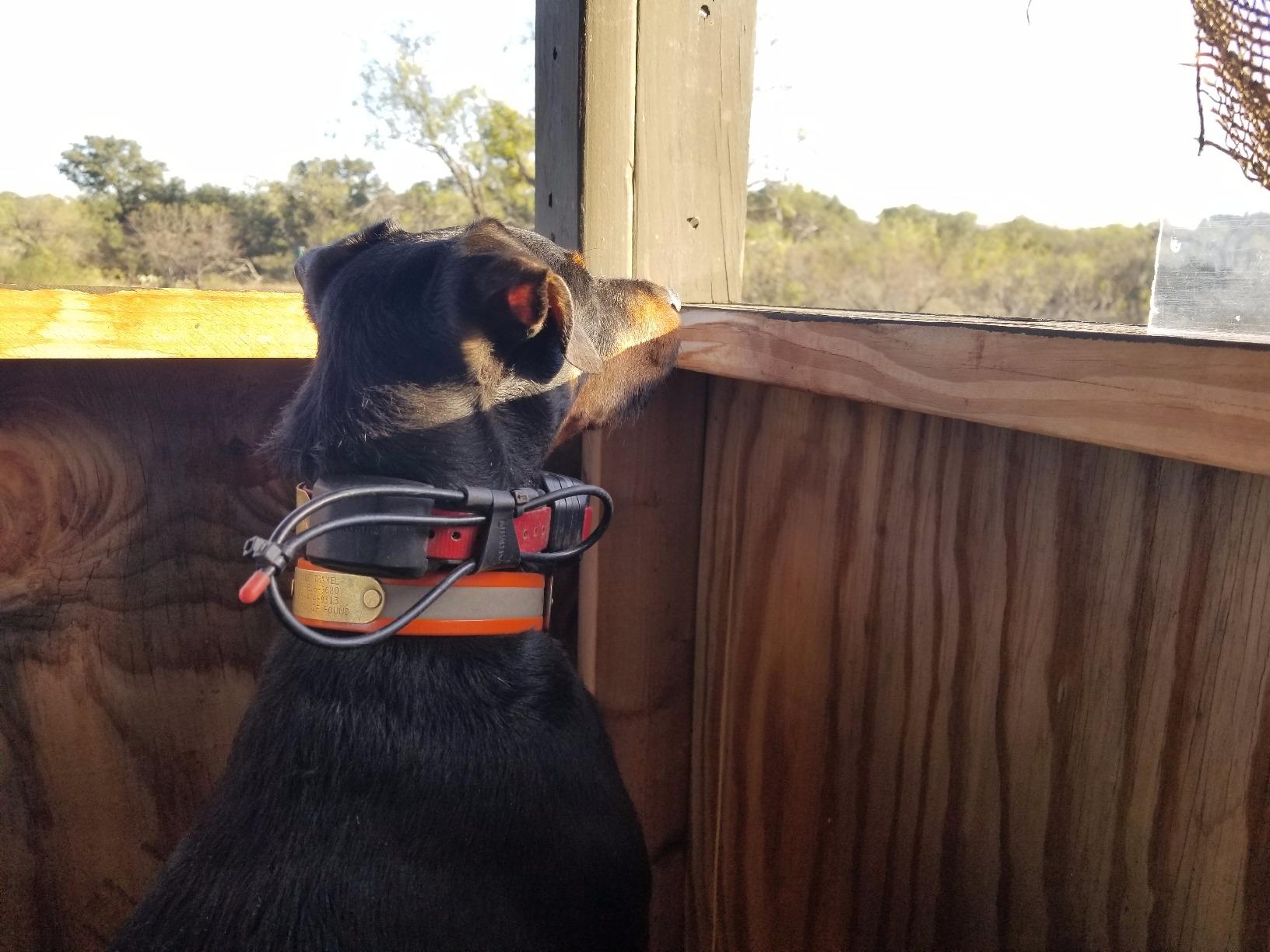
The tracking itself is a top-mounted high-sensitivity GPS/GLONASS receiver, so it holds a lock in the canopy situations that defeat a phone held at chest height. Owners hunting German Shorthaired Pointers and similar breeds single out the vibration recall as the feature they notice most, because a tone-only cue is easy to lose in wind and a vibration gets through.
Collar sleep mode is the second thing handlers appreciate, and it solves a problem that is easy to underestimate. If you are running a bird dog through three hunts in a week, the difference between a collar that needs charging between days and one that is ready when the truck starts is the difference between a tool you use and one you leave on the charger.
The build quality comes up constantly in reviews as well. Owners report collars lasting years of service, and the two lengths of removable insulated stainless steel contact points mean you can change prong length without sending anything back.
The tradeoffs are all about size. Battery life is 16 to 30 hours, and some owners report closer to 8 hours in the field with a fast update rate. Range is shorter than the full-size TT 15, and the GPS fix jumps around a bit more, which adds noise to a multi-dog grid if you are running two or three at once.
You also need a separate Garmin handheld, and the collar strap is sold separately. If you are only running one dog and it is a small pointing breed, that is a reasonable bill. If you run a pack, look at the full-size TT 15 bundle or the SportDOG add-a-dog collar instead.
Fit and sizing for this collar
The 9.5 inch minimum neck is the number that matters if you have a puppy or a small breed, and it is genuinely useful. Measure the neck where the collar will sit, not where the fur is longest, and you should be able to fit two fingers under the strap once it is snugged to the first hole.
Position matters as much as size. The antenna needs to sit high on the neck, oriented vertically, or thick cover will eat your signal before the collar ever gets a chance to report a clean fix.
How the battery behaves across a hunting week
Sixteen to thirty hours is a real multi-day number, not a single-day number, and it assumes you are using sleep mode and a sensible update rate. Run the fastest refresh for an entire three-day hunt without sleep mode and you will be charging overnight instead of tracking.
Plan on topping up the collar the night before each hunt day, and treat the handheld as the device that actually needs a mid-day charge. That division of labor is the opposite of what most people assume, and it holds for most Garmin systems.
3. Garmin Alpha TT 25 – Best All-Round Collar for Big-Running Dogs
Garmin Alpha® TT 25, GPS Dog Tracking & Training Collar
9 mile range
2.5 second updates
Up to 68 hours
18 stimulation levels
Pros
- 88 percent of reviews are five star
- Updates as fast as 2.5 seconds for fast dogs
- User-replaceable batteries and flex band extend service life
- Large multicolor LED for low light identification
Cons
- Handheld sold separately
- Only one collar per package for multi-dog setups
- Battery life varies sharply with update frequency
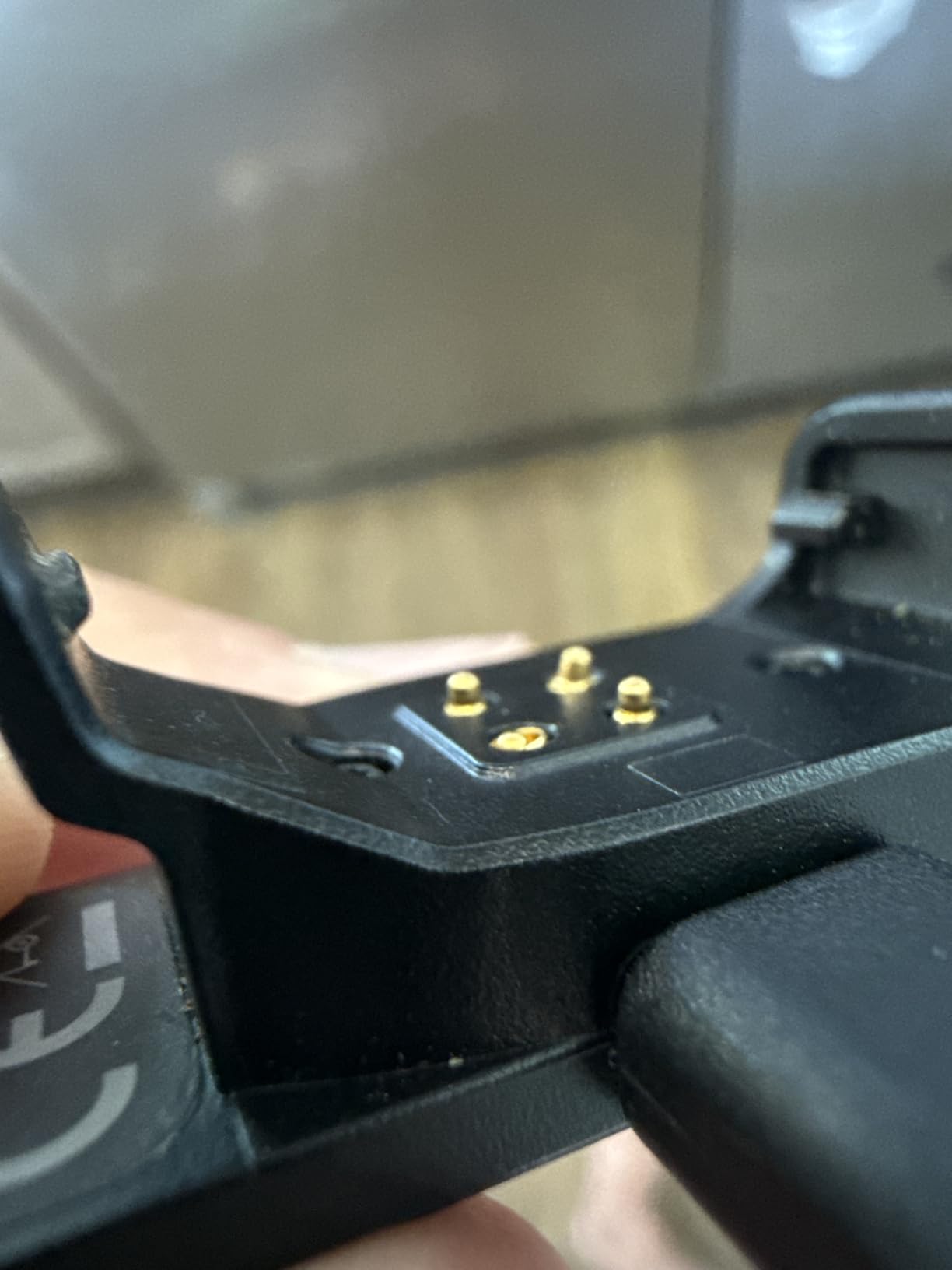
The TT 25 is the collar we would put on a German Shorthaired Pointer that ranges hard and wide, and the reason is the combination of update rate and runtime that no other single unit in this roundup matches. Positions report as frequently as every 2.5 seconds out to an advertised 9 miles, and the battery runs up to 68 hours, or 136 with the expanded pack.
That runtime is not a fixed number. Dynamic tracking extends battery life based on how much the dog is moving, so a dog working a slow CRP edge sips power while a dog running flat out across a field burns it faster. Owners running big-ranging dogs treat a 68-hour figure as a realistic single-hunt-and-change number rather than a week-long promise, and that expectation is realistic.
The training side offers 18 levels of continuous or momentary stimulation, plus audible tone and vibration. Eighteen levels is fewer than the 99 offered by some training-first systems, which matters if you are working a delicate breed, and more than enough for a dog that needs a clear but measured correction.
The multicolor LED is the sleeper feature. It cycles yellow, magenta, cyan, white, green, red and blue, and on a dog holding point in a drainage at last light that is the difference between walking to the bird and walking a quarter mile looking for it.
Only one dog collar ships in the package, which is the single most common complaint from buyers setting up a multi-dog rig. The user-replaceable flex band and user-replaceable batteries soften that considerably, since a worn strap does not mean a new collar, and automatic Wi-Fi updates while charging keep the firmware current without a computer.
Pairing is limited to Garmin Alpha and Pro 550 Plus handhelds, and those are sold separately. If you already own an older Alpha unit, this collar drops into it, which is often the cheapest path into the Garmin system for an established handler.
Why the update rate matters more than the range number
A 9 mile range figure tells you the theoretical ceiling. A 2.5 second update rate tells you what you will actually experience when the dog is running, because the gap between positions is what makes a track look like a dotted line instead of a path. Fast updates are what let you see a dog commit to a treed coon versus drifting.
The cost is battery, and the relationship is steep. A handler who runs the fastest setting through a three-day hunt will spend a night charging what other people charge weekly. Decide your update rate at the truck rather than in the field.
What to verify before purchase
Make sure you own, or are buying, a compatible Garmin Alpha or Pro 550 Plus handheld. This collar does not talk to a phone, and it does not pair with the Astro line, so buying it standalone without a handheld is a very common and very expensive mistake.
Also check the strap against your dog’s neck and confirm whether you need the expanded battery pack for a multi-day trip. Everything else about this collar is close to uncontroversial among owners, and 88 percent five-star reviews is the highest share in this group.
4. SpotOn Nova GPS Dog Fence Collar – Best for Holding a Dog on Ground You Own
SpotOn Nova GPS Dog Fence Collar, App-Controlled Wireless Fence
Dual-band dual-feed GPS
Unlimited fence shapes
Fits 10-26 inch necks
Trainer support included
Pros
- Built specifically for dependable containment accuracy
- Unlimited custom fences and keep-out zones from the app
- Works in dense tree cover and uneven terrain
- Certified one-on-one trainer support
Cons
- Built for containment rather than open-country tracking
- Rating spread is the widest here with 11 percent one-star
- Newer listing with a smaller review base
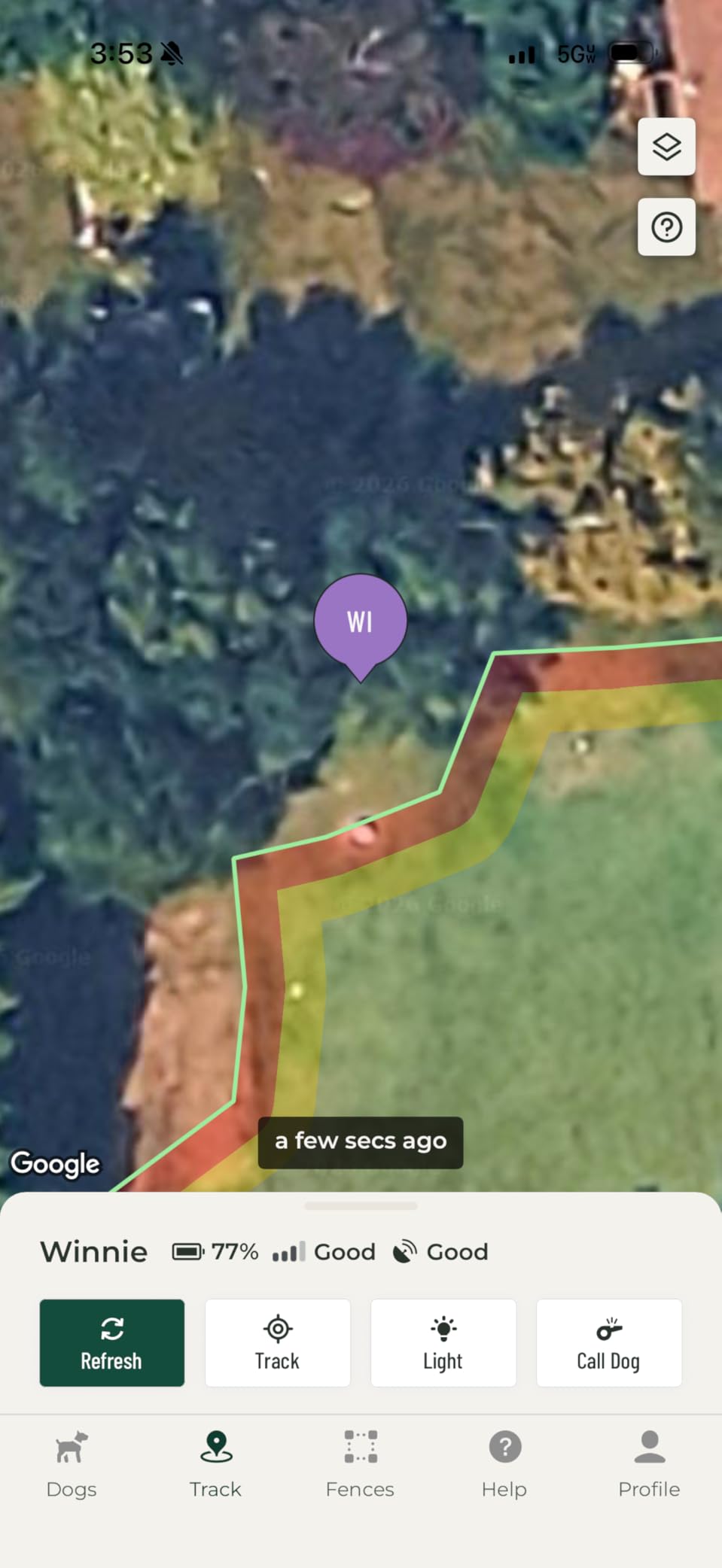
We want to be direct about this one: the SpotOn Nova is not a hunting collar, and reading it as one will disappoint you. It is a containment system, and the thing it does better than anything else in this roundup is hold a boundary exactly where you drew it. If you are hunting public land, this is the wrong tool. If you are keeping a dog off your own ground between hunts, it is a genuinely capable device.
The technology is patented dual-band, dual-feed GPS, which is the collar equivalent of a phone locking onto two satellite bands at once. That extra signal is what lets the boundary stay put in dense tree cover and low-signal areas, which is the same terrain that frustrates cheaper trackers. The manufacturer reports keeping dogs within virtual boundaries 99.3 percent of the time based on aggregate user data, and you can watch containment activity in the app in real time.
Fences are unlimited in number and can be any shape or size, and you can set correction-free keep-out areas inside them. The included Julius-K9-style adjustable collar fits 10 to 26 inch necks, and certified 1:1 trainer support comes in the box, which is unusual at any price point and genuinely useful for a first-time fence editor.
At 13.44 ounces the collar is on the heavier side for a small dog, and the neck range bottoms out at 10 inches. It is a mid-size and large dog system, and it is not a puppy collar.
Honest caveat on the ratings: only 63 percent of reviews here are five stars, with 11 percent one-star, which is the widest spread of any collar in this group. Owners credit consistent boundary cues and dependable containment, particularly under tree cover, but a meaningful share of critical reviews means you should check the current review set rather than assume it is a set-and-forget device.
It is also a newer listing than the Garmin and Dogtra options, with 121 reviews behind it. That is not a reason to skip it, but it is a reason to buy it from a seller who will still be there in three years, given how many pet tracking services have shut down.
When this collar is the right answer
The Nova earns its place when you need a dog kept out of a creek, off a road, or inside a specific boundary on ground you control, and where tree cover makes cheap trackers wander. Many handlers run one of these on the truck for a dog that is not actively hunting that day.
It is also a reasonable safeguard for a young dog being introduced to water retrieves near a farmhouse pond, where the failure mode is a dog in water you did not expect it to be in.
When to skip it
If you need to know where your dog is three miles into timber across a river bottom, stop reading and move to a VHF system. There is no range spec here to compare, because containment is a different problem from ranging, and no amount of fence accuracy changes that.
Also skip it if your dog is under about 20 pounds or a growing puppy, since the weight and the 10 inch minimum neck both work against small dogs.
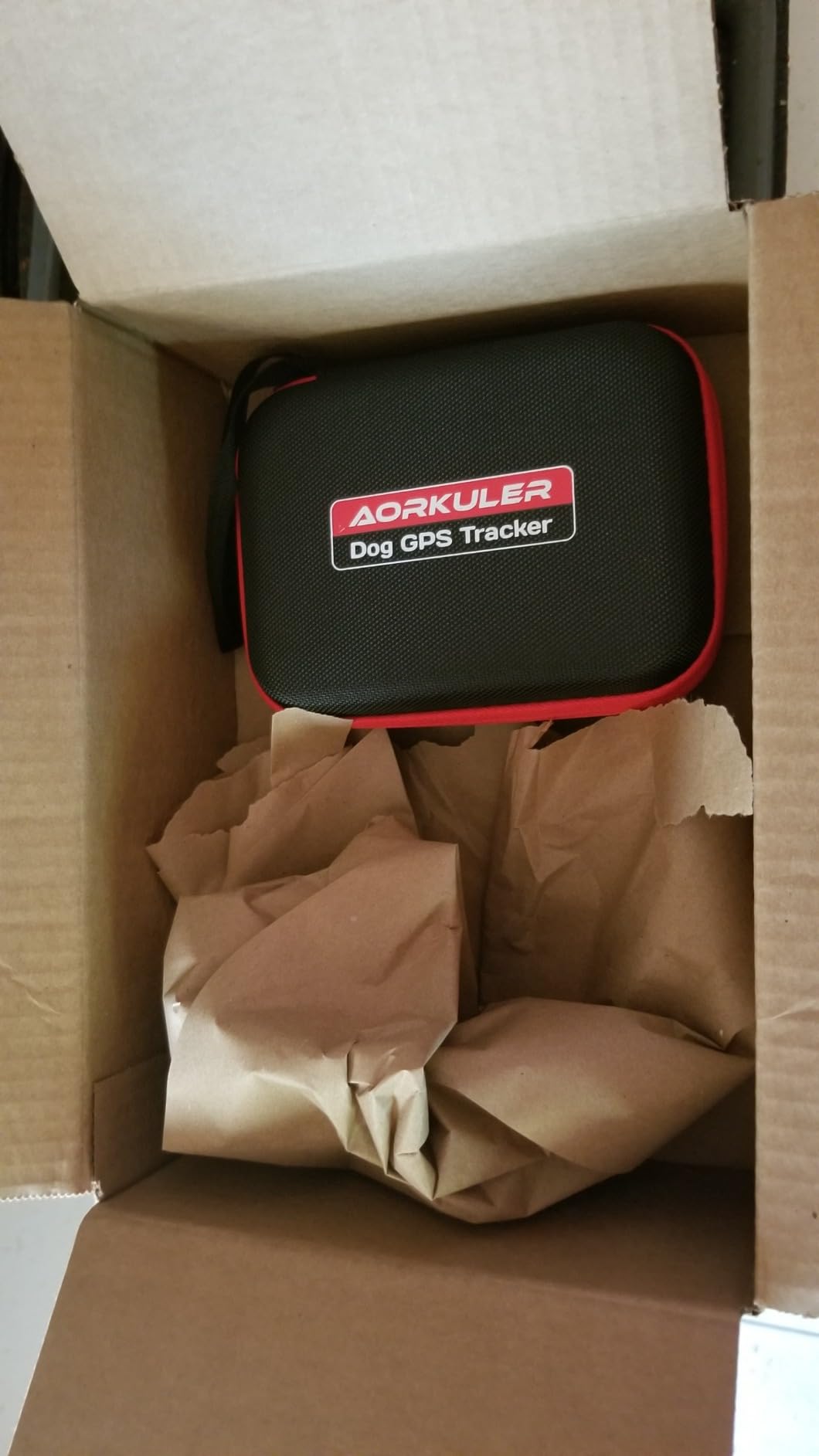
5. Aorkuler GPS Dog Tracker 2 – Best Radio Tracker for Off-Grid Country
Aorkuler GPS Dog Tracker – No Phone, No Signal, No Subscription | Real-Time Direction & Distance Up to 3.5 Miles | Built for Hiking, Farms & Off-Grid Adventures (Tracker 2)
3.5 mile range
3 second updates
1.08 oz
No phone or subscription
Pros
- No phone
- no cell signal and no subscription required
- Direction and distance arrow needs no map or app
- Lightweight at 1.08 oz and fully waterproof
- 3-year warranty with product registration
Cons
- GPS lock can take several minutes or fail entirely
- Accuracy degrades badly around buildings and dense forest
- Weakest rating spread here at 59 percent five-star
This is the simplest device in the roundup and the one that gets the fundamentals right. There is no subscription, no account, no cloud service and no phone. The handheld controller shows a green directional arrow and a distance, updates every 3 seconds, and tracks up to 3.5 miles entirely over its own radio link. Owners report real-world ranges of 3.5 to 4 miles across open brush and rolling terrain, which matches the headline figure.
For someone who refuses to carry a phone in the field, that simplicity is not a compromise. It is the whole reason to buy it. The controller is the tracker, the tracker is the collar, and the only thing you have to learn is how to point yourself at the arrow.
At 1.08 ounces it is the lightest collar here by a wide margin, and it is fully waterproof, so it handles a wet retrieve without a second thought. A 2 to 3 hour charge gives up to 24 hours of continuous tracking or 10-plus days with typical 1 to 2 hour daily walks.
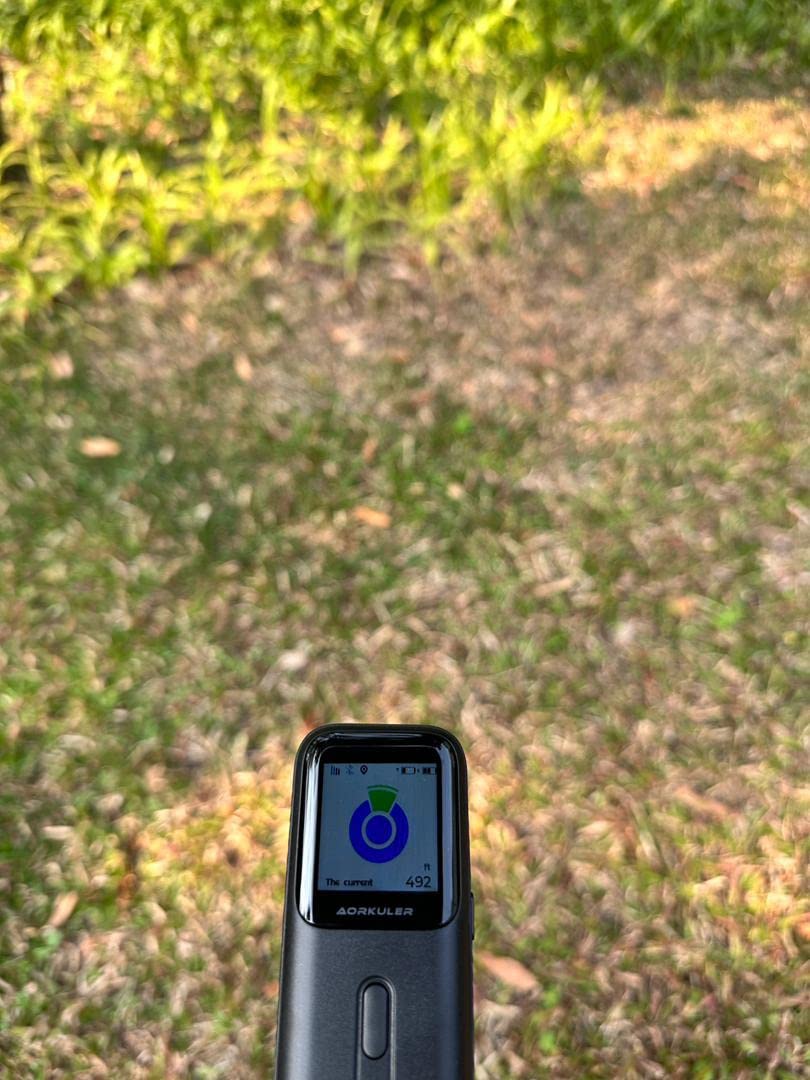
Now the part that matters. The single most common complaint is GPS lock time. Owners report waiting several minutes for the handheld to acquire satellites, and sometimes waiting and getting nothing at all. That is a real problem if you are standing in a creek bottom at 6 a.m. and the dog is already gone, so the habit to build is to power the controller on at the truck and let it lock before you release.
Accuracy also degrades badly when buildings, dense forest or other obstacles sit between the handler and the dog. Some receivers have pointed in the wrong direction entirely during real-world tests, and a receiver that has been pocketed sometimes needs a figure-eight motion to reorient the compass. The LCD is also difficult to read through polarized sunglasses, which is a detail that matters more than it sounds when you are squinting across a field at noon.
There is no stimulation or training function. This is tracking only, and if you want a recall cue you need something else.
How to plan around the satellite lock
Every radio tracker that lacks a warm start needs planning time, and this one needs the most. Power the controller at the truck, hold it still until the arrow stabilizes, and only then unhook the leash. Handlers who adopted this routine report it removes almost all of the frustration associated with the device.
If you are moving between hunt spots, give it a minute in the open before you expect a fix. A driveway or a tree line is a poor place to discover that it has not locked.
What this tracker is genuinely good for
It is excellent on a farm, on a large private tract, or in the rolling open country where a hound or a free-ranging dog works within a few miles of the truck. Owners in genuinely off-grid areas describe it as the reason they stopped paying monthly fees for a tracker they could not use anyway.
It is a poor choice if your dog routinely runs into big timber or behind buildings, and it cannot do anything about training. Know which of those describes your dog before you order.
6. Weenect Dog XT – Best Budget Entry, and Only Where You Have Signal
Weenect Dog XT – GPS Dog Collar | Subscription Required
Subscription required
Update every second
Up to 3 weeks battery
IP68 waterproof
Pros
- Lowest entry cost of any tracker in this roundup
- Multi-constellation GPS with a position update every second
- Up to three weeks battery with power-saving zones
- Escape alerts
- recall ringtone and a built-in flashlight
Cons
- Paid subscription required per tracker for tracking to work at all
- Depends entirely on mobile network coverage
- No e-collar stimulation
- location tracking only
We are including this one and warning you about it in the same breath. The Weenect Dog XT is a cellular tracker. It transmits position over the mobile network with no distance limit, which sounds ideal until you remember that the entire premise of this roundup is that hunting country has no network. A single bar of service is not enough to be confident in.
Where it does work, it works well. The multi-constellation receiver combines GPS, Galileo, Glonass and BeiDou and reports a new position every second, which is the fastest update rate in this group. Owners like the hardware, the app and the setup once the subscription is active.
Battery is a genuine strength. The 1250 mAh cell gives about a week of continuous tracking and up to three weeks with power-saving home zones set. The IP68 body is waterproof to 1.5 meters for 60 minutes, it weighs 54.2 grams, it fits dogs from 4 kg, and the included adjustable collar covers 37.5 to 56.5 cm necks. There is also a lifetime warranty that repairs whenever possible.
The extras are more thoughtful than the price suggests: escape alerts that fire in under a minute, a ringtone and vibration mode you can use for recall training, and a built-in flashlight for night finds.
When a cellular tracker is the correct choice
There are real hunting situations where cellular is fine. Small acreage you own outright, a private lease with good tower coverage, a beagle pack working a state park that happens to have service along the main road, or a younger dog you are keeping an eye on while it learns the property. In those cases the one-second updates and the three-week battery are hard to argue with.
Many owners are effectively using these as a second device, worn while the dog is at home between hunting trips. Just know that is what you are buying when you order one.
Why we would not take it into big timber
The failure mode is quiet. When you lose service, the app does not say the dog is lost, it just stops updating, and you discover the gap when you look up. Forum handlers describe cellular trackers dismissed as close to useless for real off-grid hunting for exactly this reason.
There is also no stimulation function, so this does not double as a training collar no matter how convenient the price looks.
7. Garmin Alpha 200i and TT 15 Bundle – Best Complete Hunting System
Garmin Alpha 200i/TT 15 Dog Tracking and Training Bundle, Handheld and Collar, Utilizes inReach Technology, Sunlight-readable 3.6″ Touchscreen (010-02230-00), Black
Handheld and collar
20 dogs at 2.5 second updates
Iridium satellite SOS
Preloaded topo maps
Pros
- Complete package
- handheld plus TT 15 collar
- nothing extra to buy
- Tracks up to 20 dogs at up to 9 miles with 2.5 second updates
- Iridium satellite SOS and two-way messaging for remote country
- Sunlight-readable touchscreen with preloaded topographic maps
Cons
- Battery drops to about 15 hours with inReach enabled
- Two-way messaging needs an active satellite subscription
- Heaviest and most costly system here
This bundle is the answer for the handler who wants the collar, the handheld and the safety net in one purchase. You get the Alpha 200i handheld with a sunlight-readable 3.5 inch capacitive touchscreen, preloaded TopoActive maps, direct-to-device BirdsEye satellite imagery, a three-axis compass and a barometric altimeter, plus a TT 15 collar with 18 levels of continuous and momentary stimulation plus tone and vibration.
Nothing else in this roundup lets you set up and monitor 20 dogs at up to 9 miles away with 2.5 second updates on a screen you can read in direct sun. Hunt Metrics, which logs each dog’s daily patterns per hunt, is the feature owners who run multiple dogs mention first because it turns a season into data you can actually train from.
The satellite layer is the differentiator in real backcountry country. Interactive SOS alerts and two-way messaging run over the global Iridium satellite network, which is exactly the situation where a handler usually has nothing. It requires an active satellite subscription to use, which is a running cost and worth factoring in before you commit.
Managing battery on a multi-day hunt
The handheld runs up to 20 hours, and that falls to about 15 hours with inReach enabled. Owners planning longer trips plan around the satellite function rather than assuming it is free battery-wise. The batteries are user-replaceable, which helps, but both collar and handheld still need regular charging in the field.
Bring a vehicle power cable and treat the handheld as the device to charge overnight while the collar sits in sleep mode. Collar and handheld charging on the same night is a scheduling error you only make once.
Fit, compatibility and expansion
The bundle is backward compatible with existing Alpha collars and T 5, T 5 mini and TT 15 devices, and location data transfers across. If you already own a Garmin system, adding a dog is incremental. If you are starting cold, this is the most you will spend in a single transaction and the least you will spend over five seasons.
Dog list and group management keeps inactive dogs in the system for easier setup, which sounds minor until you are working a rotation of six dogs and a picker and one feeder.
8. SportDOG TEK Series 2.0 Add A Dog Collar – Best for Expanding a Pack of Hounds
SportDOG TEK Series 2.0 Add A Dog GPS Collar, 16 KM Range, 21 Dog Tracking, Waterproof, Dogs Necks 10.75, 23 Inches
16 km range with TEK 2.0
21 dogs tracked
Waterproof to 7.6 meters
3 year warranty
Pros
- Longest advertised range in this group at 16 km with the TEK 2.0 handheld
- Tracks up to 21 dogs from one receiver
- DryTek waterproofing rated to submersion of 7.6 meters
- Works with both TEK 1.5 and TEK 2.0 handhelds for gradual expansion
Cons
- Add-a-dog collar only
- a SportDOG handheld is required
- Smallest review base in this roundup
- Owners note the preloaded maps could be better
The TEK 2.0 collar is the longest-range hardware in this roundup, quoting 16 km with the TEK 2.0 handheld and 11 km with the older TEK 1.5. That is built on HopTek technology with increased transmitting output, and for a hound man running a pack across big country it is the number that matters. Real range still depends on terrain, but no other collar here quotes a larger ceiling.
Multi-dog capacity is 21 with the TEK 2.0 handheld and 12 with the TEK 1.5, so a single receiver can cover a full pack. For a squirrel or coon hunter running six to eight hounds, that is the whole argument for this system over a single-dog setup.
Waterproofing is the standout spec. DryTek technology is rated to a submersion depth of 7.6 meters, which is deeper than anything else here and simply removes the question when a hound goes swimming after a coon.
Compatibility is the underrated part. If you own a TEK 1.5 handheld, this collar works with it, and long-time owners report drop-in setup with almost no fuss. That means you can build a pack one collar at a time over several seasons instead of replacing a working system.
There is a 3-year manufacturer warranty, which is the longest in this roundup, and owners with prior TEK collars rate the performance as reliable.
What the range figure does and does not promise
Radio range is a line-of-sight ceiling. 16 km is achievable over open water and across flat prairie. In thick timber, along a canyon wall or in rolling post-oak, the practical figure is a fraction of that, and no manufacturer claims otherwise in writing.
Handlers running this system describe a technique that helps: swing the receiver in an arc to find the signal peak rather than trusting a single heading. It takes some getting used to, and experienced handlers say so openly, but once you learn it the directional-only readout is fast.
What to check before buying
This is an add-a-dog collar. You need a SportDOG TEK 1.5 or TEK 2.0 handheld to go with it, and if you are starting from nothing, price the system rather than the collar. The adjustable range covers 10.75 to 23 inch necks, which spans most hounds but excludes very small dogs.
Look at the maps before you commit, since owners specifically call them the weakest part of the system. And note the review base is the smallest here at 48 reviews, so treat the strong rating with the caution you would apply to any young product line.
9. Dogtra PATHFINDER2 Additional Receiver – Best Add-On for Dogs 35 lbs and Up
Dogtra PATHFINDER2 Additional Receiver, Black GPS Dog Tracking and Training Collar for Dogs 35 lbs and Up, 9 Mile Range, Connector Not Included, No Monthly Fees, Free App, IPX9K Waterproof
Add-a-dog receiver
9 mile range
Dogs 35 lbs and up
IPX9K waterproof
Pros
- Adds a dog to an existing PATHFINDER2 system without new hardware
- Same 9 mile range and no monthly fees as the base collar
- Free app with offline maps and smartwatch support
- IPX9K waterproof
- LED locate light and sleep mode
Cons
- Requires the PATHFINDER2 GPS connector
- which is sold separately
- Not compatible with the original PATHFINDER series
- Only suits dogs of 35 lbs and up
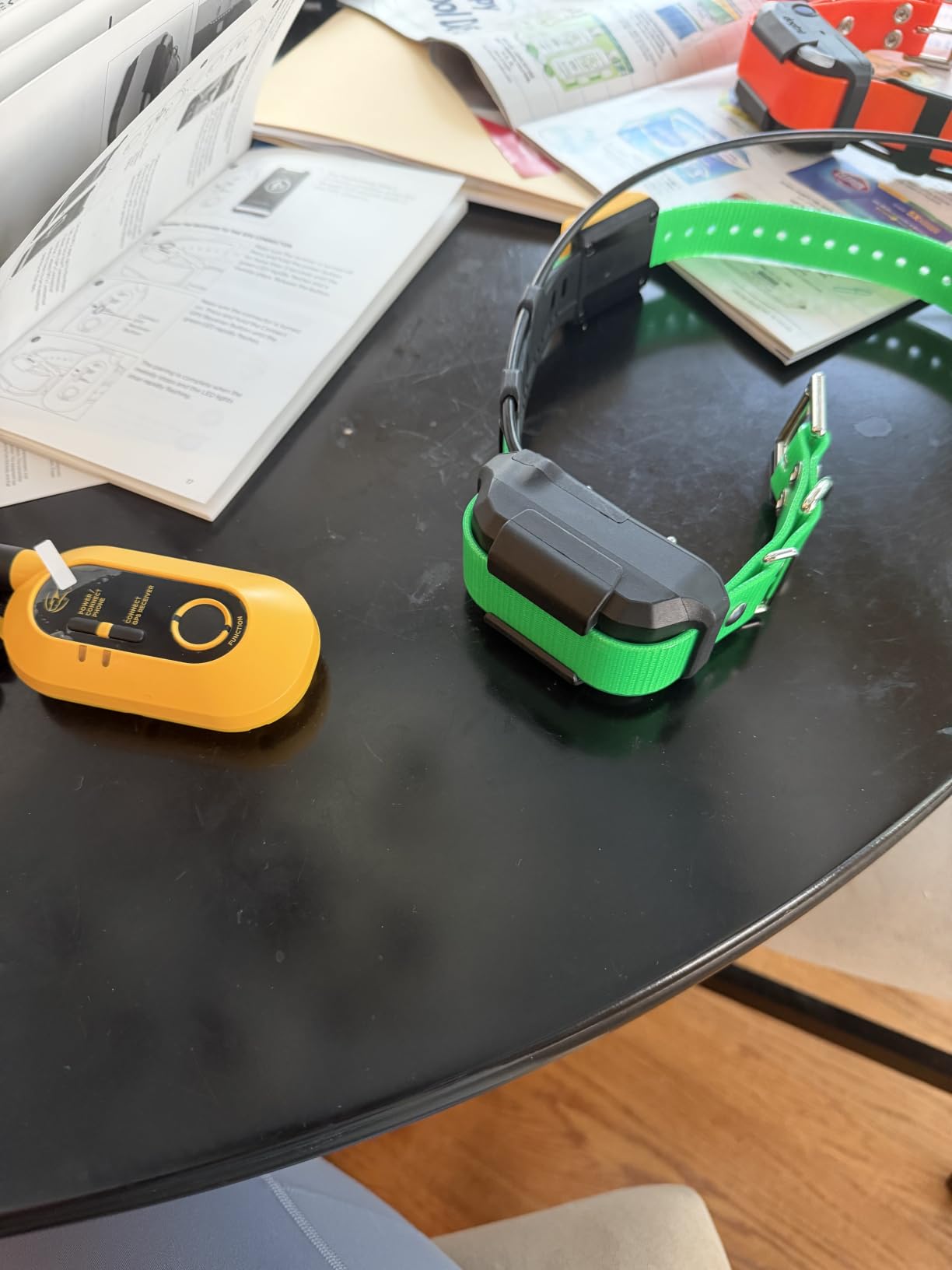
Most people buying a second dog collar make a mistake here that this product exists to solve. If you already run a PATHFINDER2 system, adding a receiver is all you need, because the connector and the app are shared. You are not buying a second handheld, a second connector or a second subscription.
The specifications match the base collar, which is the point. You get 9 mile range, IPX9K waterproofing, the free app with offline maps, smartwatch compatibility for Apple Watch and Galaxy Watch, nick and constant correction modes, audible tone, the LED locate light, pager vibration, battery-saving sleep mode and a lost collar locator.
The limitation that defines this product is the 35 lbs weight threshold. This receiver is built for large dogs, and a Brittany or a beagle needs the smaller unit instead. Owners running mixed packs should plan accordingly, or the small dog goes untracked, which defeats the purpose.
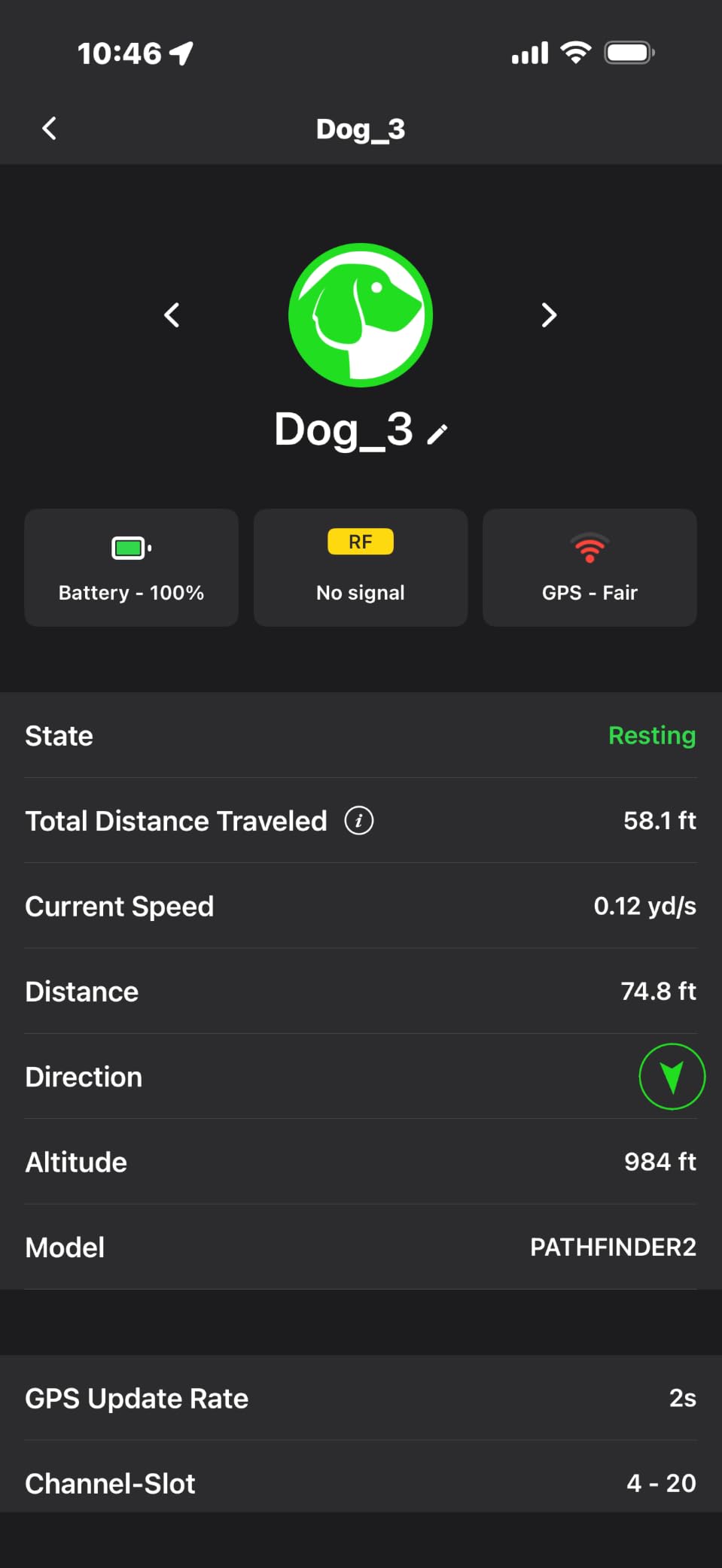
It is also not compatible with the original PATHFINDER series, only PATHFINDER2. That is a confusing naming situation and the most common question in the reviews, so check what you actually own before ordering. The GPS connector is required and not included here either.
At a 4.1 rating across 82 reviews, the feedback is steady and positive on range and the no-fee model, with the accessory-cost complaint being the consistent theme.
When buying add-a-dog hardware makes sense
Once you are past two dogs, incremental collars are dramatically better value than a second system, and this is the cleanest way to do it in the Dogtra ecosystem. The same is true of the SportDOG TEK add-a-dog collar in the SportDOG ecosystem, so pick your ecosystem first and then expand within it.
Two ecosystems in one truck is a common and workable arrangement, especially if a hunting partner runs a different brand, but it does mean carrying and charging two systems.
How to share a hunt with a partner
Many handlers write the collar radio frequency on a card and give it to their hunting partner, so a second hunter with a full-function tracker can tune in and help with a search. It is the cheapest insurance in this entire roundup and costs nothing.
Wireless device-to-device sharing also lets you pass a location to a partner in the field without a network, which is worth setting up once before you need it.
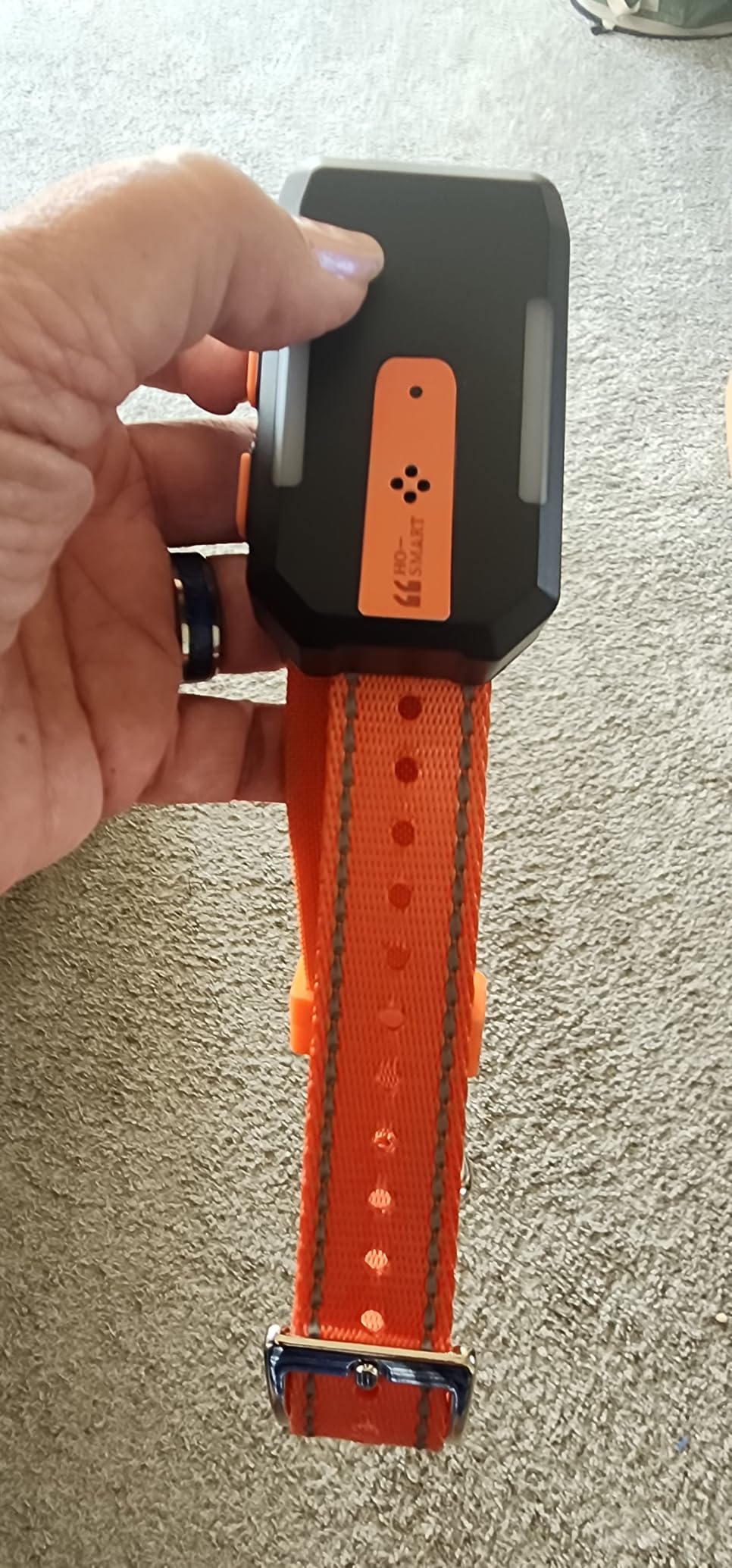
10. eMACROS Dog GPS Tracker – Simplest Setup for Large Dogs on a Budget
eMACROS Dog GPS Tracker No Subscription, Off-Grid, Up to 3 Mile Long Range
No subscription
Up to 3 mile range
5 day tracker battery
Handheld controller
Pros
- No monthly subscription and works off-grid with no cellular or internet
- Up to 3 mile range in open areas and 2 miles rural
- Five day tracker battery plus light and sound night find features
- Three-level virtual fence and reflective collar
- 2 year warranty
Cons
- Range drops to about 0.5 miles in forested areas
- Controller battery only lasts about 2 days
- No smartphone app integration
- Only 12 reviews so far
The eMACROS does the least and does it cleanly. It is an RF tracker with a handheld controller, no app, no account and no subscription, and the controller gives you arrow and distance guidance with a three-level virtual fence at 200, 500 and 1000 feet. For a large dog on ground you are actively working, that is a complete feature set.
The published range depends entirely on terrain, and the manufacturer is unusually honest about it: up to 3 miles on open coastline, 2 miles in rural areas and 0.5 miles in forested areas. That last number is the one that decides this collar for a hunter, and it is why we ranked it tenth despite a 4.8 rating.
Battery is split between the two devices. The tracker runs up to 5 days and the controller up to 2 days, so a multi-day hunt means charging both on a schedule. Night find features include a light and a sound cue, and the collar is reflective, which helps in low light before you need either.
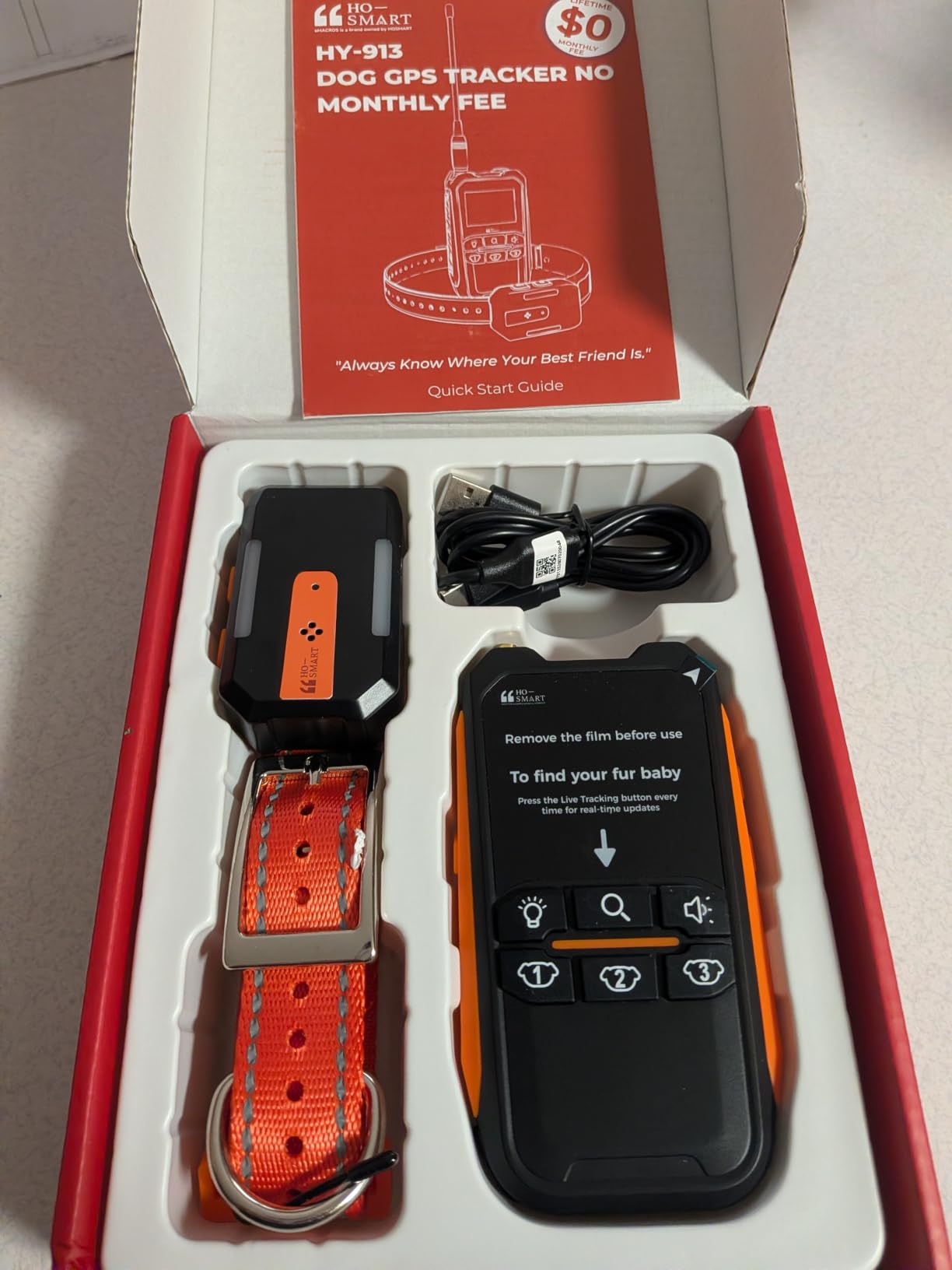
At 170 grams this is a heavy collar, and the item is specified for dogs of 35 lbs and up. There is no app integration at all, which is a genuine limitation if you have grown used to a phone interface, and the 2-year warranty is solid if shorter than SportDOG’s.
The 4.8 rating comes from 12 reviews. That is a small enough sample that the distribution tells you more than the average, and the feedback consistently praises the simple guidance and virtual fence while confirming that range varies sharply with terrain.
When arrow and distance is enough
If your dog ranges within a mile or two of you in open country, the arrow and distance readout gives you everything you need without a map to interpret. That simplicity is why many owners like it. You are not reading a topo map while holding a shotgun; you are following an arrow.
It is also a genuinely good budget way to get off subscriptions entirely, and the three-level fence adds a useful layer for young dogs working near a road.
When timber ends the conversation
At about half a mile of forest range, this is a farm and field tracker rather than a timber tracker. A dog that pushes into a drainage and gets into big trees will take your signal with it, and no amount of arrow-reading skill fixes that.
If that is your dog, spend up and get a VHF system with a real mile-plus range figure. If your dog works open country and you want zero recurring cost, this does the job honestly.
How We Picked These GPS Dog Collars for Hunting Dogs
Our starting point was simple: if the collar cannot work without cell service, it does not belong in a hunting roundup, no matter how well it performs elsewhere. That single filter removed most of what is marketed as a dog GPS tracker and shaped everything below it.
From there we weighted the factors that decide success in the field. Range figure relative to stated terrain, battery runtime against the length of a realistic hunt, whether the collar needs a handheld, a phone or both, and whether a subscription is required to make the device function at all. We also looked hard at what buyers complain about, because the failure reports are more useful than the feature lists.
Weight and fit got real attention, since a collar a dog fights is a collar that gets left on the tailgate. We checked minimum neck sizes and collar weights for every unit, and flagged the products that exclude small or young dogs rather than quietly recommending them.
One important disclosure: we did not independently measure range or submersion for these collars. Every range, battery and water figure quoted in this article is manufacturer-published, and we have labelled the terrain-dependent ones as such. Where owners report behaviour that differs from the spec sheet, we say so and attribute it to reviewers rather than presenting it as our own measurement.
Last verified for 2026 using the current specification pages and customer review sets for all ten products.
How to Choose a GPS Dog Collar for Hunting Dogs
1. Decide the communication method first, because it decides everything else
There are three ways a collar gets a position to you, and choosing wrong makes every other decision irrelevant.
VHF radio is what you want. The collar and receiver talk directly, no tower required, with a hard line-of-sight range ceiling. It is what the Dogtra Pathfinder 2, the Garmin TT 15 Mini, the Garmin TT 25, the SportDOG TEK 2.0, the Dogtra add-a-dog receiver, the Aorkuler and the eMACROS all use. No subscription, no coverage holes, and a receiver you can hold in your hand with gloves on.
Cellular removes the range ceiling entirely but requires a tower, a SIM and a monthly plan. The Weenect Dog XT is the only cellular product here, and its use case is a dog that works where you have bars.
Satellite is a safety layer rather than a primary tracking method, and the Garmin Alpha 200i bundle uses Iridium for SOS and two-way messaging. It is excellent for emergencies in dead country and poor as a day-to-day tracking link.
2. Match the range figure to the terrain, not to the marketing
Radio range is line-of-sight. The number on the box is measured over open ground or open water, and it is a ceiling rather than a promise. Rolling terrain, a tree line between you and the dog, or a ridge will all cut it substantially.
The Garmin Alpha 200i/TT 15 bundle and the Garmin TT 25 quote 9 miles, the Dogtra Pathfinder 2 and its add-a-dog receiver quote 9 miles, the SportDOG TEK 2.0 quotes 16 km with the newer handheld, the Aorkuler quotes 3.5 miles and the eMACROS quotes 3 miles open dropping to about half a mile in forest.
Rule of thumb: if your dog can be more than a mile from you in heavy timber, be skeptical of any sub-mile-range system and check whether a directional-only receiver is acceptable to you, since those require a technique that takes practice.
3. Plan battery around a real multi-day hunt
Battery claims are update-rate dependent, and the fastest refresh is the single biggest drain. A collar that runs 68 hours at standard tracking may run a fraction of that at maximum refresh, and the Alpha 200i handheld drops from about 20 hours to about 15 with satellite features enabled.
Bring a spare approach rather than a spare assumption. A vehicle power cable, a power bank for the phone you are not carrying, and a plan to charge the collar overnight while the handheld runs through the following day covers most multi-day scenarios.
Collar sleep mode is the feature most people overlook and the one that most improves a multi-day trip. If your dog points for an hour, put the collar to sleep rather than watching a stationary position report drain the battery.
4. Do you need training capability at all?
This is the most common question on gun dog forums and the answer depends on how much training you are actually doing.
If you are running a finished dog in the field and only need to call it back, a tracking-only unit is simpler, lighter and cheaper. The Aorkuler is the cleanest example of that, and it does the job with nothing extra to charge.
If you have a young dog, an adopted rescue, or a dog with prey drive problems, the integrated e-collar saves carrying a second collar. The Dogtra Pathfinder 2, the Garmin TT 15 Mini, the Garmin TT 25 and the SportDOG TEK all combine tracking and stimulation, with the Garmin units offering 18 levels and the Dogtra offering nick, constant, tone and vibration modes.
Note the difference in stimulation count. A system with 18 levels suits most dogs. More levels are useful on a stubborn hound, and fewer is genuinely better on a delicate breed, so match the collar to the dog rather than the other way around.
If you want a dedicated training setup instead, our guide to dog training collars for large dogs covers the training-first side in more detail.
5. Work out the total cost before you buy the collar
Do the math yourself rather than trusting anyone’s total, including ours, because the components change. The formula is: collar plus handheld if required, plus connector if required, plus subscription years multiplied by the annual plan, plus any satellite plan.
Three realistic patterns. A Garmin Alpha 200i bundle is the highest single purchase but the lowest multi-year cost, since there is no subscription and the batteries are user-replaceable. A Dogtra Pathfinder 2 setup is mid-range with a one-time connector cost and no recurring fees. A cellular tracker has the lowest entry cost and the highest multi-year cost, because the subscription runs every year the dog lives.
Add a fifth term most people forget: a subscription you cancel is a collar that stops working. Do not buy hardware that depends on a service you are not committed to keeping.
6. Fit the collar to the dog properly
Check the minimum neck size before anything else. The Garmin TT 15 Mini fits necks as small as 9.5 inches, the SpotOn Nova and the Dogtra add-a-dog receiver start around 10 inches, the SportDOG TEK starts at 10.75 inches, and the eMACROS and Dogtra add-a-dog receiver are specified for dogs of 35 lbs and up.
Weigh the collar too. At 1.08 oz the Aorkuler is nearly invisible, 7.5 oz is the Garmin TT 15 Mini, and 13.44 oz is the SpotOn Nova, which is a real difference for a small dog on a long day.
Then position it correctly. The antenna goes high on the neck and points vertically, the strap sits snug enough that it cannot rotate over the dog, and two fingers should fit underneath. Get this wrong and every range figure on the internet becomes fiction.
7. Know what to do when the signal drops
You will lose signal, usually because the dog went into timber, and the handheld will show a question mark with a last-known position and a timestamp. Handlers note that the timestamp might be from the previous day, so treat it as a starting point, not a location.
The procedure is straightforward. Note the last-known position and the time, walk or ride to that point, and work outward from there in the direction the dog was travelling. Write the collar frequency on a card so a partner with another tracker can join the search, and use the LED or the tone and vibration cue to get a response once you are close.
If your dog is likely to be in water or dense cover after dark, a bright multicolor LED locator is worth paying for, because it turns a search into a walk toward a light.
8. What not to buy for off-grid hunting
Skip cellular-only trackers for real hunting country, and skip consumer item trackers entirely. A phone-based tracker and a coin-cell tag are both dependent on a phone that a great many hunters will not carry into the field, and neither will report a position when there is no service.
Also skip anything whose backing service is uncertain. Hardware with a live service dependency is a real risk, and a tracker that stops reporting because a company changed direction is worse than no tracker at all, because you trusted it.
For night and low-light problems specifically, our roundup of bark collars covers audible solutions for a different problem, and GPS cat collars for outdoor cats is worth a look if you also run a barn cat that ranges at night.
Frequently Asked Questions
What is the best GPS dog collar for hunting?
The Dogtra Pathfinder 2 is the best all-round choice because it tracks up to 21 dogs at an advertised 9 mile range, works with no cell service, and has no monthly fee. For pointing breeds and small dogs the Garmin TT 15 Mini fits necks from 9.5 inches at 7.5 ounces, and for big-ranging dogs the Garmin Alpha TT 25 offers 2.5 second updates and up to 68 hours of battery.
What is the best GPS dog collar that doesn’t require a subscription?
Most VHF hunting collars have no subscription at all, including the Dogtra Pathfinder 2, the Garmin TT 15 Mini, the Garmin Alpha TT 25 and the SportDOG TEK 2.0. The Aorkuler Tracker 2 and the eMACROS also charge nothing and need no account or cloud service, but both need a handheld controller and have shorter practical range in timber.
Do GPS dog collars work without cell service?
VHF radio collars work with no cell service at all because the collar and receiver communicate directly. That is the entire reason hunting-grade trackers use radio rather than cellular. Cellular trackers such as the Weenect Dog XT depend entirely on mobile network coverage and are unreliable in thick timber or remote public land.
Which is better, Dogtra or Garmin?
Dogtra wins on flexibility and cost: the Pathfinder 2 tracks up to 21 dogs, needs no subscription, and works with a phone, a smartwatch or the connector alone. Garmin wins on precision and battery engineering: the TT 25 gives 2.5 second updates, up to 68 hours of runtime, replaceable batteries and a multicolor LED. Garmin handhelds are sold separately, while Dogtra needs a connector.
Which GPS dog collar has the best battery life?
The Garmin Alpha TT 25 leads on runtime, with up to 68 hours standard and up to 136 hours with the expanded battery pack, helped by dynamic tracking that adjusts to the dog’s movement. The Garmin TT 15 Mini runs 16 to 30 hours and the Aorkuler gives up to 24 hours of continuous tracking. Cellular units like the Weenect Dog XT last longest in wall-clock terms because they are not running a radio at full duty cycle.
Should I buy a tracking collar or an e-collar?
Buy a tracking and training combo if you have a young dog, an adopted rescue or a dog with prey drive issues, since one device handles recall cues and corrections. Buy tracking only if you run a finished dog and just need to know where it is, because tracking-only units are lighter and simpler. The Dogtra Pathfinder 2, Garmin TT 15 Mini, Garmin TT 25 and SportDOG TEK 2.0 all combine both functions.
How many dogs can a GPS collar track at once?
Most hunting systems handle a pack easily: the Dogtra Pathfinder 2 and the SportDOG TEK 2.0 each track up to 21 dogs, and the Garmin Alpha 200i bundle handles 20 dogs with 2.5 second updates. Smaller systems such as the SportDOG TEK 1.5 handheld track 12. Add-a-dog collars like the Dogtra PATHFINDER2 additional receiver expand a pack without new handhelds or subscriptions.
Conclusion
If you want one answer to the question of the best gps dog collars for hunting dogs, it is the Dogtra Pathfinder 2. It tracks up to 21 dogs, reaches an advertised 9 miles, needs no cell service and no monthly fee, and it does everything a hunting day requires without asking you to carry anything heavier than your own phone.
Match the collar to the dog rather than the brand name, though. A small pointing breed needs the Garmin TT 15 Mini at 7.5 ounces and a 9.5 inch minimum neck. A dog that runs flat out for miles needs the Garmin Alpha TT 25 for 2.5 second updates and 68 hours of runtime. A coon hunter with a real pack needs the SportDOG TEK 2.0 for 21 dogs and 16 km of headline range.
Whatever you choose, get it out to the field before the season, run it through a full hunt on a charge, and learn the lost-signal procedure while nothing is wrong. That preparation is worth more than any feature on a spec sheet.