
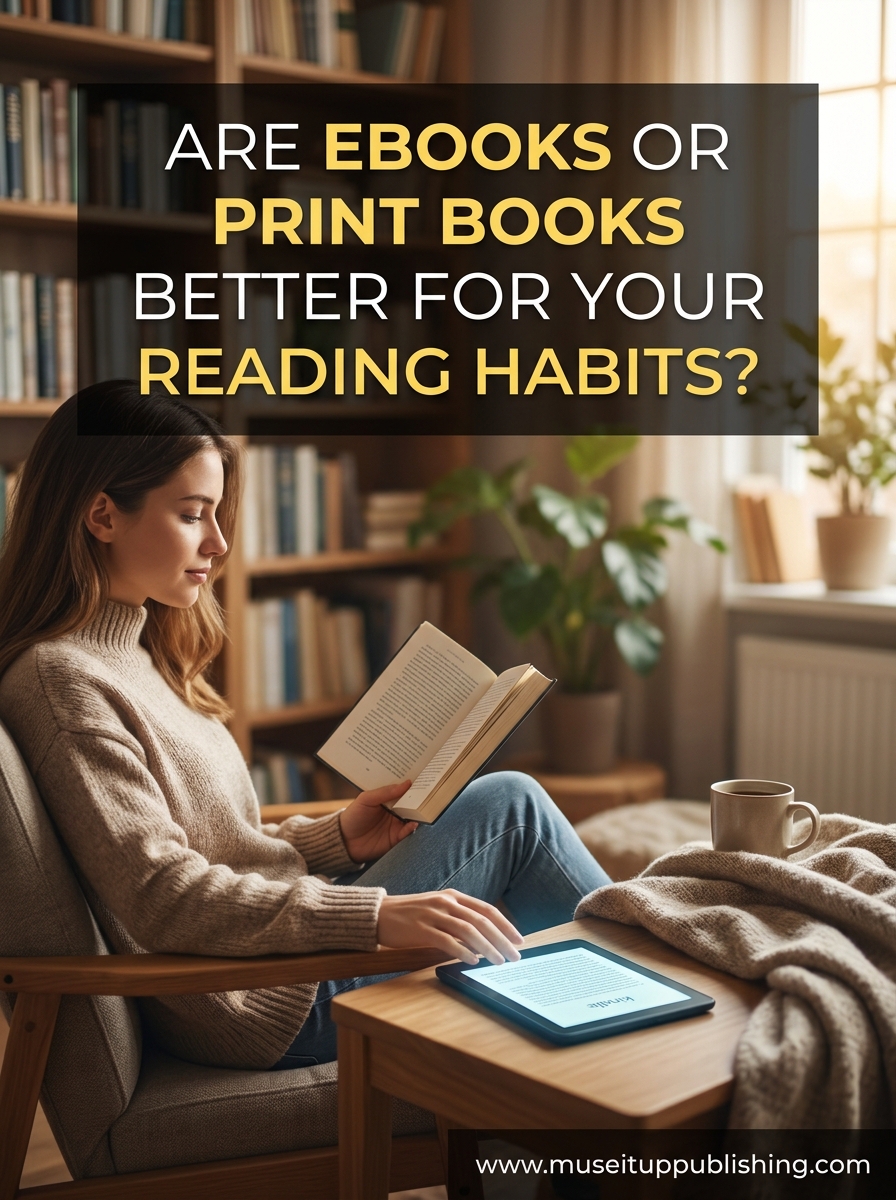
Print books are better for comprehension and retention, while ebooks win on convenience and portability. The best format depends on what you value most: studies show print offers 6 to 8 times better comprehension, but ebooks let you carry thousands of titles in a single device. Understanding whether ebooks or print books are better for your reading habits means looking at how each format affects your brain, body, budget, and daily routine.
Our team has spent months researching reading science, forum discussions, and academic studies to break down this debate. We looked at everything from MRI brain scans to Reddit threads where thousands of readers shared their honest experiences. What we found is that there is no single winner. Instead, the right choice depends on your lifestyle, reading goals, and personal preferences.
Whether you are a daily commuter, a college student, a parent building a home library, or someone trying to read more consistently, this guide will help you make an informed decision. Let us walk through what the research says, what real readers report, and how to choose the format that fits your life.
Table of Contents
Comprehension and Retention: What the Research Shows
Research consistently shows that print books deliver significantly better comprehension than digital formats. A widely cited study reported by Psychology Today found comprehension is six to eight times better with physical books than with e-readers. That means when you read something important in print, you are far more likely to remember it.
The reason comes down to how your brain processes physical information. When you turn a real page, your brain creates a spatial map of where information sits in the book. You remember that a key passage was on the left page, about two-thirds of the way through, near the bottom. This is called embodied reading, and it gives your brain an extra indexing system for recalling what you read.
MRI studies back this up. Reading on paper activates the medial prefrontal cortex and cingulate cortex more strongly than reading on screens. These brain regions handle spatial memory and narrative comprehension. When you read digitally, your brain treats the text more like a scroll of undifferentiated content, making it harder to anchor specific information.
That said, the comprehension gap narrows for shorter reads. If you are reading a blog post or a news article, the format makes less difference. The real impact shows up with longer texts like novels, textbooks, and research papers.
Key takeaway: Print wins on comprehension and retention, especially for long-form reading and material you need to remember.
The Physical and Sensory Experience
There is something about holding a physical book that no screen can replicate. The weight of a hardcover in your hands, the texture of the paper, the smell of ink and binding glue. These sensory details are not just nostalgic. They actually affect how you engage with what you read.
Reddit users in communities like r/books and r/fantasybooks talk about this constantly. One common theme: readers keep physical copies of books they love, even if they first read them digitally. The physical object becomes a trophy, a memory, a piece of identity. You display it on a shelf and it becomes part of your personal story.
The tactile feedback of turning pages also serves a purpose. Each page turn gives your brain a micro-break, a moment to process what you just read. Swiping a screen does not create the same rhythmic reading pattern. Some researchers believe this haptic feedback is part of why print readers report feeling more immersed in stories.
E-readers have gotten better at mimicking this experience. Modern devices use e-ink displays that look remarkably like paper, and some even add page-turn buttons. But even the best e-reader cannot replicate the smell of a new book or the satisfying thud of closing a finished novel.
Key takeaway: Print delivers a richer sensory experience that deepens emotional connection to what you read.
Convenience, Portability, and Storage
This is where ebooks pull ahead decisively. A single e-reader can hold thousands of books and weighs less than a paperback. For commuters, travelers, and anyone who reads on the go, this changes everything.
A study published in PMC found that 74.6% of students prefer e-books specifically because they are easy to carry. That same study showed 80.6% of students spent more than an hour reading from e-books. When your entire library fits in your bag, you read more often simply because your books are always with you.
Storage is another factor. If you live in a small apartment or move frequently, physical books become a logistical challenge. Bookshelves take up wall space, boxes of books are heavy to move, and a growing collection can quickly overwhelm your home. Ebooks take up zero physical space.
Instant access is a huge advantage too. When you want a new ebook, you can download it in seconds without leaving your couch. No trip to the bookstore, no waiting for shipping. This immediacy can keep your reading momentum going, especially when a friend recommends something and you want to start right away.
Forum discussions reveal an interesting pattern here. Many readers use both formats strategically. They buy physical books for home reading and keep an e-reader for commuting and travel. This hybrid approach gives them the best of both worlds.
Key takeaway: Ebooks dominate on portability, storage, and instant access. Print struggles with weight and space.
Cost Considerations
Ebooks are typically cheaper than their print counterparts. Without printing, shipping, and warehousing costs, publishers can pass some savings to readers. Many classic titles are available digitally for free, and frequent sales on platforms like Amazon make it easy to stock up inexpensively.
However, the cost equation is not always straightforward. Print books can be resold, lent to friends, donated, or traded. An ebook is locked to your account and cannot be transferred. Over time, a shelf of physical books retains value, while a digital library does not.
Library access differs too. Many public libraries offer both physical and digital lending. But ebook availability often depends on publisher licensing, which can mean long wait times for popular titles. Physical books in libraries are more predictably available.
The upfront cost of an e-reader is also worth considering. While prices have come down over the years, you still need to buy the device before you can start reading ebooks. If you only read a few books a year, that initial investment might not pay off quickly.
Key takeaway: Ebooks usually cost less per title, but print books offer resale and sharing value that ebooks cannot match.
Eye Strain and Health: Screen vs Page
Screen fatigue is one of the most common complaints from ebook readers, especially those who already spend all day working at computers. Reading on a backlit tablet or phone exposes your eyes to blue light, which can cause eye strain, headaches, and sleep disruption.
E-ink readers like the Kindle Paperwhite solve much of this problem. E-ink technology reflects ambient light like real paper, rather than emitting light directly at your eyes. Many users report that reading on an e-ink device feels similar to reading print, at least in terms of eye comfort.
That said, even e-ink screens differ from paper in subtle ways. Contrast ratios are not identical, and some readers still experience mild eye fatigue after extended sessions. The backlight feature, while convenient for reading in the dark, does add blue light exposure that you would not get from a lamp-lit physical book.
Sleep researchers have found that blue light exposure before bed suppresses melatonin production, making it harder to fall asleep. If you read in bed, a physical book is the safest choice for your sleep cycle. If you must read digitally at night, e-ink with the backlight turned off or very low is better than a phone or tablet.
Forum users frequently mention this trade-off. People trying to reduce screen time often switch back to physical books specifically to give their eyes a break after work. This digital detox motivation is a growing trend among readers who feel overwhelmed by screens.
Key takeaway: Print is gentlest on your eyes and best for bedtime reading. E-ink is a reasonable middle ground, but backlit screens are the harshest option.
Attention Span and Digital Distractions
One of the biggest hidden costs of digital reading is the constant potential for distraction. When you read on a phone or tablet, notifications, social media, and the urge to browse are always one tap away. Even dedicated e-readers can include experimental browsers or app stores that tempt you away from the page.
Print books create a natural barrier to distraction. You cannot accidentally open Instagram from a paperback. The single-purpose nature of a physical book forces you into deeper focus, which supports better comprehension and a more immersive reading experience.
Research on attention spans suggests that digital reading encourages skimming behavior. Readers on screens tend to scan rather than read deeply, bouncing between sections and losing the narrative thread. This F-shaped reading pattern is well-documented in web usability studies and carries over to digital books.
Many Reddit users in r/minimalism and r/books report choosing physical books specifically as a way to disconnect from technology. After a full day of screens at work, holding a book that cannot buzz, beep, or flash a notification feels like relief. This intentional disconnection is a legitimate reading habit strategy, not just nostalgia.
Key takeaway: Print supports deep, focused reading. Digital reading invites distractions that can undermine comprehension and engagement.
Accessibility: Who Benefits Most from Each Format
Ebooks offer powerful accessibility features that print simply cannot match. Adjustable font sizes help readers with visual impairments. Text-to-speech functionality makes books accessible to people with dyslexia, motor limitations, or other conditions that make traditional reading difficult. Built-in dictionaries allow instant word lookups without breaking your reading flow.
For struggling readers, especially students, ebooks provide something less obvious but equally important: anonymity. A person reading a remedial-level book on a device looks the same as someone reading advanced material. Nobody can see the cover or judge the difficulty level. This removes a barrier that keeps many people from reading confidently in public.
Adjustable backgrounds and fonts also help readers with dyslexia or Irlen syndrome. Some e-readers offer dyslexia-friendly fonts specifically designed to prevent letter confusion. Dark mode options reduce eye strain for sensitive readers. These features make reading possible for people who might struggle with standard print.
Print books have their own accessibility advantages. They never run out of battery, which matters for readers who may not have reliable access to charging. Large-print editions serve readers with low vision. And the physical act of turning pages can support fine motor skill development in young children.
Key takeaway: Ebooks offer superior digital accessibility features. Print offers reliability and tactile learning benefits.
Children, Education, and Early Reading Development
When it comes to young readers, the format debate takes on additional weight. Research from Scholastic and other educational organizations suggests that print books may be better for early childhood reading development. The physical act of holding a book, turning pages, and tracking text across a page helps children build foundational reading skills.
Parents consistently report that physical books support better bonding during shared reading. Cuddling with a child and a physical book creates a sensory-rich experience that a tablet cannot replicate. Children can touch the pages, point at illustrations, and feel the progression of the story in a tangible way.
That said, interactive ebooks can engage reluctant readers who might otherwise avoid books entirely. Animations, sound effects, and touch-responsive elements can draw in children who struggle with traditional reading. The key is choosing quality interactive content that supports rather than distracts from the story.
A balanced approach works well for many families. Physical books for bedtime stories and bonding, digital books for travel and independent reading. The format matters less than the simple act of reading regularly with your child.
Key takeaway: Print supports early development and parent-child bonding, but interactive ebooks can engage reluctant young readers.
The 50 Page Rule Explained
The 50 page rule is a simple reading habit guideline: give a book 50 pages before deciding whether to keep reading or set it aside. The idea is that 50 pages gives you enough exposure to the writing style, plot, and characters to make an informed decision about whether a book deserves your time.
This rule applies to both print and digital reading, but it plays out differently in each format. With a physical book, you can see those 50 pages as a physical chunk of the total. You feel how far you have read relative to the book’s thickness, which gives you a tangible sense of investment and progress.
With ebooks, the percentage counter serves a similar purpose, but some readers report it feels less impactful. Seeing 7% on a screen does not carry the same weight as holding a book and feeling that you are a couple of dozen pages in. This subtle difference can affect how committed you feel to finishing a book.
The 50 page rule is also a guard against the sunk cost fallacy. Many readers feel obligated to finish every book they start. Giving yourself permission to quit after 50 pages frees you to move on to something better without guilt. No competitor in the current search results fully addresses this question, so here is your answer: 50 pages is the sweet spot between giving a book a fair chance and not wasting your limited reading time.
Key takeaway: The 50 page rule helps you decide whether to commit to a book or move on, and print makes your progress feel more tangible.
Reading for Stress Reduction: Does Format Matter?
Reading is one of the most effective ways to reduce stress. Research has shown that just six minutes of reading can reduce stress levels by up to 68%, which is more effective than listening to music, having a cup of tea, or taking a walk. Reading lowers cortisol, the stress hormone, by immersing your mind in a narrative and pulling attention away from anxious thoughts.
But does the format affect this stress reduction? Evidence suggests it does. Reading a physical book requires you to step away from screens, which themselves can be a source of stress. The tactile experience of holding a book, feeling its weight, and turning pages creates a calming, grounding ritual.
Digital reading on a phone or tablet can undermine stress reduction because the device itself is associated with work, social media, and notifications. Your brain may struggle to fully relax when reading on a device that has interrupted you with alerts all day. This is where bibliotherapy, the therapeutic use of reading, increasingly favors print formats.
E-ink readers occupy a middle ground. They are less stimulating than phones and tablets, but they are still electronic devices. For maximum stress reduction, especially before bed, physical books appear to be the strongest choice.
Key takeaway: All reading reduces stress, but print books deliver the most calming experience by disconnecting you from screens entirely.
How to Choose the Right Format for Your Reading Habits
Now that we have broken down the research and real-world experiences, how do you decide? The answer comes down to your specific reading habits and goals. Here are some questions to help you self-assess.
Choose print books if you:
- Want maximum comprehension and retention from what you read
- Read before bed and care about sleep quality
- Love the tactile and sensory experience of physical books
- Want to build a visible library or collect editions
- Are trying to reduce screen time and digital distractions
- Read to young children and want to support bonding
- Study material that requires deep focus and memorization
Choose ebooks if you:
- Commute or travel frequently and need portability
- Live in a small space and cannot store physical books
- Want instant access to new releases
- Need accessibility features like large fonts or text-to-speech
- Read primarily for entertainment and quick consumption
- Want to save money per title on average
- Prefer reading without drawing attention to what you are reading
Use both strategically if you:
- Read different types of books in different settings
- Want physical copies of favorites but digital for everything else
- Travel with ebooks but read at home in print
- Study with print textbooks but read fiction digitally
The most successful readers we encountered in our research do not pick one format. They use both, choosing whichever format fits the moment. A Kindle for the train, a paperback for the couch, a hardcover for the shelf. This flexible approach keeps reading enjoyable rather than turning it into a format loyalty contest.
Key takeaway: There is no wrong answer. Match the format to your situation, and do not be afraid to use both.
FAQs
Is reading books in print better than reading on devices?
Yes, for comprehension and retention. Research shows print books deliver six to eight times better comprehension than e-readers. Your brain creates spatial memory maps from physical page-turning that digital reading cannot replicate. However, devices win on portability and convenience.
What is the 50 page rule?
The 50 page rule means giving a book 50 pages before deciding whether to continue or stop reading. It gives you enough exposure to the writing style and plot to make an informed decision about whether the book deserves your time, while preventing you from wasting reading hours on books you do not enjoy.
Does reading help lower cortisol?
Yes. Research shows that just six minutes of reading can reduce stress by up to 68%, making it more effective than music, tea, or walking. Reading lowers cortisol by immersing your mind in a narrative. Physical books appear to be the most effective format for stress reduction because they disconnect you from screens.
Is it better to read eBooks or physical books?
Neither format is universally better. Physical books are better for comprehension, retention, eye comfort, and stress reduction. Ebooks are better for portability, storage, cost, and accessibility. The best choice depends on your reading habits, lifestyle, and what you value most in the reading experience.
The Bottom Line
So, are ebooks or print books better for your reading habits? The research points to print for comprehension, retention, eye health, and stress reduction. Ebooks win on portability, cost, and accessibility. The readers who get the most from their habits use both formats strategically, choosing whichever fits the moment. Pick the format that keeps you reading consistently, because reading itself matters more than the medium.