
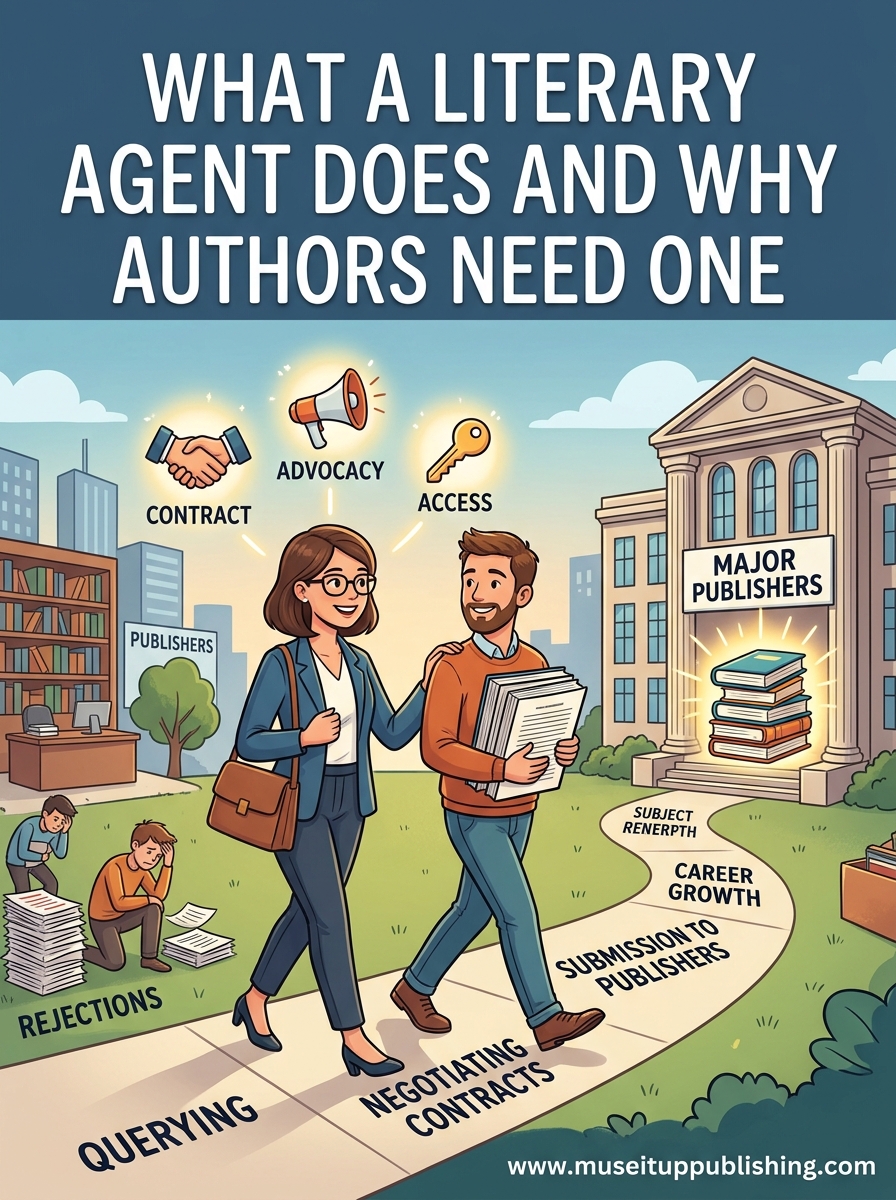
If you are an aspiring author, you have probably heard the same advice over and over: you need a literary agent. But what a literary agent does, exactly, can feel like a mystery wrapped in industry jargon. This guide breaks it all down in plain language so you understand the role before you start querying.
A literary agent is a professional representative who sells your book to publishers, negotiates your contracts, manages your rights, and advocates for your long-term writing career. Think of them as part salesperson, part contract lawyer, part editor, and part career strategist. They are the bridge between you and the publishing houses that decide which books reach store shelves.
Whether you are writing a debut novel, a nonfiction proposal, or the next great fantasy series, understanding what a literary agent does will help you decide whether representation is the right path for your work. Let us walk through everything you need to know.
Table of Contents
What a Literary Agent Does The Core Role Explained
A literary agent represents authors and their work to publishers. Their primary job is to find the right editor at the right publishing house for your manuscript, then negotiate the best possible deal on your behalf. They work on commission, meaning they only earn money when you do.
The role has evolved significantly over the past few decades. In the mid-20th century, many publishers accepted submissions directly from authors. Editors had the time to read through unsolicited manuscripts and discover new talent. As the publishing industry consolidated through waves of mergers, the Big 5 publishers (Penguin Random House, HarperCollins, Simon and Schuster, Hachette, and Macmillan) grew larger and busier. Editors simply could not keep up with the volume of submissions landing on their desks.
Agents stepped into that gap. Today, they serve as the industry’s filtering mechanism. Publishers trust agents to send them polished, market-ready manuscripts because agents have already done the work of evaluating, selecting, and refining. Most major imprints at the Big 5 now only accept agented submissions. If you want to be published by a major house, an agent is effectively your only way in the door.
But the agent’s role goes far beyond simply passing your manuscript along. A good agent is your creative collaborator, business manager, and industry insider all rolled into one. They understand market trends, know which editors are looking for what, and have relationships built over years of lunches, phone calls, and deal-making.
What Does a Literary Agent Do Day to Day?
Understanding what a literary agent does means looking at the specific responsibilities they handle throughout the life cycle of a book and a career. Here are the core duties, broken down step by step.
Manuscript Evaluation and Editorial Feedback
Before your book ever reaches a publisher, your agent reads it carefully and provides editorial feedback. This is one of the most valuable things an agent does, and many authors do not realize how involved this stage can be. An agent who believes in your project will often ask for revisions before submitting.
This process is sometimes called a Revise and Resubmit, or R and R. The agent sees potential in your manuscript but wants specific changes before they pitch it to editors. This might mean restructuring chapters, deepening character arcs, cutting a subplot, or adjusting pacing. The goal is to make your book as strong as possible so editors cannot put it down.
Good agents are skilled readers with years of experience in the market. They know what is selling, what editors are tired of seeing, and what gaps exist in current lists. Their feedback is practical and market-aware, not just about craft but about commercial viability.
Pitching and Submitting to Editors
Once your manuscript is ready, the agent begins the submission process. This is where their industry relationships become invaluable. An agent does not send your manuscript to a generic slush pile. They pitch it directly to specific acquisitions editors at specific imprints who they know are looking for your type of book.
The agent crafts a pitch that highlights why your book fits that editor’s list and the current market. They might submit to a handful of editors simultaneously or strategize a tiered approach, starting with their top targets and expanding if initial passes come back negative.
This submission phase can take anywhere from a few days to several months. Editors are busy, and response times vary. Your agent manages this process, follows up when appropriate, and keeps you informed about where things stand. When an editor expresses interest, the agent leverages that interest to build competitive tension among publishers, which can drive up your advance.
Contract Negotiation
When a publisher makes an offer, the agent shifts into negotiator mode. This is one of the areas where having an agent pays for itself many times over. Publishing contracts are complex legal documents filled with clauses about advances, royalty rates, rights grants, option clauses, delivery deadlines, and out-of-print provisions.
Your agent knows what standard terms look like and what to push back on. They negotiate your advance against royalties, which is the upfront payment you receive before the book starts earning royalties. They fight for favorable royalty rate escalations, meaning the percentage you earn increases as you hit certain sales thresholds.
They also negotiate rights. This includes which rights the publisher gets (North American, world, audio, electronic, and so on) and which you retain. A skilled agent often sells rights separately to different buyers, maximizing your total earnings. Without an agent, most authors would not know which clauses are standard and which are deal-breakers.
Rights Management and Subrights
Beyond the main book deal, agents manage what are called subrights. These are the secondary rights associated with your book that can be sold separately. They include film and television rights, foreign translation rights, audio rights, serial rights (excerpts published in magazines), and merchandising rights.
Your agent either sells these rights directly or works with co-agents who specialize in specific markets. For foreign rights, many agents partner with literary scouts and foreign rights agents in territories around the world. For film rights, they work with Hollywood agencies and producers.
This is a significant revenue stream that most authors never access on their own. A book that earns a modest advance from its publisher might generate substantial additional income through foreign sales, especially if it performs well internationally. Your agent tracks these opportunities and handles the deals.
Career Guidance and Long-Term Planning
The best agents do not just sell one book. They help build careers. A good agent thinks about your trajectory over multiple books and years. They advise you on what to write next, which genres to pursue, and how to position yourself in the market.
If your first book underperforms, your agent helps you figure out why and strategizes the next project to get your career back on track. They might suggest a genre pivot, a pen name, or a shift from standalone novels to a series. They understand the business side of publishing and help you make decisions that protect your long-term earning potential.
This career-shaping role is something you simply cannot replicate on your own. It requires deep industry knowledge, relationships with editors across multiple houses, and a feel for market trends that comes from being immersed in the business every single day.
Why Authors Need a Literary Agent
Now that you understand the day-to-day responsibilities, let us address the question directly: why do authors need literary agents? There are several compelling reasons, especially if your goal is traditional publication with a major house.
Access to Major Publishers
The single biggest reason authors need agents is access. Most imprints at the Big 5 publishers do not accept unagented submissions. Their submission guidelines explicitly state that they only review manuscripts submitted by literary agents. This is not a preference. It is a firm policy.
Even many mid-size and independent publishers prefer or require agented submissions. Without an agent, your manuscript simply cannot reach the editors at these houses. You can self-publish or submit to the small percentage of publishers that accept direct submissions, but you are cutting yourself off from the largest and most resourced publishers in the industry.
Agents have personal relationships with editors. When an agent calls an editor, the editor picks up the phone. When an unknown author emails an editor, the email goes to a slush pile that may never be read. That relationship is the currency agents bring to the table.
Better Contract Terms
Publishing contracts heavily favor publishers. They are written by publishers’ lawyers to protect publishers’ interests. Without an agent or an entertainment attorney, you are signing a document designed to benefit the other side.
Agents negotiate for better advances, higher royalty rates, more favorable rights splits, and protective clauses. The difference between an agented and unagented contract can be tens of thousands of dollars or more over the life of a book. Agents also ensure that reversion clauses are included, which specify when rights revert to you if the book goes out of print or stops selling.
Even if you could get a publisher’s attention without an agent, you would be negotiating against experienced publishing professionals. Your agent levels that playing field.
Professional Advocacy
Your agent is your advocate in every interaction with your publisher. If royalty statements are wrong, your agent investigates. If the publisher is not meeting marketing commitments, your agent pushes back. If there are creative disagreements about cover design or editing, your agent advocates for your vision.
This advocacy extends to difficult conversations. If a book is delayed, if an editor leaves mid-project, if the publisher wants to change publication plans, your agent handles these conversations so you do not have to damage your relationship with your publisher by pushing back directly.
Think of it this way: your publisher is a business partner with their own interests. Your agent is the person whose interests align entirely with yours. That representation is worth a lot.
Do You Actually Need an Agent?
The honest answer is: it depends on your goals. If you want to be published by a major traditional house, you need an agent. There is no workaround. If you want to publish with a small independent press that accepts direct submissions, you may not need one. If you plan to self-publish, an agent is not necessary at all, though some hybrid authors use agents for foreign and subrights deals.
Even J.K. Rowling had a literary agent. Her first agent, Christopher Little, received the Harry Potter submission and believed in it when twelve publishers passed. That representation is what eventually got the book in front of Bloomsbury. Having an agent does not guarantee success, but it dramatically increases your odds of getting a fair shot.
Poetry is one genre where agents are less common. Most poets publish through university presses and independent poetry publishers that accept direct submissions. A handful of poets with large followings or crossover appeal do work with agents, but it is the exception rather than the rule.
How Literary Agents Get Paid: Commission Explained
One of the most common questions we hear is: do literary agents cost money? The answer is no, not upfront. Reputable literary agents work on commission. They earn a percentage of what you earn, and they only get paid when you get paid.
The standard commission is 15 percent on domestic deals. That means if you earn a dollar, your agent gets fifteen cents and you keep eighty-five cents. For foreign rights deals, where a co-agent is typically involved, the commission is often 20 to 25 percent because the commission is split between your primary agent and the foreign rights agent.
For film and television deals, the commission structure can vary. Some agents handle film rights themselves and charge 15 percent. Others work with a Hollywood co-agent and split a 20 percent commission. Your agent should be transparent about these arrangements before any deal is signed.
Here is the critical point: legitimate agents never charge reading fees, evaluation fees, or upfront costs of any kind. If an agent asks you to pay them to read your manuscript, run. That is the number one red flag in the industry. Reputable agents invest their time in your project because they believe it will sell, and they earn their money from the deal, not from your pocket.
The commission model means your agent is financially motivated to get you the best deal possible. The more you earn, the more they earn. Your interests are perfectly aligned. This is why the agent-author relationship works so well when both parties are committed.
It is also worth understanding how advances work. An advance is an upfront payment from the publisher, paid against future royalties. You do not start earning royalties until the book earns back the advance amount. Your agent receives their commission from the advance when it is paid, typically in installments tied to contract milestones like signing, delivery, and publication.
How to Find and Query a Literary Agent
Finding the right agent is a process that requires research, patience, and a thick skin. Here is a step-by-step overview to get you started.
Researching the Right Agents
Start by identifying agents who represent books similar to yours. Look at the acknowledgments pages of recently published books in your genre. Authors frequently thank their agents by name. Make a list of agents who rep books you admire and that feel comparable to yours.
Use reputable databases like QueryTracker, Manuscript Wish List (MSWL), and the Association of Authors’ Representatives (AAR) member directory. These resources show you what agents are looking for, their submission guidelines, and their track records. The AAR is a professional organization with a code of ethics, so members have committed to industry standards.
Check each agent’s recent sales using Publishers Marketplace, a subscription database that tracks book deals. You want an agent with verifiable sales to major publishers, not someone who has never closed a deal. Experience and a proven track record matter enormously.
Writing Your Query Letter
Your query letter is your first impression. It should be concise, professional, and compelling. A strong query includes a hook (one or two sentences that capture the premise of your book), a brief synopsis (the core conflict and stakes without giving away every plot point), your title and word count with comparable titles, and a short bio establishing your relevant credentials.
Keep it under 400 words. Personalize each query by mentioning why you chose that specific agent. Reference an interview they gave, a book they represent, or something from their MSWL profile. This shows you have done your homework and are not just blasting queries to everyone.
Follow each agent’s submission guidelines exactly. Some want the query plus the first ten pages pasted in the email. Others want a query plus a synopsis. Some want only the query initially. Ignoring guidelines is the fastest way to get rejected without being read.
Submitting and Waiting
Most authors submit to multiple agents simultaneously. This is standard and expected in the industry. Keep a spreadsheet tracking who you queried, when, what you sent, and their response status. Follow up only after the agent’s stated response time has passed, and do so politely.
Response times vary widely. Some agents respond within a week. Others take months. Some never respond at all if they are not interested, though this is increasingly considered unprofessional. Silence after several months is generally treated as a pass.
Rejections are normal. Most published authors were rejected dozens or hundreds of times before finding representation. One writer on Reddit’s r/PubTips community described querying for over two years before landing an agent. Patience and persistence are essential. Do not take rejection personally. It often means the agent simply did not connect with the project, not that the work is bad.
Evaluating Offers of Representation
When an agent offers representation, do not accept immediately, even if you are thrilled. You are entering a professional relationship, and you need to evaluate fit. This is especially important if you receive multiple offers, which does happen when a manuscript generates buzz.
Schedule a phone call or video meeting with the offering agent. Ask about their vision for the book, their submission strategy, how they communicate with clients, their editorial approach, and their recent sales. Ask for references from current or former clients. A reputable agent will welcome these questions.
If you have multiple offers, compare agents on track record, communication style, editorial fit, and enthusiasm for your work. The most prestigious agent is not always the best fit. You want someone who loves your book, communicates clearly, and has the skills to sell it.
Take your time making this decision. The author-agent relationship is built on trust and can last for an entire career. Getting it right matters more than moving quickly.
Red Flags: Warning Signs in Literary Agents
No competitor guide we reviewed covers this topic comprehensively, but it is one of the most important things an aspiring author can learn. The vast majority of literary agents are ethical, hardworking professionals. However, there are bad actors in every industry, and publishing is no exception. Here are the warning signs to watch for.
Charging upfront fees is the biggest red flag. Legitimate agents never charge reading fees, editing fees, or submission fees. They earn their money from commission on deals they close. If an agent asks for money before selling your book, they are not operating under industry standards. Run the other way.
Directing you to a specific paid editing service is another warning sign. Some questionable agents refer authors to a paid editor (sometimes run by someone connected to the agent) and imply that using that editor will improve your chances of representation. This is a conflict of interest and a predatory practice.
Lack of verifiable sales is a concern. An agent should be able to point to recent deals they have closed. If they are vague about their track record or have no sales to share, they may not have the publisher relationships needed to sell your book. Check Publishers Marketplace or ask directly about recent deals.
Poor communication before you sign is a preview of communication after you sign. If an agent takes weeks to respond to a simple email during the courtship phase, when they are trying to win you over, expect worse once you are a client. Responsive, professional communication is a baseline expectation.
Pressure to sign quickly without a conversation is a red flag. A reputable agent wants to talk with you, discuss the book, and make sure the fit is right before offering representation. If someone is rushing you to sign without a discussion, something is off.
Finally, if something feels wrong, trust your instincts. Authors on r/PubTips frequently share stories of relationships that went south because they ignored early warning signs. The publishing community is smaller than you think, and a bad agent relationship can cost you years. Take the time to find the right partner.
Frequently Asked Questions
Why do authors need literary agents?
Authors need literary agents because most major publishers, including all Big 5 imprints, only accept submissions from agents. Agents also negotiate better contracts, manage rights sales, provide editorial guidance, and serve as professional advocates throughout the publishing process. Without an agent, authors cannot access the largest publishers or secure the most favorable deal terms.
How do literary agents get paid?
Literary agents work on commission, typically 15 percent on domestic deals and 20 to 25 percent on foreign rights deals where a co-agent is involved. They only earn money when you earn money. Legitimate agents never charge upfront reading fees, evaluation fees, or any other costs before selling your book.
Did JK Rowling use a literary agent?
Yes, JK Rowling was represented by literary agent Christopher Little. He received the Harry Potter submission and championed it after twelve publishers rejected it. His representation is what eventually secured the deal with Bloomsbury, making it one of the most famous examples of how a literary agent can change an author’s career.
What is the 90/10 rule for authors?
The 90/10 rule in publishing is an informal observation that roughly 90 percent of book sales come from 10 percent of published titles. This highlights how competitive the industry is and underscores why having an agent who positions your book effectively matters so much for reaching that top tier.
How many books do you have to sell to make $100,000?
The number of books needed to earn $100,000 depends on your royalty rate, advance, and retail price. At a typical hardcover royalty rate of 10 percent on a $25 book, you earn about $2.50 per copy, meaning you would need to sell around 40,000 copies after earning back your advance. With an agent negotiating higher royalty rates or escalators, the number can be lower.
Can you submit to publishers without an agent?
Yes, but your options are limited. Most Big 5 imprints do not accept unagented submissions. Some smaller and independent publishers do accept direct submissions, and academic and poetry presses often prefer direct submissions. Self-publishing is also a fully viable path that does not require an agent. However, if your goal is a major traditional publisher, an agent is essential.
Conclusion: Is a Literary Agent Right for You?
Understanding what a literary agent does changes how you approach your publishing journey. An agent is not just a gatekeeper to the Big 5. They are your editor, negotiator, rights manager, career strategist, and advocate, all working on your behalf for a commission that only activates when you succeed.
If your goal is traditional publication with a major house, representation is not optional. It is the system. If you are exploring small presses, self-publishing, or academic publishing, you may take a different path. Either way, knowing how agents operate helps you make informed decisions about your career.
Your next step is simple. If you have a finished, polished manuscript, start researching agents who represent books like yours. Build your list, craft your query letter, and begin submitting. The path to representation is long and competitive, but it starts with understanding the process. Now you do.