
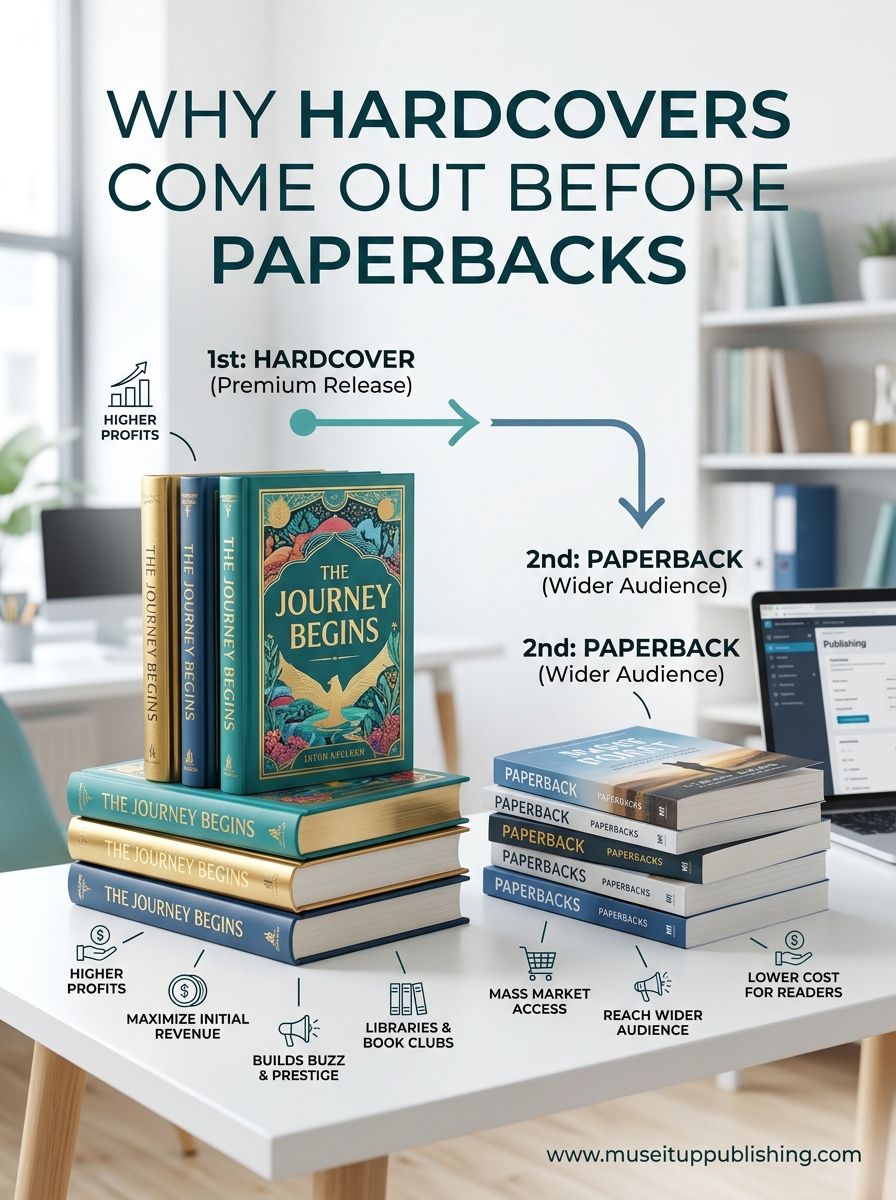
Every time a highly anticipated book drops, the same frustration ripples through reading communities online. You want to read it now, but the only option is a hardcover that costs twice as much as the paperback will. If you have ever wondered why hardcovers come out before paperbacks, you are not alone. This is one of the most common questions readers ask about the book publishing industry.
The short answer is profit. Publishers release hardcover editions first to maximize revenue from readers willing to pay a premium, then follow up with a cheaper paperback months or even years later to capture the rest of the market. But the full story involves prestige, award eligibility, bookstore economics, and a publishing tradition that stretches back nearly a century.
In this guide, we break down every reason publishers stagger their releases this way. We also cover the typical timeline, what is changing in 2026, and how you can find out when that paperback edition is finally arriving.
Table of Contents
The Short Answer: Why Hardcovers Come Out Before Paperbacks
Hardcovers come out before paperbacks because the staggered release lets publishers charge two different prices for the same book at two different points in time. This is a textbook example of price discrimination, and it is the single biggest reason the practice persists.
Think about it this way. A publisher knows that some readers are so eager for a new release that they will pay 28 dollars or more for a hardcover on launch day. Those same publishers also know that many other readers will only buy the book if it costs 12 to 18 dollars in paperback. By releasing the expensive version first, publishers collect maximum revenue from the eager buyers before opening the doors to the price-sensitive crowd.
This strategy is not greedy trickery. It is how the entire traditional publishing industry sustains itself. Hardcover sales front-load the revenue that funds everything else, from marketing campaigns to advances for new authors.
The Revenue Math: Why Hardcovers Make More Money
To understand why hardcovers come out before paperbacks, you need to look at the actual economics. A typical hardcover novel might retail for around 28 dollars. A trade paperback edition of the same book might retail for 17 dollars. That is roughly a 40 percent drop in retail price when the paperback arrives.
But here is the part that surprises many readers. The hardcover does not cost anywhere near twice as much to manufacture as the paperback. Production costs for a standard hardcover run roughly 2 to 4 dollars per unit depending on print run size and materials. A comparable paperback might cost 1 to 2 dollars to produce. So the hardcover costs perhaps twice as much to make, but it sells for nearly twice as much at retail, which means the absolute profit per unit is significantly higher.
On a single hardcover sale, a publisher might clear 10 to 14 dollars in profit after accounting for printing, distribution, and author royalties. On a paperback sale of the same book, that profit might drop to 3 to 6 dollars. The math is stark, and it explains why publishers want to sell as many hardcovers as possible before the cheaper format ever appears.
Authors also benefit from the hardcover-first model, though not always as dramatically as publishers. Hardcover royalties typically run 10 to 15 percent of the retail price, while paperback royalties often sit at 7 to 10 percent with escalator clauses based on sales volume. A single hardcover sale can earn an author 3 to 4 dollars in royalties. A paperback sale might earn them 1 to 2 dollars. For authors who rely on book sales as their primary income, those hardcover months matter.
This is the core of why publishers delay paperback releases. Every month the paperback is held back, readers who cannot wait will buy the hardcover instead. The longer the window, the more hardcover copies sell, and the more total revenue the book generates across its lifetime.
The Typical Timeline: How Long Until the Paperback Arrives
So how long do you actually have to wait? For most traditionally published books, the paperback edition arrives 6 months to 1 year after the hardcover. Bestsellers with strong ongoing demand sometimes see faster paperback releases because the publisher wants to keep momentum going. Books that sell more slowly in hardcover may wait 12 to 24 months before the paperback appears.
There is no fixed rule. Each publisher evaluates the timing based on hardcover sales velocity, retail reorder rates, and seasonal marketing opportunities. If a hardcover is still selling well at full price eight months after release, there is little incentive to rush the paperback. If hardcover sales have plateaued, the paperback arrives sooner to reinvigorate demand.
This is where reader frustration comes in. In online book communities, particularly on forums like Reddit, readers frequently express annoyance at long paperback waits. Some report waiting 18 months or longer for a paperback edition of a book they desperately want to read. Others mention giving up and buying the hardcover anyway because the wait felt unreasonable.
Series fiction can make the wait even more painful. If you are waiting for the paperback of book one in a trilogy and the hardcover of book two is already out, the staggered format can feel like a penalty for preferring paperbacks.
Prestige and Quality Signals
Profit is not the only reason hardcovers come out before paperbacks. There is also a powerful prestige factor at play. In the publishing world, a hardcover release signals that the publisher believes in the book enough to invest in a premium format. It is a mark of quality and a demonstration of intent.
Reviewers, critics, and librarians all take hardcover releases more seriously. When a book arrives in hardcover, it signals that the publisher is making a serious push for attention. Media outlets are more likely to review hardcovers. Bookstores give them better display placement. Libraries prioritize hardcover acquisitions because the binding holds up better under heavy circulation.
There is also a collector psychology at work here that no competitor in the search results fully explores. Many readers genuinely prefer owning hardcovers. They like the weight, the dust jacket, the sewn binding, the way a hardcover looks on a shelf. For these readers, the hardcover is not an inconvenience to endure before the paperback arrives. It is the preferred product, and they are happy to pay the premium.
This dual audience, eager readers who will pay anything and collectors who prefer the format, is exactly what makes the hardcover-first model so effective. Publishers are serving two distinct customer bases with a single staggered release strategy.
Award Eligibility and Critical Attention
Another reason hardcovers come out before paperbacks is that many of the most prestigious literary awards require hardcover publication for eligibility. The Pulitzer Prize, the National Book Award, and numerous other major literary honors typically consider only books originally published in hardcover within their eligibility window.
This is not an accident. These awards were established in an era when hardcover publication was the norm, and their rules have not changed. For publishers, this means that a hardcover release is not just about immediate sales. It is about keeping the book eligible for awards that can dramatically boost its long-term sales trajectory.
Winning or even being shortlisted for a major literary award can transform a book’s fortunes. Backlist sales spike. Foreign rights deals accelerate. The author’s next advance goes up. All of this starts with the hardcover release, which is why publishers are so reluctant to skip it for books they believe have literary potential.
Even books that do not win awards benefit from the attention cycle that hardcovers trigger. Review copies go out in hardcover months before publication. Industry publications like Publishers Weekly and Kirkus review hardcovers. This early critical attention builds buzz that carries through to the eventual paperback release.
Historical Context: How This Practice Began
To fully understand why hardcovers come out before paperbacks, it helps to know how the system started. For most of publishing history, there was no paperback option at all. Books were simply bound in hardcover because that was the only durable binding available. Paperbacks as we know them did not exist until the 1930s.
Everything changed in 1935 when Allen Lane founded Penguin Books in the United Kingdom. Lane was waiting at a train station and realized there was nothing good and affordable to read on his journey. He decided to publish quality literature in cheap paperback format, and Penguin’s ten initial titles sold for the price of a pack of cigarettes. The paperback revolution was born.
But publishers did not abandon hardcovers. Instead, they adopted a dual strategy that persists to this day. Hardcover editions would serve as the premium first release for serious readers and collectors. Paperbacks would follow as the affordable mass-market option. This staggered approach allowed publishers to serve both audiences without cannibalizing their own sales.
The model proved so profitable that it became institutionalized across the global publishing industry. Even as e-books, audiobooks, and digital distribution transformed every other aspect of publishing, the hardcover-first release window has remained largely intact. It is one of the oldest surviving pricing strategies in the media industry.
2026 Mass Market Paperback Trends: What Is Changing
The publishing landscape in 2026 looks different than it did even a decade ago, and the hardcover-to-paperback pipeline is shifting along with it. One of the biggest trends is the slow decline of the mass market paperback, the small, cheap format that used to dominate airport bookstores and supermarket racks.
Mass market paperbacks have been losing ground for years. Rising production costs, shrinking retail shelf space, and changing reader preferences have all contributed to the decline. Many major publishers have reduced their mass market paperback output significantly or shifted those titles to trade paperback format instead. Trade paperbacks are larger, higher quality, and retail for a few dollars more, which makes them more profitable for publishers.
This shift is compressing the traditional release timeline in some cases. When the gap between hardcover and trade paperback prices is smaller than it used to be between hardcover and mass market paperback, publishers have less incentive to hold the paperback back for a full year. Some publishers are experimenting with 4 to 6 month windows for certain titles.
E-books and audiobooks have also disrupted the staggered model. Digital editions typically launch simultaneously with the hardcover, giving price-sensitive readers an immediate alternative. Some readers who would have waited for the paperback now buy the e-book instead, which has eaten into the traditional paperback sales bump.
Self-published authors have bypassed the hardcover-first model entirely. Most indie authors release directly in paperback and e-book formats with no hardcover edition at all. This has created pressure on traditional publishers to justify their staggered release windows to readers who see faster, cheaper alternatives from independent authors.
Despite all these changes, the hardcover-first strategy remains dominant in traditional publishing. The revenue logic is simply too strong to abandon. What is changing is the length of the window and the formats available during each phase.
Why Some Books Skip Hardcover Entirely
Not every book follows the hardcover-first model. Some titles go straight to paperback, and understanding why reveals the limits of the strategy. Debut authors with lower advances sometimes skip hardcover because the publisher does not expect enough hardcover sales to justify the format. Genre fiction, particularly romance and certain categories of science fiction, often launches directly in mass market or trade paperback because that is what the core audience expects.
Academic and niche nonfiction titles also frequently skip hardcover. The audience for these books is small and specific, and those readers tend to prioritize content over format. In these cases, the prestige and revenue advantages of hardcover release do not outweigh the production costs.
How to Find Out When a Paperback Is Coming
If you are waiting for a paperback edition, there are several reliable ways to track its release date. Check the publisher’s website first, as they typically announce paperback dates alongside or shortly after the hardcover launch. Retailer listings on Amazon, Barnes and Noble, and independent bookstore sites often show a paperback pre-order date months in advance once it has been scheduled.
Following the author directly is also effective. Most authors announce paperback release dates through their newsletters, websites, and social media accounts. If you sign up for an author’s mailing list, you will usually get paperback news before anyone else. Setting a release alert on Goodreads or your preferred retailer can also notify you the moment the paperback becomes available for pre-order.
FAQs
Why do hardcover books come out first?
Hardcover books come out first because the staggered release lets publishers maximize revenue. Eager readers and collectors buy the expensive hardcover at launch, then the cheaper paperback captures the price-sensitive audience months later. This price discrimination strategy is the foundation of traditional publishing economics.
How long before a hardback becomes a paperback?
Most paperback editions arrive 6 months to 1 year after the hardcover release. Bestsellers with strong demand may get faster paperback releases, while slower-selling titles can wait 12 to 24 months. The timing depends on hardcover sales velocity and the publisher’s assessment of remaining demand.
Why are paperbacks released later?
Paperbacks are released later to avoid cannibalizing hardcover sales. If the cheaper paperback were available immediately, most readers would skip the more profitable hardcover. Delaying the paperback forces price-insensitive readers to buy the hardcover while preserving the paperback for the broader market later.
Why do some books go straight to paperback?
Some books skip hardcover when publishers do not expect enough premium-format sales to justify the cost. This is common for debut authors with smaller advances, genre fiction like romance, and niche academic titles where the audience prioritizes content and affordability over format.
Are publishers getting rid of paperback books?
Publishers are not eliminating paperbacks, but the mass market paperback format is declining in favor of larger trade paperbacks. Rising production costs and changing retail dynamics have pushed publishers toward trade paperback editions, which are more profitable while still being affordable for readers.
Conclusion
Understanding why hardcovers come out before paperbacks comes down to one word: profit. The staggered release lets publishers collect maximum revenue from eager readers before opening the door to the budget-conscious masses. Prestige, award eligibility, and bookstore economics reinforce the model, while historical tradition gives it staying power.
The system is evolving. Trade paperbacks are replacing mass market editions, e-books offer immediate alternatives, and self-published authors are bypassing hardcover entirely. But for now, if you want to read the biggest new releases on launch day, the hardcover remains the price of admission.