
You know the feeling. You walk past your bookshelf and notice books leaning at odd angles, paperbacks crammed sideways on top of hardcovers, and a random stack on the floor that never made it to a shelf. Learning how to organize your bookshelf in a way that actually works is not about copying someone else’s Instagram-perfect setup. It is about building a system that fits your collection, your space, and the way you actually read.
I have reorganized my own bookshelves more times than I can count, and I have talked with dozens of readers on forums like r/books and r/bookshelf about what methods stand the test of time. What follows is a step-by-step approach that balances function and aesthetics, so your shelves look great and you can still find any book in seconds.
Table of Contents
Step 1: Empty Everything First
The biggest mistake people make when they try to organize their bookshelf is working around the books already on it. You need a clean slate. Pull every single book off every shelf and lay them out on the floor, a bed, or a table.
This step feels overwhelming, but it serves two purposes. First, you get to see your entire collection in one place, which makes sorting dramatically easier. Second, you can wipe down the shelves, check for dust buildup, and address any warped or sagging boards before reloading them.
I learned this the hard way after trying to organize books shelf by shelf. I ended up with a lopsided arrangement because I never saw the full picture. Starting fresh lets you plan the whole bookcase as one cohesive unit rather than five disconnected shelves.
Step 2: Declutter Before You Organize
Here is where things get emotional. Many readers on r/books describe the genuine difficulty of letting go of books. There is a sense that donating a book means losing the knowledge inside it, even if you will never open it again. This is a real psychological barrier, and pretending it does not exist will not help you get past it.
A practical approach works better than willpower alone. Pick up each book and ask yourself three questions: Have I read it in the last two years? Will I realistically read it again or for the first time? Does it have sentimental value that justifies the shelf space?
If the answer to all three is no, set it aside for donation. Local libraries, Little Free Libraries, schools, and thrift stores will happily take books in good condition. You are not throwing away knowledge. You are passing it to someone who will actually use it.
Be honest about books you bought on impulse and never touched. That celebrity-recommended novel from three years ago that you have not cracked open? Let it go. The textbook from a class you finished in 2019? Unless you reference it professionally, it is just taking up space.
Decluttering first means you are organizing only the books you truly want to keep. This single step will transform how the rest of the process feels.
Step 3: Choose Your Organization Method
This is the heart of learning how to organize your bookshelf. There is no single right answer. The best method depends on how many books you have, whether you prioritize finding books quickly or creating a beautiful display, and whether you are organizing a small apartment shelf or a full home library.
Here are the five most effective methods, along with honest pros and cons based on what real readers report.
Organize by Genre or Subject
This is the most popular method among fiction readers I have talked to. Group all your mysteries together, your sci-fi together, your cookbooks together, and so on. Within each genre, you can sub-sort alphabetically by author or by series order.
The advantage is obvious: when you want a fantasy novel, you go straight to the fantasy section. The downside is that genres can bleed into each other, and your shelves will look varied rather than uniform. For practical access, this method is hard to beat.
The Rainbow Method: Organize Books by Color
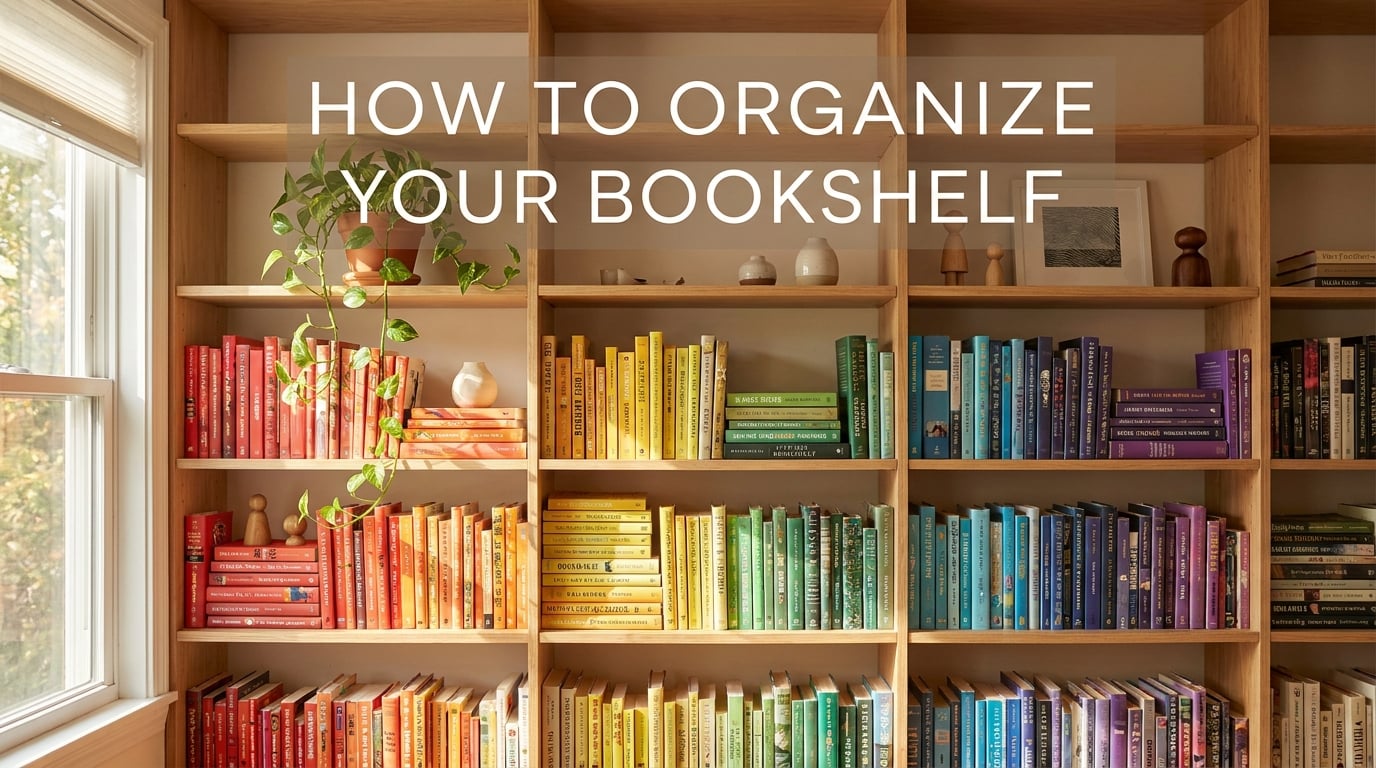
Color-coded books arranged in a rainbow gradient create one of the most striking visual effects you can achieve on a shelf. Arrange spines from red through orange, yellow, green, blue, indigo, and violet for a look that stops people in their tracks.
However, Reddit users with large collections consistently report that color organization breaks down once you exceed roughly 100 to 150 books. You lose all ability to find a specific title because a blue spine tells you nothing about author or genre. Color coding works beautifully for smaller collections or display shelves where finding a particular book quickly is not the priority.
Alphabetical by Author or Title
If you treat your bookshelf like a personal library, alphabetical arrangement is the most functional option. Sort by author last name (or title for anthologies and single works), and you will never hunt for a book again.
This method mirrors how bookstores and libraries work, which means visitors intuitively understand it. The visual result is a mix of colors and sizes that looks organic and lived-in rather than curated.
Organize by Size and Height
Many readers on r/books organize by size first because oversized books simply do not fit on every shelf. Tall hardcovers need taller gaps, while mass-market paperbacks fit almost anywhere. Grouping by height lets you maximize shelf space and creates clean horizontal lines across each row.
Interior designers often recommend placing the tallest books at the outer edges of a shelf and gradually stepping down toward the center. This creates a visually pleasing frame that draws the eye inward.
Try a Hybrid Approach
There is no rule saying you must pick one method for your entire bookshelf. A hybrid system is incredibly effective and is what many experienced readers actually use. For example, you might organize fiction by genre and author on the main shelves, arrange a display shelf by color for visual impact, and group oversized art books and coffee table books by size on the bottom.
This is the approach I use personally, and it gives me the best of all worlds. I can find any novel in under ten seconds, my display shelf looks intentional and styled, and nothing is crammed into a space that is too small for it.
Step 4: Apply the Two-Thirds Rule for Visual Balance
Interior designers swear by the two-thirds rule, and once you know about it, you will see it everywhere in professionally styled spaces. The rule is simple: fill roughly two-thirds of each shelf with books, and leave the remaining third for breathing room and decorative objects.
Wall-to-wall books packed tight can look impressive in a library setting, but in a living room or bedroom they often feel heavy and cluttered. The empty third gives the eye a place to rest and creates space for plants, framed photos, small sculptures, or baskets.
If you have too many books to spare a third of your shelf space, consider adding another bookcase or rotating books seasonally. Cramming everything onto one shelf makes it harder to remove a book without causing a domino effect, and it puts stress on the spines of the books at the bottom of each stack.
Step 5: Mix Vertical and Horizontal Stacking
Standing every book vertically is functional but visually monotonous. Mixing vertical book arrangement with horizontal stacks adds rhythm and breaks up the repetitive lines of spines. Designers call this creating visual interest through varied composition.
A common approach is to place a horizontal stack of three to five books at the end of a row of vertically standing books. You can top the horizontal stack with a small object like a candle, a small plant, or a decorative box. This creates a natural bookend and adds a layered, styled look.
Avoid making every shelf the same pattern, though. If your top shelf has horizontal stacks on the left, try placing them on the right for the next shelf down. Alternating the arrangement keeps the eye moving and prevents the bookshelf from looking like a grid.
Step 6: Separate Hardcovers and Paperbacks
Mixing tall hardcovers with slim paperbacks on the same shelf creates a jagged, uneven top line that looks messy even when the books are carefully placed. Separating hardcovers and paperbacks solves this instantly.
Paperbacks tend to be roughly the same height, so a full shelf of them creates a clean, consistent line. Hardcovers vary more in size but are generally taller, so grouping them on shelves with more vertical clearance prevents them from leaning against the shelf above.
If you do not have enough of one type to fill a whole shelf, use the horizontal stacking technique from the previous step to create subsections within a single shelf. A horizontal stack of paperbacks next to a vertical row of hardcovers looks intentional rather than accidental.
Step 7: Add Decorative Elements
Books alone can fill a shelf beautifully, but adding decorative objects transforms a bookshelf from storage into a design feature. The key is choosing items that complement your books rather than compete with them.
Plants are the single most effective addition. A trailing plant like pothos on an upper shelf softens the hard lines of books and adds life to the arrangement. Small sculptures, framed photos, or collected objects from travel give the shelf personality and tell your story.
Designers consistently recommend grouping objects in odd numbers. Three small items arranged together looks intentional, while two or four can look like you are trying too hard to match. A single larger object works well on its own as a focal point.
Baskets on lower shelves serve double duty. They hide items you do not want on display, like cables or magazines, and they add texture and warmth to the bottom of the bookcase where books alone can look heavy.
Step 8: Place Heaviest Books on Bottom Shelves
This is a practical tip that also improves the visual balance of your bookshelf. Heavy art books, textbooks, and oversized hardcovers belong on the bottom shelves for two reasons.
First, weight distribution matters for the structural integrity of the bookcase itself. Loading the top shelf with heavy books can cause bowing or tipping, especially with cheaper or older furniture. Second, visually, heavier and larger books at the base create a grounded, stable look that feels right to the eye.
Save the upper shelves for lighter paperbacks and decorative objects. This keeps the center of gravity low and makes the whole arrangement feel secure and intentional.
Step 9: Bring Books to the Front Edge
This is the simplest tip on this list, and it might have the biggest visual impact. After you have arranged your books, pull each one forward so the spine sits flush with the front edge of the shelf.
Books pushed to the back of a shelf look messy and dim. The gap between the front of the books and the edge of the shelf catches shadows and collects dust. Pulling books forward creates a clean, uniform face that photographs beautifully and looks professionally styled.
If your shelves are deep and you want to place something behind the books, a piece of decorative paper or fabric against the back of the shelf adds depth and color without requiring any permanent changes.
Step 10: Maintain and Rotate Seasonally
A bookshelf is not a one-and-done project. Collections grow, reading habits shift, and dust accumulates. Building in a simple maintenance routine keeps your shelves looking great year-round.
Every few months, take a few minutes to straighten leaning books, dust the shelves, and reassess whether any books are ready to move on. A seasonal rotation is a great way to keep things fresh. Move books you plan to read this season to the most accessible shelves and shelve the rest.
If you want to take your home library organization to the next level, consider using a digital catalog app. Apps like Libib, Goodreads, or Bookly let you scan barcodes and track what you own. This is especially helpful for large collections where remembering every title becomes impossible.
One final maintenance tip from experienced readers: take a photo of your finished bookshelf. You will appreciate having a before-and-after comparison, and if you ever need to pack up and move, the photo serves as a reference for how to put it all back together.
Common Bookshelf Mistakes to Avoid
Now that you know the steps that work, here is a quick list of mistakes to avoid:
1. Overfilling every shelf. Books need breathing room to look good and to be easy to remove without knocking others over.
2. Storing books in direct sunlight. UV light fades spines and covers. Position bookshelves away from south-facing windows when possible.
3. Using the wrong shelf height. If books lean against the shelf above, the gap is too small. Adjust shelf spacing to fit your tallest books.
4. Forgetting the back of the shelf. A painted or wallpapered backdrop adds depth and polish without taking up any shelf space.
5. Ignoring weight limits. Cheap shelves sag under heavy loads. Reinforce or replace shelving that shows signs of bowing.
FAQs
How do most people organize their bookshelves?
Most people organize by genre or subject first, then sub-sort by author alphabetically. According to reader discussions on forums like r/books, size-based sorting is also extremely common because oversized books simply do not fit on every shelf. Color coding is popular for smaller collections and display shelves but becomes impractical once you exceed about 150 books.
What is the bookshelf rule?
The bookshelf rule, often called the two-thirds rule, is a design guideline that says you should fill approximately two-thirds of each shelf with books and leave the remaining third empty for visual breathing room and decorative objects. This creates a balanced, styled look that feels intentional rather than cluttered.
What are the common bookshelf mistakes?
The most common bookshelf mistakes include overfilling shelves with no breathing room, storing books in direct sunlight which fades covers, using shelf spacing that is too short for the books placed there, placing heavy books on top shelves instead of bottom ones, and failing to pull books forward to the front edge of the shelf.
What is an anxiety bookshelf?
An anxiety bookshelf refers to the modern phenomenon of feeling overwhelmed by the number of unread books on your shelves. It is the guilt and stress that comes from owning far more books than you have time to read. Decluttering books you will never get to and being honest about your reading habits are the best ways to address it.
Final Thoughts on Organizing Your Bookshelf
Learning how to organize your bookshelf in a way that actually works comes down to three things: decluttering honestly, choosing a method that fits how you read, and applying basic design principles like the two-thirds rule and mixed stacking. The goal is not perfection. It is a shelf that serves your daily life and brings you a small bit of joy every time you walk past it.
Start with an empty bookcase, sort your books by whatever method makes the most sense for your collection, and do not be afraid to use a hybrid approach. Add a few decorative touches, pull the books to the front edge, and step back to admire your work. Then take a photo, because you will want to remember this moment the next time your shelves need refreshing.