
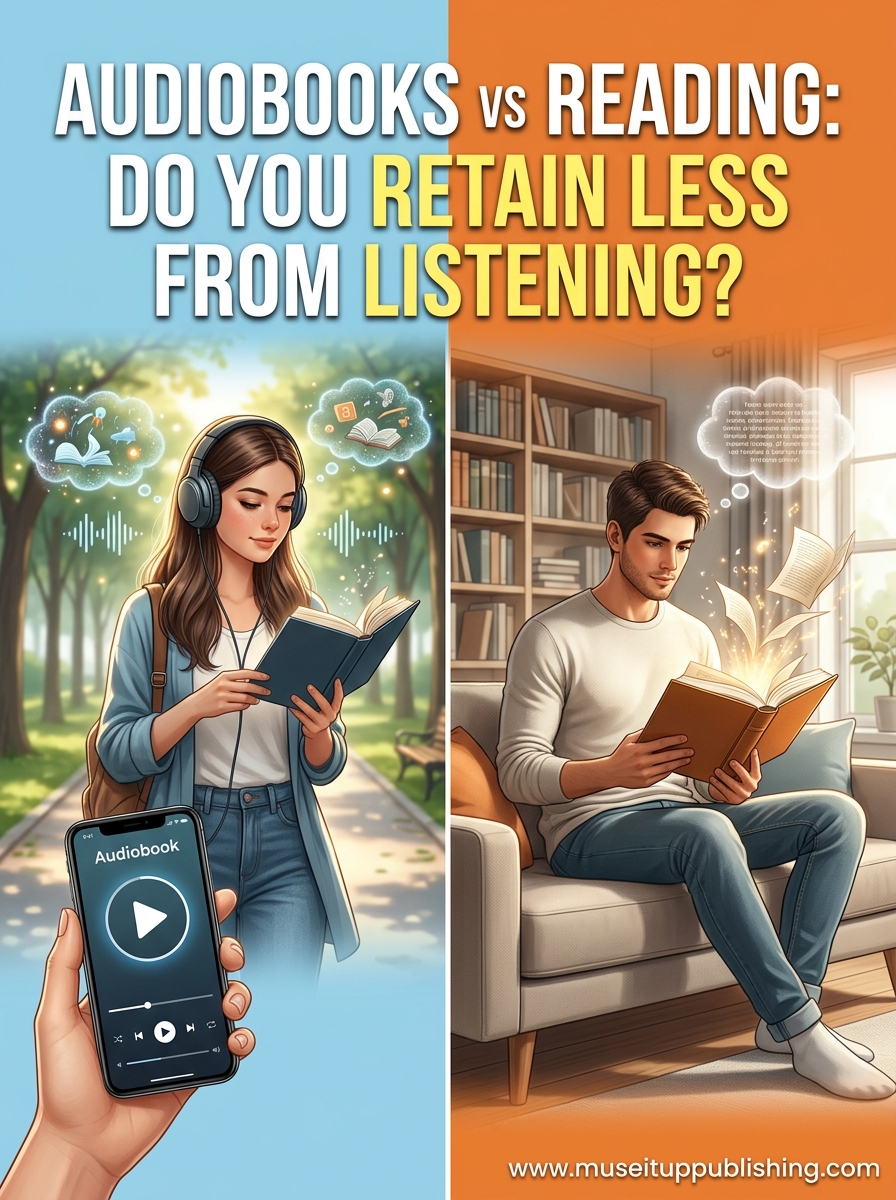
If you have ever felt a twinge of guilt pressing play on an audiobook instead of cracking open a physical book, you are not alone. More than 40 percent of Americans believe that listening to audiobooks does not really count as reading. But here is what the research actually says about audiobooks vs reading retention: for most material, there is no significant difference in comprehension between the two formats. However, when it comes to dense or complex content, listening can lead to 10 to 28 percent lower retention compared to reading.
That gap is real, but it is not a reason to abandon your audiobook habit. I dug into the major studies, forum discussions from real listeners, and expert neuroscience research to understand exactly when and why listening falls short. What I found is that the difference is not about audiobooks being inferior. It is about how we use them, what material we choose, and whether we are actually paying attention.
In this guide, I will break down what the science says, why your brain processes both formats in surprisingly similar ways, and share practical tips that no major article on this topic currently covers. Whether you are studying for an exam or just trying to remember the plot of your next novel, this breakdown will help you choose the right format and get the most out of every book.
Table of Contents
What Research Says About Audiobooks vs Reading Retention
The short answer from the scientific community is reassuring: your brain processes written and spoken language in remarkably similar ways. Multiple studies over the past decade have tested comprehension and retention across both formats, and the results paint a more nuanced picture than the “reading is always better” crowd would have you believe.
The most frequently cited study comes from Dr. Beth Rogowsky, who in 2016 tested comprehension across reading, listening, and reading-while-listening. Her team found no statistically significant differences in comprehension scores among the three groups. Participants who listened to an audiobook understood the material just as well as those who read the exact same text on paper.
But there is an important caveat. A 2010 study by Daniel and Woody found that when material became more complex, audio-only listeners scored up to 28 percent lower on comprehension assessments than readers. The difference was not about intelligence or attention. It was about the structural advantages that print provides when dealing with information-dense content.
A separate body of research from Anne Mangen and colleagues explored the cognitive load difference between formats. Their findings suggest that reading allows for what researchers call “regressive eye movements,” meaning your eyes naturally dart back to reread confusing passages. This happens almost unconsciously and helps reinforce understanding. Audiobook listeners do not have this luxury. Once the narrator moves on, you have to manually rewind, which many listeners simply do not bother doing.
What this means in practice is that for light fiction, memoirs, and narrative-driven content, audiobook retention is essentially on par with reading. But for textbooks, technical guides, philosophical treatises, or anything requiring you to stop and think, print still holds a measurable advantage.
Retention Comparison: Reading vs Listening by the Numbers
To make this clearer, here is a side-by-side breakdown of what the data actually shows. These numbers come from published studies and represent averages across test groups. Individual results will always vary based on attention, prior knowledge, and listening habits.
| Factor | Reading (Print) | Audiobook (Listening) |
|---|---|---|
| General comprehension (narrative material) | Equivalent baseline | No significant difference (Rogowsky, 2016) |
| Complex material retention | Baseline | 10 to 28 percent lower (Daniel, 2010) |
| Pace control | Reader-controlled, unlimited rereading | Narrator-controlled, manual rewind required |
| Multitasking impact | Moderate (reading demands visual focus) | High (easy to listen while distracted) |
| Emotional engagement | Moderate | Often higher (narrator inflection and tone) |
| Time to complete equivalent material | Approximately 250 to 300 words per minute | Approximately 150 to 160 words per minute at standard speed |
| Ability to highlight and annotate | Full capability | Limited or not available |
| Spatial memory of content location | Strong (physical page position cues) | Weak (no visual landmarks) |
The pattern here is clear. Audiobooks hold their own for comprehension and often exceed print in emotional engagement. But they fall behind when it comes to the structural tools that help you process and retain complex information. That is not a flaw of the format. It is simply a different set of trade-offs.
How Your Brain Processes Reading vs Listening
Here is where things get genuinely fascinating. For years, a common assumption was that reading and listening must use completely different brain systems. After all, one involves your eyes and the other involves your ears. But neuroscience tells a different story.
Dr. Nadine Gaab, a researcher at Harvard, has studied how the brain processes language across modalities. Her work and related research show that whether you read a word on a page or hear it spoken aloud, the same semantic processing networks in your brain light up. The information reaches your brain through different sensory channels, but once it arrives, your brain handles it in essentially the same way.
Think of it like two roads leading to the same destination. The visual pathway starts with your eyes recognizing letters and words, then sends that information to your brain’s language processing centers. The auditory pathway starts with your ears receiving sound waves, which get converted into language signals. Both pathways converge at the same neural destination where meaning is constructed.
This is why the Harvard Gazette confidently states that audiobooks absolutely count as reading. Your brain is doing the same interpretive work in both cases. The idea that listening is somehow “cheating” has no basis in neuroscience.
That said, there are differences in cognitive load. Reading lets you control the flow of information. You can slow down, speed up, pause, and reread at will. Listening puts you at the mercy of the narrator’s pace. If your working memory cannot keep up with the incoming stream of audio information, you lose pieces of meaning before they can be consolidated into long-term memory.
This is not a problem unique to audiobooks. It is the same challenge your brain faces in any situation where information arrives faster than you can process it. The difference is that print gives you built-in tools to manage that pace, while audio requires more conscious effort to slow down and absorb.
Why You Retain Less When Listening: Key Factors
Based on the research and the real experiences shared by listeners in forums like Reddit’s r/audible and r/audiobooks, here are the specific reasons audiobook retention can drop compared to reading.
1. Multitasking and divided attention. This is the number one culprit. The biggest advantage of audiobooks is also their biggest weakness. You can listen while driving, cooking, walking, or doing laundry. But every cognitive resource you devote to another task is a resource pulled away from processing what you are hearing. Forum users frequently report finishing a chapter and realizing they have no memory of what just happened because their attention drifted to the road or the stove.
2. No regressive eye movements. When you read, your eyes constantly skip backward to clarify meaning. You might reread a sentence three times without even realizing it. Audiobooks move forward at a fixed pace. If you zone out for ten seconds, that content is gone. You can rewind, but most listeners underestimate how often they miss something and never go back.
3. Loss of spatial cues. Cognitive scientist Daniel Willingham has pointed out that readers develop spatial memory for where information appears on a page. You might not remember the exact words, but you remember that the key argument was about two-thirds of the way through, on the left side of a right-hand page. This spatial scaffolding helps your brain locate and retrieve information later. Audiobooks strip this away entirely.
4. Complex material demands deeper processing. For fiction with a clear narrative arc, your brain can coast along with the story and still retain the plot. But for material that requires you to build mental models, compare arguments, or follow abstract reasoning, you need to pause and integrate information. Print lets you do this naturally. Audio makes it awkward.
5. Narrator pace mismatch. Some narrators speak faster than your brain can comfortably process new or complex information. Others speak so slowly that your mind wanders. Neither scenario is good for retention. With reading, you naturally adjust your speed to match the difficulty of the text.
One Reddit user in r/audible summed it up perfectly: they reported finishing entire 400-page books while gaming, but when asked basic plot questions afterward, could barely answer. The audiobook was technically consumed. But the retention was close to zero because their attention was split three ways.
How to Improve Audiobook Retention
This is the section that most articles on this topic skip entirely. They tell you that audiobook retention is sometimes lower, but they never tell you what to do about it. So here are practical, tested strategies for getting more out of every audiobook you listen to.
Treat listening as an active activity, not a passive one. If you want to retain what you hear, do not listen while doing anything that requires significant attention. Light activities like walking on a familiar path or folding laundry are fine. Gaming, having a conversation, or reading emails are not. Choose your multitasking wisely.
Use playback speed strategically, not automatically. Many listeners crank up playback speed to 1.5x or 2x to get through books faster. But speed directly competes with comprehension. Forum users who have experimented with this report that retention actually improves at slightly faster speeds up to about 1.25x because it keeps their attention engaged, but drops sharply beyond that. Find your sweet spot and adjust based on material difficulty.
Pause and summarize at chapter breaks. This is the single most effective technique I have found. When a chapter ends, hit pause. Take 30 seconds to mentally summarize what just happened or what key points were made. This forces your brain to consolidate the information from working memory into longer-term storage. You will be amazed at how much this simple habit improves retention.
Try the hybrid approach. Some listeners combine audiobooks with the print version of the same book. They listen during their commute and pick up the physical book at home. This reinforces the material through two different sensory pathways and leverages the strengths of both formats. Multiple forum users report this creates what one person called “a very different experience” that dramatically improves how much they remember.
Match the format to the material. Save audiobooks for fiction, memoirs, biographies, and other narrative-driven content where comprehension is already on par with reading. Use print for textbooks, technical guides, philosophical works, and anything you need to study deeply. Trying to absorb a dense nonfiction book through audio alone is setting yourself up for frustration.
Keep a listening journal. After finishing each book, write a short summary of the key takeaways, your favorite moments, or the main argument. This takes five minutes and dramatically improves long-term retention. It also gives you a personal library of reflections to look back on.
When to Choose Audiobooks vs Print Books
Neither format is universally better. The right choice depends on what you are consuming, where you are, and what you need to get out of it. Here is a practical guide.
Choose audiobooks when: you are commuting or traveling, the material is narrative-driven, you want to experience a story with emotional depth through skilled narration, you are revisiting material you have already read, or you are trying to build a reading habit and need a low-barrier entry point.
Choose print books when: you are studying for an exam, the material is technical or information-dense, you need to highlight and take notes, you want to absorb complex arguments at your own pace, or you are reading something you will need to reference later.
Choose the hybrid approach when: you want the convenience of audio and the retention benefits of print, you are reading a particularly long or challenging book, or you simply enjoy experiencing the same story through multiple sensory channels.
FAQs
Is listening to audiobooks less effective than reading?
For most narrative and leisure material, research shows no significant difference in effectiveness between listening and reading. A 2016 study by Dr. Beth Rogowsky found equivalent comprehension scores across both formats. However, for complex or technical material, listening can be 10 to 28 percent less effective for retention compared to reading print.
Do you retain more from reading or audiobooks?
For fiction, memoirs, and narrative content, retention is roughly equal between reading and listening. For dense nonfiction, textbooks, and complex arguments, readers typically retain more from print. The difference comes down to pace control, the ability to reread passages, and spatial memory cues that print provides.
Why do I retain less from audiobooks?
Lower audiobook retention usually comes from three factors: multitasking while listening, the inability to easily reread passages, and the narrator controlling the pace rather than you. If you listen actively without distractions, pause to summarize chapters, and choose the right material, retention improves significantly.
Are audiobooks less beneficial than reading?
No. Audiobooks engage the same semantic processing networks in your brain as reading does. Harvard researcher Dr. Nadine Gaab confirms that the brain processes written and spoken language in fundamentally similar ways. Audiobooks also provide unique benefits like emotional engagement through narrator performance and accessibility for people with dyslexia or visual impairments.
How much longer are audiobooks than reading?
The average adult reads at about 250 to 300 words per minute, while audiobook narrators speak at roughly 150 to 160 words per minute at standard speed. This means an audiobook typically takes about 1.5 to 2 times longer than reading the same book in print. You can reduce this gap using playback speed, but faster speeds can impact comprehension.
Do audiobooks count as real reading?
Yes. Since your brain processes the language and constructs meaning using the same neural pathways whether you read words on a page or hear them spoken, audiobooks absolutely count as reading. The idea that listening is cheating has no scientific basis. As the Harvard Gazette noted, we all started as listeners before we ever became readers.
The Bottom Line on Audiobooks vs Reading Retention
So do you retain less from listening to audiobooks? For most material, the answer is no. The research on audiobooks vs reading retention consistently shows that comprehension and retention are essentially equivalent for narrative content, fiction, memoirs, and light nonfiction. Your brain is doing the same work whether your eyes or your ears deliver the words.
For complex, dense, or technical material, the answer shifts to yes. You may retain 10 to 28 percent less when listening compared to reading, primarily because print gives you pace control, rereading ability, and spatial memory cues that audio cannot match. But even this gap shrinks dramatically when you listen actively and use the retention strategies outlined above.
Perhaps the most important takeaway is this: the stigma around audiobooks needs to go. Harvard experts confirm that listening engages the same neural pathways as reading. The 40 percent of Americans who think audiobooks do not count as reading are working from an assumption that neuroscience does not support. As the research makes clear, we all started as listeners before we ever learned to decode written symbols.
My recommendation is to stop choosing sides. Use both formats strategically. Let audiobooks fill your commute, your walks, and your evenings with stories you might otherwise never have time for. Let print books serve you when you need to study deeply, reference material later, or wrestle with complex ideas. The best readers are the ones who use every tool available to them, not the ones who limit themselves to a single format out of a misplaced sense of purity.
Your next book does not care whether you read it or listen to it. What matters is that you show up, pay attention, and engage with the material. Do that, and the retention will follow.