
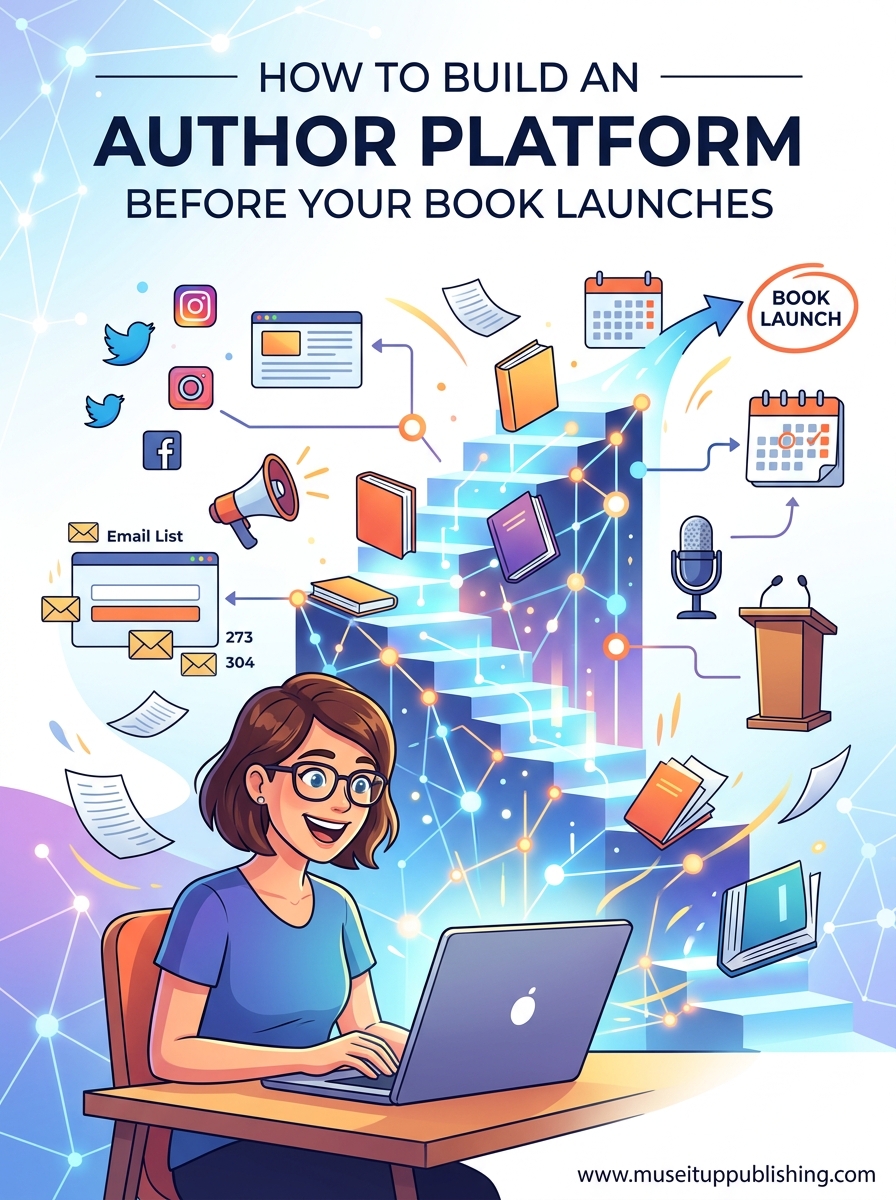
If you are an unpublished author staring at a half-finished manuscript, you have probably heard the same advice on repeat: “You need an author platform.” It sounds exhausting when you do not even have a finished book yet. I remember that feeling well, and so do thousands of writers on communities like r/writing and r/selfpublish who ask the same question every week. They want to know how to build an author platform before your book launches without burning out or becoming a full-time marketer.
The good news is that an author platform is not about going viral or accumulating a massive follower count before you have anything to sell. It is about becoming discoverable, building trust, and creating a small but genuine audience that actually wants to read your work. You can start with one social profile, a simple website, and an email list of zero, and still be in a stronger position at launch than authors who wait.
This guide walks you through every core element of platform building, with a concrete timeline you can follow whether you are six months or a year out from publishing. I have pulled insights from author forums, publishing professionals, and writers who have launched successfully, so the advice here is practical rather than generic. You will finish this article knowing exactly what to do first, what to skip for now, and how to measure progress before you have a single reader.
Table of Contents
What Is an Author Platform (and Why You Need One Before Publishing)
An author platform is the collection of assets, tools, and touchpoints that allow you to connect with readers, agents, publishers, and the wider literary world. That includes your website, email list, social media presence, online reputation, and the body of content you produce over time. Think of it as the sum of the places where people can find you, recognize your name, and decide whether they trust you enough to buy your book.
Pre-published authors often wonder whether they need a platform before they have anything to promote. The short answer is yes, and the reason comes down to lead time. A platform built over twelve months is far more valuable than one thrown together in the final weeks before launch. Agents and publishers look at platform signals when evaluating manuscripts, and self-published authors who launch into an existing audience sell measurably more copies in those critical first weeks.
Your platform also does something less obvious but equally important: it forces you to clarify who you are as a writer before you publish. Defining your author brand, choosing where to show up online, and writing content for a specific audience all sharpen your sense of what your book is and who it serves. The work of building a platform is, in a real sense, the work of becoming the author you want to be.
How to Build an Author Platform Before Your Book Launches: Core Elements
Authors build a platform by combining five core elements: a defined author brand, a professional website, an email list, one or two well-chosen social media channels, and genuine engagement with the writing and reading community. None of these require a finished book, a large budget, or a marketing degree. They require consistency, honesty, and a willingness to show up before you feel ready.
Here is a quick overview of how the pieces fit together:
- Author brand: the identity, voice, and promise readers can expect from you.
- Website: your permanent online home that you own and control.
- Email list: the only audience asset you truly own, and the most direct line to readers.
- Social media: visibility channels that help new readers discover you.
- Community engagement: relationships with other writers and readers that compound over time.
Each element reinforces the others. Your website hosts your email sign-up. Your social channels drive traffic to your site. Your community engagement builds the trust that converts visitors into subscribers, and subscribers into launch-day buyers. Skip any one piece and the system works less efficiently, but you do not need all five perfectly built to begin.
Step 1: Define Your Author Brand
Your author brand is the foundation everything else sits on, yet it is the piece most pre-published writers skip. Brand does not mean a logo or a color palette, although those can help. It means the consistent identity, voice, and promise that readers come to associate with your name. When someone encounters your website, your Instagram post, or your newsletter, they should feel a coherent sense of who you are and what you write.
To define your author brand, work through these questions in order:
- What genre or niche do you write in? Be specific. “Romance” is too broad; “slow-burn historical romance set in Edwardian England” gives readers and the algorithm something to grab onto.
- Who is your ideal reader? Picture a real person, not a demographic. What else do they read? What do they care about? Where do they hang out online?
- What is your unique angle? This could be your background, your setting, your themes, or your writing process. Every successful author has something only they can offer.
- What tone do you want to project? Warm and conversational? Sharp and analytical? Playful? Pick a voice you can sustain for years, not weeks.
- What promise are you making to readers? Whether it is escapist entertainment, rigorous research, or emotional catharsis, your brand should hint at the experience your book delivers.
Reddit writers consistently say that defining a niche early, even before publication, is what made their later marketing feel easy rather than forced. Once your brand is clear, every other decision, from your website copy to which social platform to use, becomes simpler because you have a filter to run choices through.
One related concept worth knowing: the 90/10 rule for authors. The idea is that 90 percent of your platform content should serve readers through value, entertainment, or genuine connection, and only 10 percent should be direct promotion. Pre-published authors who internalize this rule avoid the trap of treating every post as a sales pitch before they even have something to sell.
Step 2: Create Your Author Website
Your author website is the one piece of online real estate you fully own. Social platforms change their algorithms, email providers adjust their pricing, but your domain name and the content on your site remain yours. For that reason alone, building a simple website is the single highest-leverage step a pre-published author can take. You do not need anything elaborate; you need a clean, fast-loading site that tells visitors who you are and what you write.
At minimum, your author website should include these pages:
- Home page: a short introduction, your genre, and a clear email sign-up form above the fold.
- About page: a written author bio (200 to 400 words), a professional author photo, and any relevant credentials or backstory.
- Books page (or Coming Soon page): even if your book is unfinished, a placeholder describing your work-in-progress builds anticipation.
- Blog or News page: a place to publish updates, essays, or behind-the-scenes content that draws search traffic and gives subscribers something to read.
- Contact page: a simple form or email address for interview requests, collaboration inquiries, and reader messages.
Setting up a website is more accessible than it has ever been. You can register a domain name (ideally your author name or a close variation) for around ten to fifteen dollars per year and host a basic site for a similar monthly amount. Platforms like WordPress, Squarespace, and Wix all offer author-friendly templates that require no coding. If budget is a real constraint, free options exist, but a paid domain signals professionalism that free subdomains cannot match.
Forum writers repeatedly describe the website as the “easy” part of platform building, then get stuck on what to put on it. My suggestion: start with the About page and your email sign-up form, and let the rest grow over time. A thin site published today beats a perfect site that lives forever in your drafts folder.
Step 3: Build Your Email List (Your Most Valuable Asset)
If your website is your home, your email list is your direct line to the people who actually want to hear from you. Every experienced author I have read or spoken with says the same thing: the email list matters more than social media followers, more than website traffic, more than any other platform metric. Email is the only channel where you control delivery, and open rates for engaged author lists routinely outperform social media reach by a wide margin.
To build an email list before you have a book, you need three things:
- An email marketing platform. Services like MailerLite, ConvertKit (now Kit), and Mailchimp offer free tiers that cover your first thousand subscribers. Pick one and learn it well rather than switching every few months.
- A sign-up form on your website. Place it prominently on your home page and at the end of every blog post. Make the call to action specific: “Join my newsletter for writing updates and behind-the-scenes notes” beats a generic “Subscribe.”
- A reason for readers to subscribe.
That third point is where pre-published authors stall. You do not have a book to offer, so what could possibly entice someone to hand over their email? Plenty, as it turns out. Consider creating a free short story or prequel novella in your genre, a downloadable resource like a research guide or reading list, early chapter previews from your work-in-progress, or a regular newsletter with genuine value such as book recommendations, writing craft notes, or essays on topics your target readers care about.
Start simple. A monthly newsletter with one short personal update and one piece of useful content is enough to build the habit. The goal in the pre-publication phase is not list size; it is building a list of subscribers who actually open your emails. A thousand engaged subscribers at launch will outperform ten thousand purchased or disengaged contacts every time.
One rule that prevents burnout: do not email more often than you can sustain. Authors who promise weekly newsletters in month one and then go silent for three months train their list to ignore them. Pick a cadence you can hold for a year, even if that is once a month, and stick with it.
Step 4: Choose Your Social Media Platforms Strategically
Social media is where most pre-published authors feel the most pressure and make the most mistakes. The instinct is to be everywhere at once: Instagram, TikTok, Facebook, X, Threads, LinkedIn, YouTube. The result is burnout and shallow presence everywhere rather than depth anywhere. The writers who succeed pick one or two platforms and go deep.
Choose your platforms based on two factors: where your ideal readers already hang out, and which format plays to your strengths. Here is a quick guide to the major platforms authors use:
- Instagram: strong for visual genres like romance, YA, fantasy, and cookbook authors. Bookstagram is a real community with active readers. Best if you enjoy photos, short videos, and aesthetic content.
- TikTok: the breakout platform for book discovery, with BookTok driving measurable sales across genres. Best for authors comfortable with short video and willing to post consistently.
- X (formerly Twitter): the traditional home of the writing community, particularly strong for agents, editors, and authors in literary fiction, sci-fi, and horror. Best for conversation and networking.
- Facebook Groups: still relevant for genre fiction readers, particularly romance, mystery, and women’s fiction. Best if you enjoy longer-form discussion.
- LinkedIn: useful for nonfiction authors, business writers, and anyone whose book has a professional angle. Best for building authority before publication.
- YouTube or Substack: for authors who enjoy long-form content and want to build a deeper relationship with a smaller, more invested audience.
What platform do most authors use? In 2026, the answer depends on genre, but Instagram and TikTok dominate for fiction discovery, while X remains the default for industry networking and LinkedIn leads for nonfiction. The mistake is assuming there is one correct answer; the right platform is the one where your specific readers already gather and where you can show up consistently without dreading it.
For introverted authors or anyone who finds social media draining, the strategy is the same but the volume should be lower. Two thoughtful posts per week on one platform, with genuine replies to other people’s content, will outperform daily broadcasting from someone who hates every minute of it. Quality and consistency beat quantity every time.
The 90/10 rule applies here too. Share other authors’ work, recommend books in your genre, ask questions, celebrate milestones of your writing community. Promotion, when it comes, feels natural because you have already built context. Pre-published authors who follow this pattern find that their small audience is genuinely excited when launch day arrives.
Step 5: Engage With the Writing and Reading Community
Community engagement is the most underrated element of platform building, and it is the one that costs nothing but time. Every forum thread, comment section, book club, and writers group you participate in compounds over months and years. Writers on Reddit consistently report that genuine community participation, not follower counts or posting frequency, was what eventually moved the needle for their careers.
Effective community engagement for pre-published authors looks like this:
- Join genre-specific groups on Facebook, Discord, or Reddit where your future readers gather.
- Participate in writing communities like r/writing, r/selfpublish, NaNoWriMo forums, or genre-specific subreddits.
- Comment thoughtfully on other authors’ posts rather than just broadcasting your own.
- Review books in your genre on Goodreads or StoryGraph and tag the authors.
- Attend virtual or in-person author events, conferences, and book launches.
- Collaborate through guest posts, newsletter swaps, or joint social media takeovers.
The key is authenticity. Readers and fellow writers can smell transactional behavior from a mile away. If you show up only to promote, you will be ignored. If you show up to genuinely participate, you build relationships that translate into newsletter subscribers, launch team members, and word-of-mouth recommendations when your book finally lands.
This kind of engagement also solves a problem specific to pre-published authors: how to build platform when you have nothing to sell yet. Community participation gives you a reason to be visible without needing a product. You are not selling a book; you are becoming part of a conversation. By the time your book exists, you are already known and trusted in the rooms where your readers live.
Your Platform Building Timeline: 6 to 12 Months Before Launch
One of the biggest gaps in competing content is timeline specificity. Most guides say “start early” without giving concrete milestones. Here is a phased timeline you can adapt whether you have a year before launch or only six months.
Phase 1: Foundation (12 to 9 months before launch)
This phase is about getting the basics in place before you worry about growth. Define your author brand using the five questions in Step 1. Register your domain name and build a simple website with at least a home page, about page, and email sign-up form. Choose your email marketing platform and set up your first welcome email. Pick one social media platform and create a complete profile with a clear bio linking back to your website.
Do not worry about follower counts or subscriber numbers at this stage. The goal is infrastructure. By the end of Phase 1, you should have a website that exists, an email list that can accept subscribers, and one social profile that looks professional.
Phase 2: Content and Consistency (9 to 6 months before launch)
Now you start publishing. Commit to a regular cadence: one blog post or newsletter per month, two to three social posts per week, and daily or near-daily community engagement. Focus on value over promotion using the 90/10 rule. Start building your free resource or reader magnet so you have something compelling to offer new subscribers.
This is also when you start measuring what resonates. Which blog posts get traffic? Which social posts get engagement? Which newsletter topics get replies? Use that data to refine your content strategy, but resist the urge to pivot every week. Patterns emerge over months, not days.
Phase 3: Growth and Collaboration (6 to 3 months before launch)
With a foundation and a content rhythm in place, start actively growing. Reach out to other authors in your genre for newsletter swaps or guest post exchanges. Submit your work to relevant publications, podcasts, or blogs. Begin building your launch team by inviting your most engaged subscribers and community contacts to read advance copies.
This is also when you start talking about your upcoming book publicly, but lightly. Share cover reveals, blurb teasers, and behind-the-scenes glimpses without making every post about the launch. Your audience should be excited, not exhausted, by the time release day arrives.
Phase 4: Launch Preparation (3 to 0 months before launch)
Final preparation mode. Open pre-orders if your publishing setup allows. Coordinate your launch team for reviews and release-day buzz. Schedule your email and social content for launch week. Plan a small launch event, virtual or in person. Reach out to bloggers, podcasters, and bookstagrammers for coverage.
By this point, your platform should feel less like a marketing campaign and more like a community ready to celebrate with you. The work you did in Phases 1 through 3 pays off here in ways that authors who waited until the last month simply cannot replicate.
Common Mistakes to Avoid When Building Your Author Platform
Most pre-published authors stumble over the same handful of avoidable mistakes. Recognizing them early saves months of wasted effort.
- Trying to be everywhere at once. Spreading yourself across five social platforms guarantees shallow presence everywhere. Pick one or two and go deep.
- Chasing follower counts over engagement. A thousand engaged readers beats ten thousand passive followers. Measure opens, replies, and click-throughs, not vanity metrics.
- Treating every post as promotion. The 90/10 rule exists for a reason. Readers tune out authors who only sell, especially before there is anything to buy.
- Waiting until the book is finished to start. The most common mistake of all. Every month you delay is a month of compounding audience growth lost.
- Comparing your platform to established authors. Authors with published backlists and years of audience-building have a head start you cannot see. Compare yourself to where you were last month.
- Neglecting your email list. Social platforms can disappear or change overnight. Your email list, hosted on a platform you pay for, is the asset you actually control.
- Copying generic influencer advice. Author platform building is different from influencer marketing. Your goal is reader trust over a career, not viral reach in a week.
If you avoid these traps and follow the phased timeline above, you will arrive at launch day with a small but real audience that knows who you are, trusts your voice, and wants your book. That is what an author platform actually does.
FAQs
What is the 90/10 rule for authors?
The 90/10 rule for authors suggests that roughly 90 percent of your platform content should serve readers through value, entertainment, or genuine connection, while only 10 percent should be direct promotion. Following this rule keeps your audience engaged rather than feeling sold to, and it is especially important for pre-published authors who do not yet have a book to promote.
How do authors build a platform?
Authors build a platform by combining five core elements: defining their author brand, creating a simple professional website, building an email list with a reader magnet or value-driven newsletter, choosing one or two social media platforms where their target readers gather, and engaging genuinely with the writing and reading community. None of these require a finished book, and consistency over months matters more than any single tactic.
How many books do you need to sell to make $100,000?
The number of books required to earn $100,000 depends on your royalty per book. At a $5 royalty per sale, you would need 20,000 sales. At a $2 royalty, you would need 50,000. Self-published authors with higher royalty rates reach the target with fewer sales, while traditionally published authors earning lower per-copy royalties need higher volume. A strong author platform directly affects how quickly you reach those numbers at launch.
What platform do most authors use?
In 2026, Instagram and TikTok dominate fiction discovery through the Bookstagram and BookTok communities, X remains the default for industry networking and agent interactions, and LinkedIn leads for nonfiction and business authors. The best platform for any individual author is the one where their specific target readers already gather and where they can show up consistently.
Conclusion
Learning how to build an author platform before your book launches is less about mastering marketing tactics and more about showing up consistently as the writer you already are. Your brand, website, email list, social presence, and community relationships all work together to make you discoverable and trusted long before publication day. Start with one element, follow the phased timeline, and remember that a thin platform built today will always beat a perfect platform that never ships. Your future readers are out there right now, looking for exactly the kind of book you are writing. Give them a way to find you.